
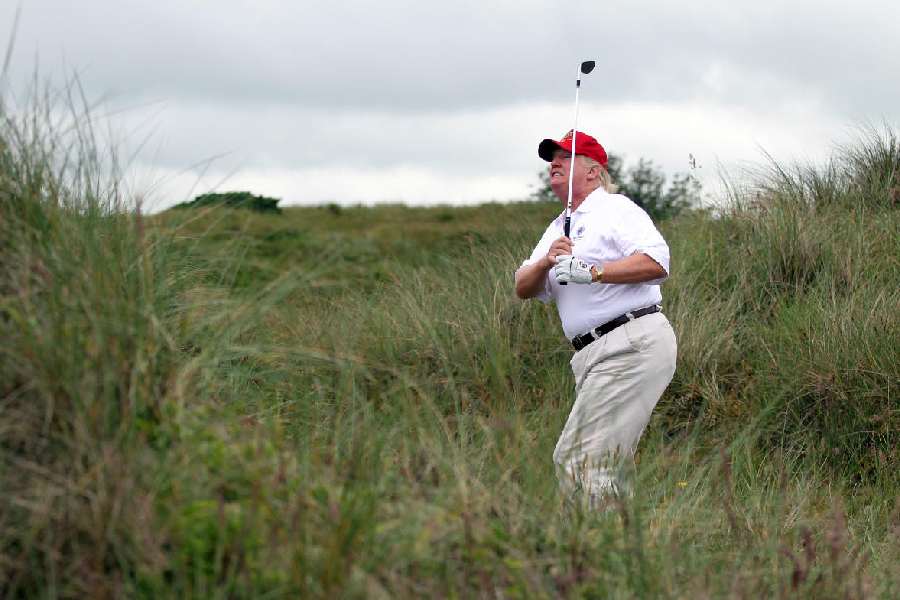
President Donald Trump seems to have snookered America’s trading partners on and off the golf course.
The basic truth in this statement is couched in a flawed sporting metaphor that yokes golf with the pool table. But it is a sign of the uncertain times we live in that policy mavens and commentators need to quickly bone up on the new idiom — the tees and cues — emerging from the Turnberry System, which foreshadows a new world trading order that Trump has started to fashion.
The moniker comes from the golf resort that the US president’s family owns in Scotland called the Trump Turnberry where he signed a landmark bilateral framework accord with the European Commission president, Ursula von der Leyen, on July 27, 2025. The Turnberry System has all but knocked the rules-based multilateral trading order established by the World Trade Organization into a cocked hat.
The Turnberry System rests on four core principles: the use of tariffs as an instrument of coercion to extract significant concessions from trading partners; focus on bilateral deals and steer clear of the babbledom of multilateral negotiations under the WTO framework; quickly ramp up tariffs if a partner turns mutinous and non-compliant; and seek to rebalance yawning trade deficits by gaining market access for American agriculture, energy, and automotive exports.
If the US trade representative, Jamieson Greer, is to be believed, everything has gone swimmingly well for the Trump administration since the signing of the historic accord with the EU last July. He wrote in an Op-Ed in the Financial Times recently: “... the ‘Turnberry Round’ of global trade negotiations continues at an accelerated pace. In the autumn, he [Trump] concluded trade agreements and frameworks with Malaysia, Cambodia, Thailand, Vietnam and Korea. He finalised an investment agreement with Japan, and more recently announced new framework agreements with Guatemala, El Salvador, Argentina and Ecuador.”
The success of Trump’s strategy — which is designed to rekindle the process of industrialisation in the US — will depend on how quickly he can ramp up economic growth, pare trade deficits with major partners, raise American wages, and increase the share of manufacturing in the $30-trillion US economy. Some green shoots of revival are starting to show: the US’s annual GDP growth in the third quarter (July-September) has surged to 4.3% — which is the highest in eight quarters since the 4.7% growth in the third quarter of 2023. However, it will be a while before the rationale for Trump’s minatory trade policy finds its validation in the other metrics.
Where does all this leave India?
The confabulations between the US and the Indian trade interlocutors have gone on for close to nine months — and we are still nowhere near a trade deal. Last month, the Union commerce minister, Piyush Goyal, said the two sides were in advanced stages of negotiation and that an initial framework deal would be finalised soon.
Data obtained from the US Census Bureau show that the US had a trade deficit of $47.1 billion with India in the first nine months of 2025 (Jan-Sept), which is 41% higher than the $33.4 billion in the same period in 2024. This could suggest that Trump’s tariff threats against Delhi have not really worked. India’s exports to the US in January-September have risen 24.6% to $80.1 billion against $64.3 billion in the same period in 2024. In contrast, India’s imports from the US have gone up by a piffle at 7% at $33.7 billion in Jan-Sept 2025 against $31.5 billion in the year-ago period. But there is a flipside to this narrative: the Bureau says that US exports to India in September hit a new record at $4.4 billion.
The US had announced a 25% tariff on Indian goods on July 31 last year and then topped it with another 25% in an attempt to force India to halt imports of crude oil from Russia. The claim is that India has been indirectly greasing Russia’s war machine enabling President Vladimir Putin to attack Ukraine — an argument that loses its legitimacy because the levy is discriminatory. The Trump administration does not penalise China which buys much more crude oil from Russia than India does.
Prime Minister Narendra Modi has tried hard to hold his ground. His government has often asserted its sovereign right to source crude oil from anywhere to secure the country’s energy needs. But the fight ahead will test his resolve to resist Trump’s aggressive tactics, especially after the US president issued a fresh threat to ratchet up tariffs if India fails to stop buying Russian crude oil.
The threat of sanctions from the US and Europe has already slowed imports of Russian crude to 1.2 million barrels per day (bpd) — a three-year low — from a June 2025 peak of around 2 million bpd. This could dip further as Indian refiners scout for more crude oil from the Middle East to offset the decline in shipments from Russia. Recent reports also suggest that the Modi government has started seeking weekly reports from refiners about crude imports from Russia as it counts down to a trade deal with the US.
Both sides have now hunkered down to negotiate their way past the red lines that have stalled progress towards a deal. India has dug in its heels and refused to open up its markets to US farm and dairy products. With its genetically-modified corn exports to India stymied, the US has retaliated by threatening to impose higher tariffs on Indian rice exports, claiming that it is being dumped in the US market. The US is also targeting India’s pharmaceuticals, jewellery, and textile exports. Data from the commerce ministry show that precious and semi-precious stone exports tumbled by over 45% in April-October 2025 to $3.14 billion from $5.8 billion in the same period last year.
In early 1990, Jagdish Bhagwati spoke about a disconcerting shift in US policy-making towards “aggressive unilateralism” to achieve its trade objectives and stamp out unfair practices in countries like India and Brazil. This began with the creation of Section 301 under the Trade Act of 1974 under which the US Congress authorised executive action when traditional methods to protect American interests failed. Later legislative changes introduced the Special 301 and Super 301 mechanisms, which were also unleashed against India. Seen in that light, Trump’s imposition of escalatory tariffs on countries with which it has large deficits is of a piece.
The truth is that the US’s faith in multilateral negotiations to correct what it sees as egregious trade distortions crumbled after the WTO ministerial meeting in Cancun, Mexico, in September 2003. The failure of the Cancun talks was blamed on India and the then commerce minister, Arun Jaitley, who spearheaded a coalition of developing nations to thwart an agreement on new trade rules.
At his press conference, a glowering Robert Zoellick, the then US trade representative, had seethed: “We are going to open markets one way or the other.” Slamming nations like India for their inflammatory rhetoric and inflexible stand on a host of issues, he had added ominously: “Now, they are going to face the cold reality of adopting such a strategy.”
How was anyone to know that a potent cocktail of Trump, golf and the Turnberry System would explode two decades later to fulfil Zoellick’s dire prophecy?
Saumitra Dasgupta is a senior journalist who writes on economic issues