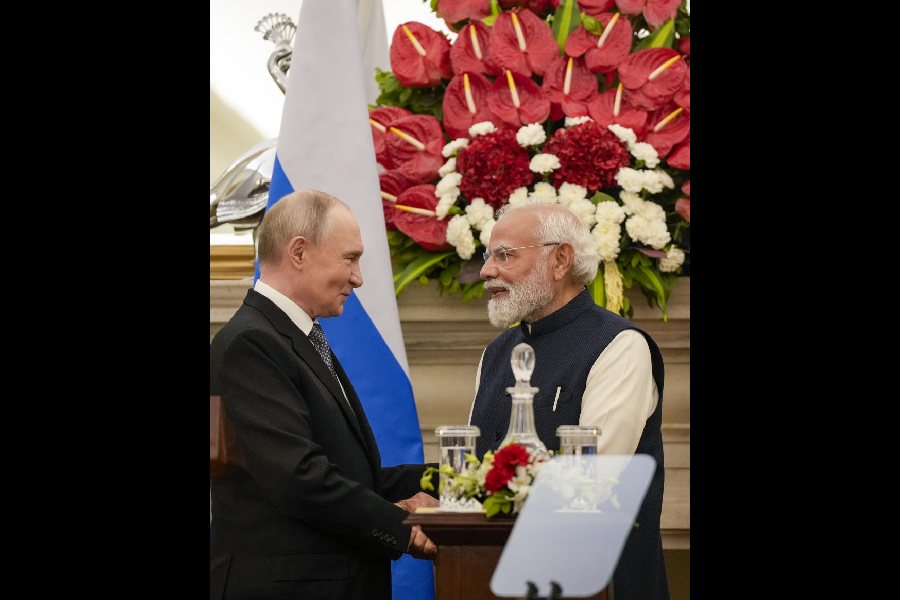
The recent visit to India by President Vladimir Putin and the warm welcome extended by Prime Minister Narendra Modi have revived a familiar debate: why does India persist in cultivating a close relationship with Moscow at a time when Russia appears isolated, embattled, and increasingly dependent on China? The answer lies not in nostalgia or diplomatic habit, but in a deeper logic woven through history, statecraft, and India’s current strategic anxieties, especially in a volatile world increasingly shaped by the impulses of the president of the United States of America, Donald Trump.
For those of us who have lived the India-Russia relationship not only through texts but also through memory, its constancy is hardly surprising. Growing up in Kashmir, I often heard stories of the 1955 visit of the Soviet statesmen, Nikita Khrushchev and Nikolai Bulganin. One image, passed down with almost cinematic vividness, captured the spirit of the era: the then prime minister of Kashmir, Bakshi Ghulam Mohammad, feeding Khrushchev a gustaba, a gesture of intimacy wrapped in geopolitical significance. It was on that visit, in Srinagar, that the Soviet leadership publicly backed India’s position on Kashmir, the only P5 country to do so. For India, this was more than diplomatic support; it was validation at a moment of profound vulnerability.
That early warmth matured into strategic partnership in 1971 when Moscow’s diplomatic and military backing during the subcontinent’s greatest crisis helped anchor India’s security environment and led to the creation of Bangladesh. The Indo-Soviet Treaty was not merely a Cold-War alignment; it was a recognition of convergent interests when the Nixon-Kissinger duo in Washington were using Islamabad as a conduit to making an opening to China. These formative episodes shaped India’s strategic consciousness, producing a reservoir of trust that endures even as global politics shift.
But we now inhabit a markedly different geopolitical terrain, described
by some as a ‘Trumpian’ world of volatility. The old certainties of American leadership have frayed and transactionalism has replaced predictability. India has experienced this first-hand, from punitive trade tariffs and H1B visa restrictions to wavering signals on China and Pakistan.
This unease is not anti-Americanism; it is a sober recognition that India must insure itself against the impulses of leaders who view alliances as disposable and commitments as negotiable. Russia offers precisely that insurance: not perfect alignment, but dependable ballast.
What, then, drives the contemporary India-Russia relationship?
First, structural complementarity endures. Russia remains central to India’s defence architecture through high-end platforms, spare parts, and technologies that cannot be easily substituted in the short term. Even as India diversifies suppliers, Russian systems remain deeply embedded in India’s military order of battle. Energy, fertilisers, and strategic minerals add layers of interdependence.
Second, both nations share an instinct for multipolarity. India believes the world is moving towards a more diffused distribution of power; Russia insists the unipolar moment is over. Even though their interpretations differ, both seek strategic space free from hegemonic constraint. Moscow’s willingness, unlike Washington’s, to affirm India’s autonomy without conditionalities remains attractive in a world increasingly shaped by great power rivalry.
Third, there is a deeper intellectual resonance. Consider the controversial but influential Russian philosopher, Aleksandr Dugin, whose extreme right-wing writings oscillate between philosophical inquiry and geopolitical provocation. On a visit to JNU, we confronted Dugin’s worldview that situates global politics within a civilisational frame. One must approach such ideas cautiously and critically, but they reflect the intellectual currents that animate Russian strategic thinking today. India, too, is rediscovering its civilisational confidence, though through a democratic and pluralistic idiom. These parallel currents do not make India and Russia ideological partners; they make them unusually capable of understanding each other’s strategic vocabulary.
Yet no partnership is sustained only by shared memories and philosophical sympathy. It must confront its constraints.
The most significant challenge is Russia’s tightening embrace of China. Moscow’s dependence on Beijing, economically, diplomatically, and technologically, has grown dramatically since the Ukraine war. This limits Russia’s ability to play the balancing role India once relied upon. New Delhi must constantly assess whether Moscow’s strategic autonomy is shrinking and how this affects India’s interests.
The second challenge is Russia’s contested global legitimacy. India’s nuanced position on Ukraine, calling for dialogue without condemning Moscow, has preserved channels of engagement. But it also requires diplomatic agility. New Delhi cannot afford secondary sanctions that compromise its technological partnerships with the US or Europe even as it refuses to be coerced into abandoning ties with Russia.
The third challenge, often understated, is the values’ gap. Russia’s increasingly authoritarian trajectory and its suppression of dissent sit uneasily with India’s democratic identity. While geopolitics often demands accommodation with illiberal partners, this divergence complicates efforts to deepen people-to-people ties and limits the partnership’s evolution beyond transactional cooperation.
And yet, despite these challenges, opportunities remain profound.
India today is one of the few powers capable of engaging simultaneously with Washington, Moscow, and Beijing while maintaining credibility across the Indo-Pacific, the Gulf, Europe, and Africa. This diplomatic reach gives India unique convening potential. A world marked by fragmented power and unpredictable alignments, paradoxically, increases India’s value as a stabilising interlocutor. In such a world, Russia sees India not merely as a buyer or a balancer but as a partner capable of bridging divides and legitimising a more pluralistic global order.
Moreover, Russia’s pivot to Asia creates openings — on energy corridors, the Northern Sea Route, connectivity across Eurasia, and advanced manufacturing — that India can shape. A Russia economically integrated with Asia, and not solely dependent on China, serves India’s interests. India, in turn, benefits from access, leverage, and diversification.
But perhaps the most important driver of all is psychological. India is determined to avoid overdependence on any one power. The shadow of Trump, his unpredictability, his disdain for alliances, his volatility on issues vital to India, reinforce New Delhi’s instinct to diversify strategic partnerships. Russia is not an emotional fallback; it is a rational hedge against a world in which even the most powerful democracy may become an unreliable partner.
In an uncertain world, the India-Russia relationship survives because it adapts. It must now evolve again. Whether it can remain not only warm but wise will depend on decisions made in New Delhi and Moscow, and on the shifting winds of great power politics that neither capital can fully control.
Amitabh Mattoo is Professor and Dean, School of International Studies, JNU, and a former member of the National Security Advisory Board