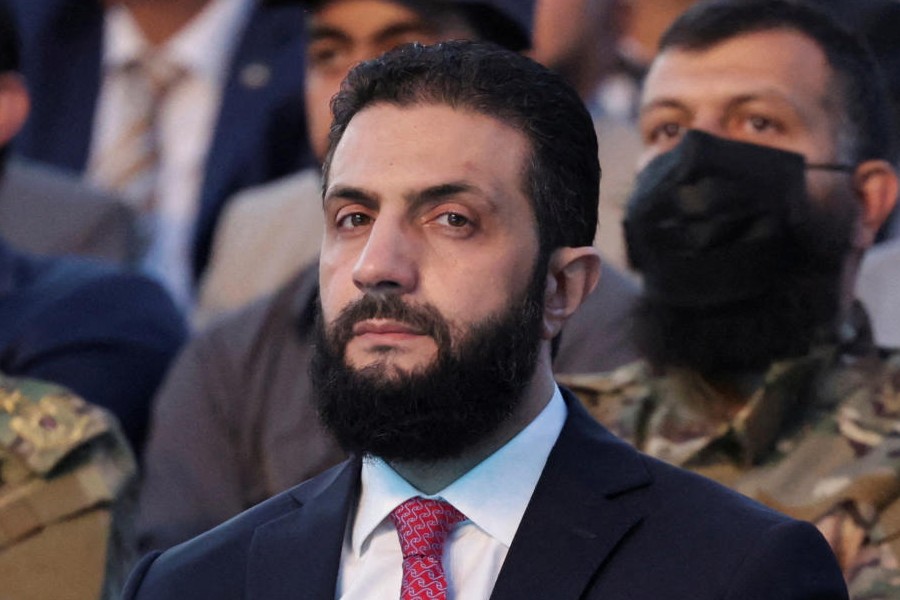
A year after a lightning offensive by rebel groups forced the then Syrian president, Bashar al-Assad, to flee to Russia, the country stands at the crossroads of hope and fresh conflict. The leader of the most prominent rebel outfit that defeated Mr Assad's forces, Ahmed al-Sharaa, is now interim president. Once a wanted terrorist who led al Qaida's Syrian wing, he is now a slickly suited politician who has been hosted at the White House by Donald Trump, the president of the United States of America, and at the Élysée Palace by the French president, Emmanuel Macron. Arab leaders have embraced Mr al-Sharaa, who has used his newfound diplomatic legitimacy to seek an end to the sanctions that the West imposed on Syria under Mr Assad during the country's long civil war. Yet, while some of those sanctions have been lifted, Syria remains in a precarious situation economically as its new leadership tries to rebuild institutions devastated by the war as well as by Mr Assad's authoritarianism and the ethnic divisions that have long fractured the nation. Moreover, a series of domestic and regional challenges threatens to drag the country back into conflict unless Mr al-Sharaa delivers on some key promises fast. The wider international community must help Damascus in this context.
Syria has significant Druze, Alawite, Kurdish and Christian populations that have coexisted with the Sunni majority for centuries. Mr Assad, whose family was Alawite, pursued a broadly secular style of politics under which religious minorities were guaranteed protections. Mr al-Sharaa's background, by contrast, has understandably stoked fears among those minorities. Multiple deadly massacres against the Druze and the Alawite communities have compounded those worries. In June, a suicide bomber attacked a church in Damascus; other cathedrals and cemeteries have been desecrated as well. Mr al-Sharaa has said on more than one occasion that he wants to build an inclusive Syria but when his administration attacks the Druze and the Alawites, and is unable to stop church bombings, those words mean little. Then there is the question of Syrian sovereignty. Parts of the Kurdish-controlled Syrian northeast are effectively out of bounds for his government. Israel has also taken advantage of the chaos following Mr Assad's fall to invade and capture chunks of Syrian territory. Mr al-Sharaa needs to move beyond rhetoric and ensure security for minorities. The international community needs to help Syria rebuild. And Israeli expansionism must be stopped before it forces a new war on the Middle East.