
Presenting a classical dance programme is in itself an art. It requires precise planning and a refined perspective. The focus should be on a crisp, compact performance. Time management is important in order to run the show in an engaging manner. An unending series of lectures will ruin the purpose and mood of such evenings.
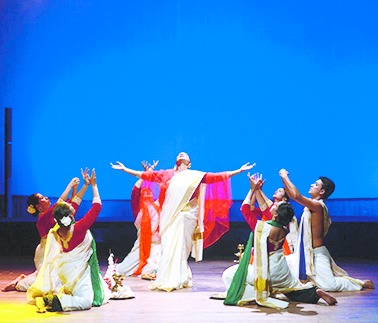
These, unfortunately, were the problems that plagued a recent programme spearheaded by the veteran Odissi dancer, Sutapa Talukdar, even though the show comprised various enjoyable performances under the guidance of different gurus. On the occasion of the opening of a new chapter of Gurukul, Talukdar's institute, South Gurukul Society presented Gurudakshina at Kalamandir. It felt very nice to watch compositions and choreography in the Odissi style.
Maintaining the traditional custom of the classical dance repertoire, the two-day festival began with a vandana. Choreographed by Ratikant Mahapatra, the son of the legendary Guru Kelucharan Mahapatra, this Ganesh vandana was performed by Srijanchhanda, which is Rajiv Bhattacharya's team. This was followed by ' Jatatabi', an item praising the extraordinary feats of Shiva, performed by Talukdar's team. Based on taal khemta, it was marked by the wonderful music of Raghunath Panigrahi; Partha Desikan did justice to the music through his soulful vocals. Nilanjana Mukherjee and her troupe presented pallavi, a pure dance number, based on the Raga Patdeep. Under the guidance of Arnab Bandyopadhyay, the dancers were precise and rhythmic.
Bhajamana Rama narrated the divinity of Lord Ram's feet through stories taken from Hindu mythology. Choreographed by Talukdar, it was lively and spontaneous. Another performance, based on 'Bipul taranga re', a Brahmasangeet by Rabindranath Tagore, was presented by Rajiv Bhattacharya and his team. Sankalpa Nrityayan chose ' Jurabandhina', an Odiya song, where the dancers depicted the shringar of the devdasis. Based on talamalika, Subikash Mukherjee's group choreography was pleasing. The music of this piece was composed by Ramahari Das. Ratikant Mahapatra's choreography showed its brilliance in a performance based on the Raga Megh and ardha jhamp taal. The dancers displayed their taiyari with their supple movements, rhythm, precise tribhangi and chauk. ' Nagendra haraya trilochanaya', a Shiva panchakshara stotram, performed by Arnab Bandyopadhyay and Sanjukta Roy, was well-synchronized. The show was compered by Biplab Ganguly.
Every presentation of the Ramayan is a recognition of its contemporaneity, its many levels of reality and symbolism. This belief was reflected in Ashoka Vanam at the Satyajit Ray auditorium. Presented by Bhaskar's Art Academy, Singapore, as a part of the Ramayana International Mela 2015, it tried to interpret the story of the Ramayan through the vocabulary of dance. The fascinating tale of Ram was beautifully depicted by a group of well-trained dancers with chiselled bodies clad in aesthetic costumes. The contemporaneity in the presentation was praiseworthy.