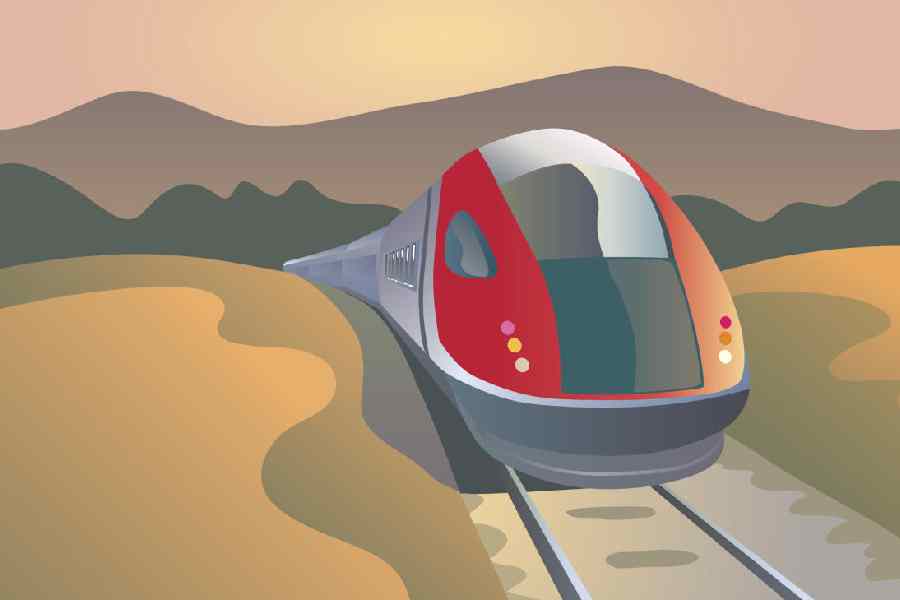
The railways minister, Ashwini Vaishnaw, has announced that India will witness its first bullet train by August 15, 2027. The Mumbai-Ahmedabad High-Speed Rail marks a paradigm shift in infrastructure development. But the Indian railways has long ceased to be simply a conveyance system. It is a socio-economic machine, shaping how Indians perceive distance, time, labour and nationhood. The bullet train project cannot be framed outside such a context.
The ability of the railways to compress time and space created a great impact on the human experience. During the 19th century, the railways erased pre-modern temporal cadences, which promoted the centralisation of governance and the development of national markets. The economic liberalisation at the end of the 20th century chimed perfectly with the introduction of express and superfast services as speed-enhanced communication among expanding industrial and commercial hubs. The bullet train takes this phenomenon to a whole new level. The Mumbai-Ahmedabad route will reduce a journey time of about 7 hours to just 2-3 hours.
In this context, velocity is synonymous with empowerment, inculcating productivity changes of high calibre, supply chain optimisation, and acceleration of decisions. The railways has always been an intermediary between mobility and modernity; the bullet train is its most ambitious effort at such a mediation.
Yet, the bullet train still exists in a railway ecosystem that remains the most important means of mass transportation. The railways carries millions of people every day, most of whom lack the means of affluent travel. The challenge, therefore, is to reconcile elite technology with egalitarian accessibility. High-speed rail services are mainly targeted at well-off travellers whereas the traditional networks support informal and formal sectors of labour in the country. The railways' political economy requires a sensible cross-subsidisation, balanced pricing, and reinvestment in non-premium services. High-speed rail should not replace the social responsibilities of the Indian railways but complement them, offloading some congestion on the old tracks, improving punctuality, and providing effective freight and passenger services.
The railways is the blood of the nation's economic life. Specific freight routes reach coal to power plants, grains to marketplaces, and raw materials to factories. This framework can be obliquely supported by the high-speed rail that can remove premium passenger traffic from the old lines, thus reducing congestion and, in turn, increasing freight services. The bullet train has the potential of harmonising the interests of the citizenry, the efficiency of the freight, and the stewardship of the landscape.
The bullet train will certainly redefine speed and desire in the Indian imagination. As an institution, the railways has always had a symbolic place in Indian cinema, literature, and memory. The bullet train will be emblematic of an India that is at ease with international standards but with an internal developmental logic.