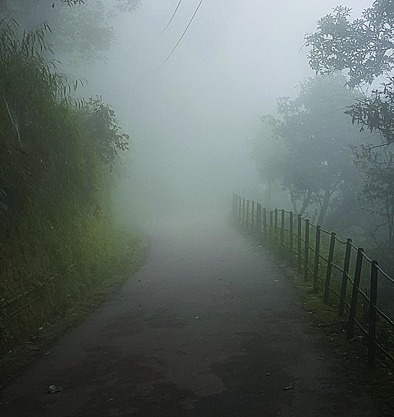

Enchantment can be a kind of entrapment. For the one under a spell usually loses the ability to put things in perspective. Darjeeling has enchanted both laymen and the gifted. Only a handful, Parimal Bhattacharya seems to be among them, have attempted to see through the mist, as it were, in order to piece together an account that chronicles both the beauty and the warts of the hill town.
Bhattacharya's reminiscing about Darjeeling - he had spent a few years there as a teacher at a time when the town was recovering from a spell of violent agitation - renders him vulnerable to bouts of nostalgia. This softens the edges of his otherwise searching gaze. The prose reflects this lapse into mellowness: Bhattacharya, for instance, compares the slow - and inevitable? - disappearance of Julia, an Englishwoman who befriends him, to, of all things, a receding comet.
But these lapses are occasional. Mostly, Bhattacharya is able to fight off his enchantress - not Julia but Darjeeling. He keeps chipping away at its layers and discovers realities that are as haunting as the queen of the hills. There is, for one, Darjeeling's ecological degradation. Its pithy description may strike a chord with the discerning reader. Staring at the settlement from a nearby village, Bhattacharya writes, "Darjeeling town lay upon the narrow spur... Countless windowpanes and the tin roofs of miniature houses glinted in the light of the setting sun. I could never have imagined how unbelievably congested and bereft of green Darjeeling was".
The narrative meanders like one of Darjeeling's chor batos - the snaking pathways - connecting past with present. Bhattacharya's examination of colonial documents - the research is a redeeming feature of his work - provides irrefutable evidence of the ecological decline.
There is also the hint of an explanation why visitors, who soak in the sight of lush tea gardens, fail to think about the great forests that have given way to the plantations. For Darjeeling, Bhattacharya writes, is "a narration that is being put together for more than a century now." An idealized vision - the British modelled Darjeeling on the home they had left behind - continues to inform the modern gaze. The results, of this patina of the past on the eye, can be curious. The aged Mrs Datta, whom Bhattacharya meets, is entirely consumed by the past: she spends her days with three cats and a domestic help in a house filled with memorabilia of another time.
Of course, ways of seeing can lead to conflict, and Bhattacharya captures multiple dimensions of this contest. He refers to the agitation for a separate state by the Gorkhas who are fighting a government that is of different ethnic stock, and looks at history and politics differently. But there are only glimpses of the indelible scars: Kiran- daju's wife confides that during the troubles she could tell apart a CRPF jawan from an agitator by the sound of boots. A deeper exploration of the simmering memory of the violence is overdue.
It takes a while for Bhattacharya, all of the nearly 200 pages, to learn the obvious: that the way he looks at Darjeeling can never be similar to the ways in which his students or Julia see it, and that returning to a place may not always be pleasurable. The resultant disenchantment darkens the mood, prompting Bhattacharya to describe the experience of his return to Darjeeling, seven years after he left, as masturbatory, leaving behind a sense of fleeting pleasure and longing.