
This piece is primarily meant for millions of Indians who may, or may not, have heard of a Delhisultan, Muhammad bin Tughlaq (of Turkish descent), and also may not be aware of the apparently impulsive (but in actuality well-thought-out) 'deeds' of his 26-year (1325-1351) reign in the 14th-century Delhi durbar.
The 690-years-old era of fighting and bloodshed based on his religious, spiritual or personal conviction could be likened to the 21st-century local ruler's penchant for abusing all and sundry as "corrupt" in contemporary Delhi; chaos then, and the potential chaos now, of 2015, appears more than an interesting case study to analyse the psyche, philosophy and psychology of the men who ruled yesterday, the men who rule Delhi today and will do so in years to come.
Our story begins with two of the most talked-about actions of the Delhi sultan that started with a bang but ended in a whimper, nay, in an unmitigated disaster, a ludicrous fiasco. All owing to an implementation failure resulting in unbearable woes for the people of Delhi in the 14th-century.
The sultan, like virtually all rulers of Delhi, being super-intelligent, realized that his capital city had problems; first, it was not centrally located in an era of poor connectivity with far-flung areas and, second, geographically it was extremely vulnerable to foreign invasions through the north-western gates of India, which more often than not brought death, devastation and destruction to north India and adjacent areas like Delhi since time immemorial. The analytical ability of the ruler being excellent, this was followed by an equally brilliant decision: transfer the capital from Delhi to Daulatabad (also known as Deogir or Devagiri) in central India, which was at a distance of a 40-days' journey. The sultan's action nevertheless instantaneously made the new capital Daulatabad equidistant from Delhi, Gujarat, Lakhnauti, Satgaon, Tilang, Mabar, Dhur Samundar and Kampila.
The ruler was right; but the right soon became wrong as the entire action was carried out without any consultation with anyone; and without carefully looking into the advantages and disadvantages on every side. The ruler simply brought ruin upon Delhi, a city which had grown for almost 200 years, rivalling Baghdad and Cairo. Worse followed when the sultan's diktat led to removal of the people from Delhi en masse to Daulatabad, thereby resulting in an incalculable magnitude of suffering. Realizing his failure, however, the sultan did not take long to retransfer the capital back to Delhi, thereby inviting comments that Daulatabad was a "monument of misdirected energy".
The quixotic Tughlaq soon followed up the failed capital transfer with an experiment borrowed from the paper currency prevalent in China and Persia. He issued brass or copper tokens (currency) in exchange for the silver tanka. Although the scheme on the whole was considered to be quite good by some, it miserably failed owing to its non-implementation and its non-regulatory machinery. There simply was no check on the unauthorized issue of copper tokens and no limit to the power of production of the masses at large. Consequently, wholesale counterfeiting of the token coins created unprecedented chaos in currency transactions, in local markets and in people's lives. Although token coins were not current for more than three or four years, there was a very heavy loss to the treasury and the episode severely dented the credibility and authority of the rule of the sultan.
The above incidents happened almost 700 years ago, when Delhiwallahs were a troubled lot owing to their rulers. Does the situation today appear different? That may or may not be; it depends on a person's individual perspective. Nevertheless, one issue looms larger than ever before, as it may turn out to be as controversial as the projects undertaken by the 14th-century Delhi sultan.
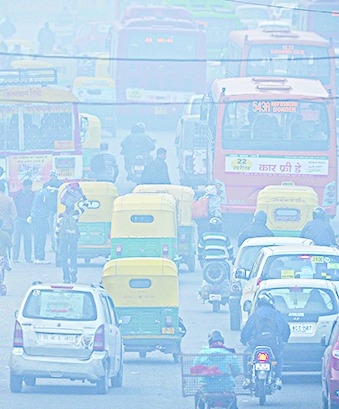
The pollution control programme of alternating odd and even numbered vehicles, plying on Delhi roads on odd and even dates respectively, appears to be a potential danger zone that may lead to a controversy akin to that of the experiments of Tughlaq. There could be a catastrophic implementation failure, followed by complaints of corruption, high-handedness, favouritism and gross negligence.
Question can be asked as to what could be the rationale of singling out four-wheeled vehicles as the sole factor in pollution. What about the quality of fuel, or the vehicles operated by the city and the federal government? What about the hopelessly polluting public transport system: the three-wheelers, the variety of poorly maintained cabs, the coal-based energy users of the city, the unauthorized and illegal construction areas and buildings which are playing havoc with the pollution control departments of the city as well as the Central government? What about the thousands of people who have brazenly flouted all regulations and laws of land to resort to hectic construction on the bed of the Yamuna, thereby destroying the ecology as well as environment of the capital?
Further, it would be of interest to find out whether there is going to be a major spurt of activities and placing of fresh orders for the purchase of new four-wheeled vehicles to drive on Delhi roads all seven days a week with the vehicles with odd/even numbers? One would also be curious as to the effect it would be likely to have on the land sharks and builders' lobby of Delhi. Are they going to make changes in their building designs to make more room for automobiles, thus seeking changes in building by-laws, architecture, design and sanction in fresh schemes? Similarly, is there a tacit understanding between the transport manufacturer and distributor with rulers who want to succeed at a political rival's expense?
Now imagine a scenario. Police, land and public order do not fall under the city government. In one stroke, therefore, if all three face troubled days, followed by the total failure of the police, leading to mounting litigations, what happens? The finger would be pointed towards the judiciary which is supposed to be closely monitoring pollution, and if things fail drastically, the onus is likely to be shifted to all three: the court, police and the federal government. And if it succeeds, the credit for the victory would go solely to the city government. It is the classical plot of "heads I win, tails you lose".
In reality, the entire focus appears to be on Delhi's police force, which is perceived as the 'corrupt enemy' number one of the present city government. Chances of police failure do run very high. The present one-point programme, conceived by the city government of Delhi, appears well calculated and purportedly well intentioned; but lingering doubt remains. Can the proposed plan of action be implemented successfully without causing avoidable difficulties as seen by the citizens of Delhi almost 700 years ago? One sincerely hopes that the 21st-century city government of Delhi will not repeat the mistake, misery and mayhem of the Delhi sultanate of a bygone era.