Bare essentials
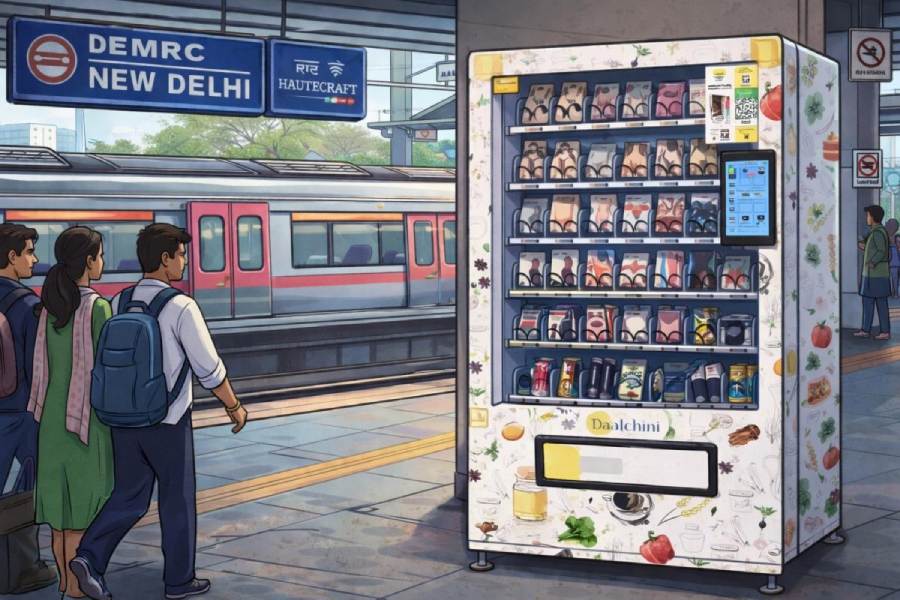
Sir — Urban planning often ignores small comforts. But Delhi has entered a new era of convenience by installing an underwear vending machine at the Rohini East Metro station, ensuring that one can now buy underwear as easily as a packet of chips. Metro stations stay open for long hours and are accessible to a wide cross-section of people and this will definitely help the masses. Public discussion around the vending machine misses a basic point. Buying undergarments remains uncomfortable for many citizens — shopkeepers often wrap women’s underwear in three layers of newspaper like a secret government document, for instance. Automated sales offer privacy without judgement. Women will also benefit during a sudden onset of menstruation.
Richa Roy,
Calcutta
Risky bargain
Sir — The recent trade deal between India and the United States of America promises an economic boost but raises concerns over dependency on American oil imports (“Too sketchy”, Feb 4). Shifting from Russian crude could stabilise fuel prices and, yet, it would also expose us to geopolitical risks. The government must ensure energy security in the country amidst this pivot.
T.S. Karthik,
Chennai
Sir — The US president, Donald Trump, has agreed to lower reciprocal tariffs on India from 25% to 18%. This is a welcome move. He further claimed that India has agreed to reduce its tariffs and non-tariff barriers against the US “to ZERO”. It is not yet clear whether the interests of Indian farmers are being compromised in this agreement . There are claims by the US president that India will now buy oil from Venezuela instead of Russia. Does it mean that India has yielded to pressure from the US?
N.R. Ramachandran,
Chennai
Sir — The announcement of a trade deal between India and the US hopefully marks the conclusion of a turbulent phase that tested the bilateral relationship across sectors like trade, defence and geopolitics. Coming soon after the conclusion of the India-European Union free trade agreement, the deal underscores India’s strategy of holding firm in negotiations while diversifying its trade partnerships. By demonstrating strategic resilience, India has asserted itself as a competitive power rather than a junior partner.
M. Jeyaram,
Sholavandan, Tamil Nadu
Sir — The leaders of the present government seem to have agreed to serve a new colonial master by agreeing to the trade deal with America. The concessions allegedly extracted by the Donald Trump government risk permanent economic subjugation. The primary sufferers of this deal will be our farmers, the educated youth, and small business owners. India may face an unending recession whose outcome will be worse than anything that the country has seen before. This deal risks bringing a deadly form of American colonial influence to our country.
Asim Boral,
Calcutta
Sir — The India-US trade deal will likely put India’s manufacturing sector in a favourable position in comparison to export rivals such as Bangladesh and Vietnam. However, concerns loom large over sensitive sectors like agriculture and dairy, especially when US officials have expressed hopes for greater access in India for US farm products.
Prasun Kumar Dutta,
Kharagpur
Brave stand
Sir — It was heartening to read about Deepak Kumar, a resident of Kotdwar, Uttarakhand, who stood up for his fellow citizen, Mohammad Shoeb, when Bajrang Dal activists asked him to change the name of his garment store since it had the word, ‘Baba’ (“Price of holding up secular values: Cop case”, Feb 3). It is puzzling how the term, ‘Baba’, can be claimed to stand exclusively for Lord Hanuman. In our society, this affectionate term is commonly used for fathers as well. Is Bajrang Dal now trying to trademark a common term of endearment?
Partha Sarkar,
Bankura
Sir — Deepak Kumar from Uttarakhand has not only displayed courage by confronting Bajrang Dal activists who were blackmailing a Muslim shopkeeper to either change the name of his store or convert to Hinduism but also embodied the spirit of India by identifying himself as “Mohammad Deepak”. Yet, instead of honouring him, a criminal case has been registered against Kumar.
Kajal Chatterjee,
Calcutta
Sir — The incident in Kotdwar, Uttarakhand, raises an important question: why did the police fail to save Mohammad Shoeb? Strict action should be taken against all those who disrupt harmony in the country.
Sandeep Rawat,
Chandigarh
New strategy
Sir — The decision to build a new railway alignment deep beneath the ground in the narrow Siliguri Corridor, popularly known as the Chicken’s Neck, reflects a strategic shift in how India is hardening its most critical transport links. The 40-kilometre twin-track tunnel will be built 20-24 metres underground to supplement surface lines and create a six-track system. The corridor is the country’s only land bridge connecting the northeastern states with the rest of India and any prolonged disruption in this stretch would have immediate and far-reaching consequences for both national security and the regional economy. It will use earthquake-resistant design to withstand tremors and landslides. The project reduces vulnerability to sabotage or blockade from hostile neighbours and, at the same time, ensures uninterrupted military and civilian movement. The primary objective is to ensure that rail connectivity between mainland India and the Northeast remains functional even in extreme scenarios.
R.S. Narula,
Patiala