Mamata Banerjee on Wednesday became the first serving chief minister in the country to argue a petition in the Supreme Court.
Then Delhi chief minister Arvind Kejriwal had last year argued his own bail application before a sessions court in connection with the Prevention of Money Laundering (PMLA) case related to the alleged liquor scam.
Mamata’s decision to appear in the top court as a petitioner-in-person, and not as a lawyer, was a loaded political message to the rival BJP in poll-bound Bengal.
Chief Justice of India Surya Kant said she had raised some pertinent issues, such as voter deletions on the ground of mismatches arising out of different spellings of the same Bengali surname.
Though Mamata sought permission to argue for only “five minutes”, the bench, which also had Justices Joymalya Bagchi and Vipul M. Pancholi, told her that she would get 15 minutes, which was later extended to 20 minutes.
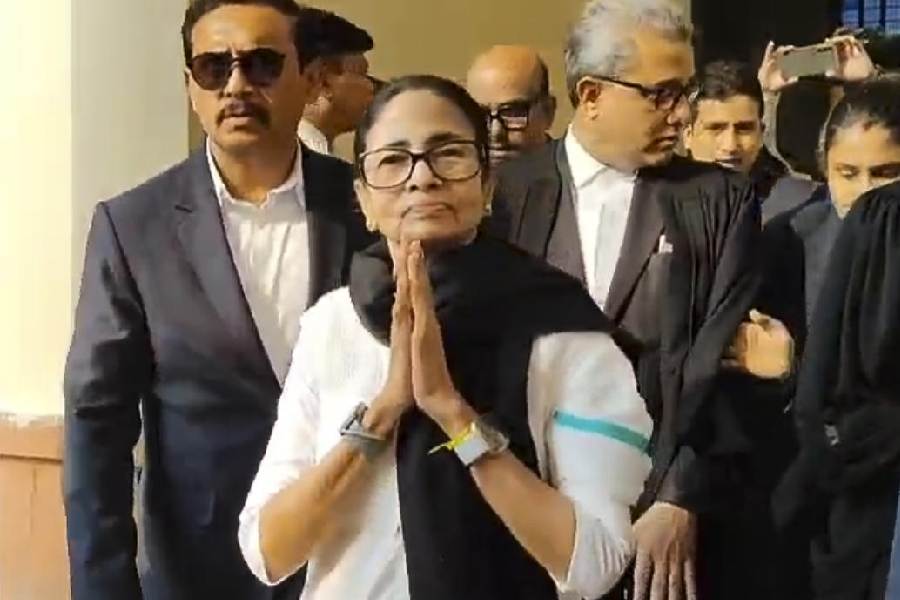
Clad in a traditional white sari paired with a black scarf, the Bengal chief minister reached the Supreme Court’s gate around 10am flanked by her lawyers, including senior advocate Kalyan Banerjee.
At 10.05am, Mamata, along with her lawyers, entered the CJI’s courtroom and sat in a chair in the visitors’ gallery. She was in the first row meant for lawyers at 12.55pm, when the bench commenced the hearing.
Senior advocate Shyam Divan argued for Mamata till she sought permission from the bench to put forward her points herself. Her other lawyer, Kapil Sibal, appeared through video conference on account of illness.
During her submission, Mamata described herself as a “bonded labour”, and “not an important person”, who had come to the court only to espouse the cause of the people of Bengal.
Mamata began her arguments by saying that “I am here because of your kindness (court’s). My regards to the bench. Thank you very much. My humble regards to the opposing lawyers also.”
Mamata’s presence generated considerable excitement and curiosity, with scores of lawyers and litigants thronging the courtroom.
Security was ramped up not just on the sprawling Supreme Court premises but also on the main arterial roads leading to it. Several police vans were deployed at vantage points in and around the top court.
After the conclusion of the hearing, Mamata was mobbed by lawyers, with many craning their necks to click pictures and record videos.
Constitutional expert and senior advocate Rakesh Dwivedi, who is representing the EC in the matter, told The Telegraph that this was the first instance of any sitting chief minister appearing and arguing before the Supreme Court.
“Yes, this is the first time,” he said.
Asked if there is any precedent of a chief minister arguing in the top court, senior advocate Abhishek Manu Singhvi said. “Don’t know about any precedent... that has to be researched. Basically, no.”
Under Supreme Court rules, someone appearing as a petitioner-in-person does not need to don the lawyer’s robe or neck band. Mamata avoided the robe despite being a law graduate herself.
Rule 49 of the Bar Council of India Rules prevents any advocate from being employed with the government, corporation or private sector as a full-time employee.
In September 2018, a three-judge bench ruled that MPs, MLAs or MLCs could not be barred from practising as lawyers as they are not public servants or in full-time employment. There is also no prohibition on any citizen from appearing before courts as a litigant/ petitioner-in-person with the permission ofthe court.