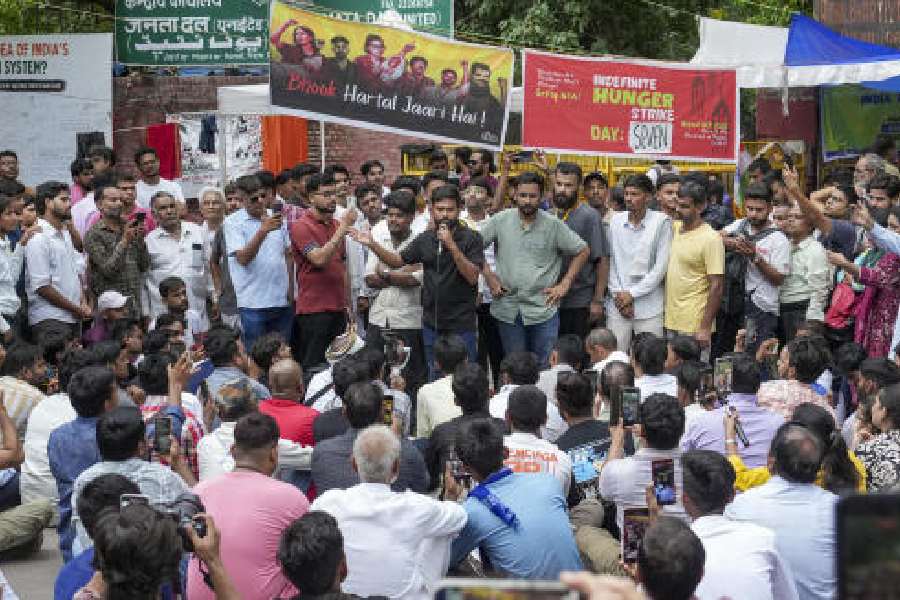
Few encounters in my professional life enrage me so much as a misguided compliment that goes like this: ‘Students these days aren’t what they were in your time. They aren’t serious about their work, they stay glued to their phones ...’ and so on. Whenever I hear this litany, I am tempted to a riposte that I once actually vented on the vice-chancellor of a university (not my own): ‘I have never felt that of my students — in fact, the reverse. They make better use of their opportunities, such as they are, than we did in our day.’ Had time and courtesy allowed, I might have added: ‘We give them ill-funded, poorly staffed institutions, commandeered by politicians as their stomping-ground, bound by curbs that cramp all academic activity. I think they give back more than we can rightfully demand of them — of course, only where politicians have not hijacked the student bodies as well.’
Another lament works the variant, ‘Things were different in our time ...’ That golden age invariably proves to be their own student days, under a dispensation for which they can take no credit. When the turn of our own generation came, we failed our youth.
The vice-chancellor on whom I inflicted my tirade was not a professional educator. He was one of the retired judges and administrators who stray after superannuation into a fraught and volatile work milieu of which they have no experience. Trapped in that state of perpetually unstable equilibrium, they seek protection in drastic, short-cut measures. This may be appropriate when dealing with moonlighting or corruption. It is pathetically misdirected in persuading the young to mend their feckless ways insofar as they need mending. The distress to their elders is not, in itself, grounds for reform. In any case, such measures invariably prove counterproductive. Extreme repression, physical or (worse) bureaucratic and ‘disciplinary’, induces a sullen acquiescence at best. It spells an end to the freedom and stimulation, at its best a creativity, that a college (literally an association or community) requires to perform its rightful academic functions.
Freedom does not mean impunity. Violence or destruction cannot be condoned simply because it occurs within a place of learning: in fact, that might be thought to aggravate the offence. Almost worse is the disruption of academic activity without external violence — calling wildcat strikes, blocking academic visitors, impeding movement and supplies, or simply creating an environment where potential collaborators shy off and funding agencies hesitate to risk their money. If graffiti-marred walls could bring about reform, it would have happened long ago. If the now tired slogans harking back to my own student days (when College Street really was on fire) could have brought about revolution, there would be a new heaven and new earth by now.
The solution does not lie in calling in the police. It lies in a continuous, adaptive (and stressful) coordination among all sections of the university — again with the near-impossible proviso that political parties must not interfere. In particular, the party in power cannot treat the campus as a free zone to exercise its will, weaponising the rule book against students and faculty. Nothing is more dispiriting, and more deadening to all academic activity, than the metronomic operation of an institution run crassly and repressively by a ‘higher’ external authority.
The damage need not arise from explicit policy. The public university system is crippled even more by delays, byzantine formalities, and uninformed and unimaginative obstacles imposed by an uncaring administration. I do not mean censorship, though that grows worse with every passing month. I mean the simple refusal to understand the environment needed for productive mental activity, regarding the latter with indifference at best and active suspicion at worst.
I taught all my life at two volatile institutions that are also academically active at the international level. Contrary to the prime minister’s election speeches, they adorn the ranking tables prepared by his own government. All my life, I have been depressed and exasperated by the sterile and sometimes wrong-headed student action that kept both campuses on simmer and sometimes boiled over, putting academic activity on hold. I have felt no less that all too often, the grievances were amply justified yet ignored or grotesquely mishandled by the authorities. By the latter, I do not mean the university administrators (who too are complicit victims of the system) but the remote puppet-masters pulling the strings for purposes unrelated to the pursuit of knowledge.
Across the world, and emphatically in India, the academic community is trapped in a state of alienation. Faculty members are demoralised everywhere, but naturally it is the young who are most strident. They carry around an inbuilt cynicism that not all the ‘value education’ in the world can overcome in the dire absence of values around them. We must respect that cynicism before we can hope to dispel it. Platitudes and politicians’ promises will not assuage them. They are not fools.
This is the context of the rise of the Cockroach Janta Party. But let me end with a happier feature of the same dismal situation: the handful of young people who not only exposed but analysed the flaw in the system of which they were themselves victims. My first response was extreme concern for their future: how would the system avenge itself on these youths who had turned their own victimhood into a strength? Instead, my own cynicism has had a salutary reality check by IIT Kanpur employing one of these ethical hackers in its cybersecurity venture. But I confess I still cannot quite dispel my fears.
We need more such stories, till these sporadic episodes become the dominant narrative. What we need even more is an education system that aspires to something more than crowd control, whether actually by police at rallies and protests or, much more perniciously, by online teaching and virtual exams with canned answers. Education demands that student and teacher meet face to face and each learns from the other.
Sukanta Chaudhuri is Professor Emeritus, Jadavpur University