 |
COSMIC LOVE AND HUMAN APATHY: SWAMI VIVEKANANDA’S RESTATEMENT OF RELIGION By Jyotirmaya Sharma, HarperCollins, Rs 499
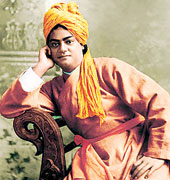
Usually, accounts of spiritual leaders are hagiographic, calling for, so to speak, the critical heat to make the mystical haze evaporate, and arrive at a solid sediment of truth. But sometimes, overheating may cause some integral parts of the truth to evaporate too. This seems to be the case with Jyotirmaya Sharma’s book on Swami Vivekananda’s “restatement of religion”. That the book has triggered controversies is only expected because Sharma has refused to tread the beaten track, and also because his book undercuts the emotional fervour around the memory of the monk, which is at its peak this year, 2013 being his 150th birth anniversary. Sharma’s courage that goes against the zeitgeist is commendable. But unfortunately, his critical interpretations, passing hasty judgments, are not always as profound as they are intrepid.
To start with, one may consider what Sharma writes in the preface: “Vivekananda’s forceful and substantial articulation of Hinduism as religion also makes him the father and preceptor of Hindutva”. It sounds uncannily similar to the argument which makes Friedrich Nietzsche out to be a preceptor of the Holocaust. Vivekananda was loath to call his brand of religion ‘Hinduism’; he preferred ‘Vedantism’ or ‘Non-dualism’, which sought to erase the distinction between the personal and the universal god that has often contributed to sectarian acrimony. Is this the working principle of the so-called ‘Hindutva’? In Hindutva, V.D. Savarkar took great pains to distinguish between Hinduism and Hindutva, pointing out racial traits and deep cultural ties as ‘true’ markers of ‘Hinduism’. For Vivekananda, as he points out in a lecture, “Common bases of Hinduism”, philosophy and spirituality are more fundamental characteristics of the Hindu — or rather the Vedantic — identity than race, culture and territoriality. Therefore, according to him, a Hindu can be a Vedantist as much as a Muslim or a Christian can. Holding Vivekananda responsible for jingoistic Hindutva is like censuring the inventor of the wheel for road accidents.
What needs to be considered next is Sharma’s charge that Vivekananda distorted Ramakrishna’s self-effacing devotional philosophy “beyond recognition”. In the first chapter, “Ramakrishna’s one-fourth”, Sharma highlights — among other things — Vivekananda’s alleged appropriation of Ramakrishna’s universalist and pluralist ideals. Here, Sharma’s views are at once true and untrue. He is right in observing that Vivekananda deviated from Ramakrishna’s version of ‘God-consciousness’, but he is wrong in surmising that the former was pleading for a Hindu supremacist position like the Hindutvavadis. In fact, Vivekananda was trying to forge a Vedantist (and not a Hindu) nationalism which would aspire for a supreme harmony of existence, triumphing over mutually exclusive and hostile dispensations of religious nationalism. Phrases such as “unity of Hindu religion” that Vivekananda used do not indicate any forced homogeneity of faiths, but a common Vedantic goal of harmony. The following quote from the monk’s speech, “The ideal of a universal religion”, will suffice: “What makes motion possible in this universe? Lost balance. The unity of sameness can come only when this universe is destroyed, otherwise such a thing is impossible. Not only so, it would be dangerous to have it.”
Sharma does also carp at Vivekananda’s masculinizing cum rationalizing ‘caricature’ of the emotive and feminine aspects of Ramakrishna’s teachings. But it must be acknowledged that ‘masculinity’ has several connotations. For Vivekananda, the term meant overcoming the weaknesses of the mind; Satan’s famous words in Paradise Lost, “to be weak is miserable”, reverberate in Vivekananda’s speech “Work and its secret” (Los Angeles, 1900): “Weakness leads to slavery. Weakness leads to all kinds of misery, physical and mental. Weakness is death”. Here, Vivekananda condemns what Nietzsche called “the slave morality” in Genealogy of Morality. The masculinity he admired is not antithetical to mildness and clemency, but to timidity. The distinction, albeit subtle, is crucial. In a speech delivered in Colombo in 1897, Vivekananda says: “‘The mild Hindu’ sometimes is used as an expression of reproach; but if ever a reproach concealed a wonderful truth, it is in the term, ‘the mild Hindu’, who has always been the blessed child of God.” Is this not a rather disappointing proclamation for the Hindutvavadis?
As far as rationalization is concerned, Vivekananda sought to enlarge the scope of Ramakrishna’s non-egoistic devotional philosophy so that it could transcend the sphere of absolute self-absorption and become a socially cohesive force. This was in consonance with his monistic faith, necessitating his attempts to lend a practical/practicable base to Ramakrishna’s ideals so that the Vedantic philosophy could become a part of everybody’s lived reality. Many of his speeches, including those on the “Practical vedanta”, were geared to this purpose.
In the chapter, “Whose society, what religion”, Sharma brands Vivekananda as an arrant casteist by quoting a chunk from one of his speeches in which he says that “caste is a natural order”. But Sharma’s quote itself carries evidence that Vivekananda was trenchantly critical of humiliations and atrocities related to caste hierarchy. In Vivekananda’s reading of Indian history (which may not always be correct), caste once performed a social function, but has now become obsolete. In a letter addressed to Alasinga, he writes: “Caste is simply a crystallised social institution, which after doing its service is now filling the atmosphere of India with its stench, and it can only be removed by giving back to the people their lost social individuality.”
Sharma’s critical attempts are good, but not his critical outputs. Vivekananda only adapted his guru’s teachings; it is Sharma who has ‘caricatured’ Vivekananda’s.