|
|
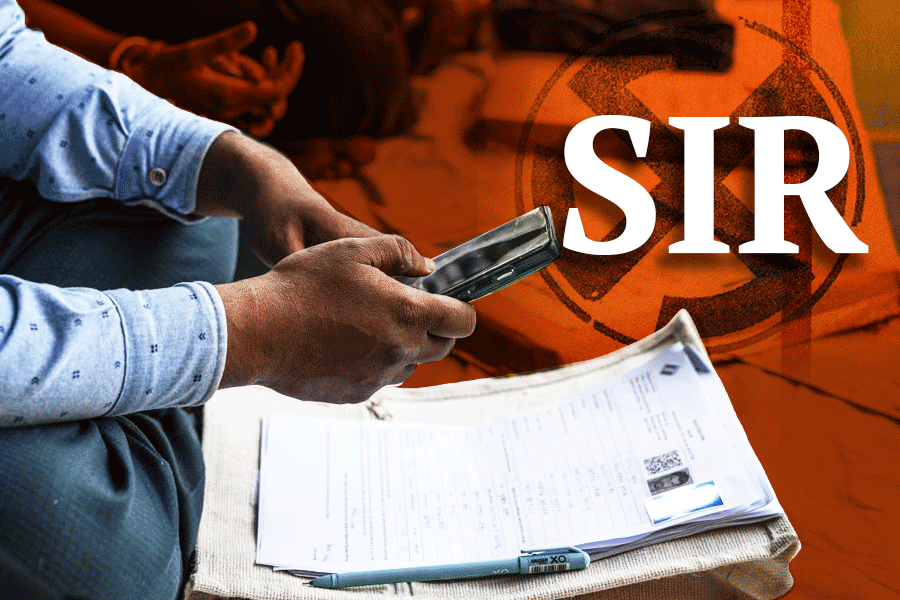
| TILLING FIELDS: A farmer at a sit-in during the recent protests against land acquisition in Greater Noida |

More than 750 farmers have signed on the dotted line and accepted the enhanced compensation for their lands from the Greater Noida Industrial Development Authority. Nagendra Bhati is not one of them. Bhati says that like countless other farmers in the area, he will continue the fight against the Uttar Pradesh government that acquired thousands of acres of land in the name of industrialisation.
“We sold our land for peanuts while the government and private developers have made hundreds of crores of rupees from them,” says Bhati. “We will not sell our lands until we get a better deal,” he asserts.
Bhati may indeed get that if the recent Draft Land Acquisition and Rehabilitation and Resettlement Bill, 2011, proposed by the central government, comes to pass. Some of the main features of the draft bill include enhanced compensation amounts, clubbing of land acquisition with resettlement and rehabilitation, and emphasis on taking the consent of 80 per cent of the land owners before land acquisition.
In its preamble, the draft bill states that it will “balance the need for facilitating land acquisition for industrialisation, development of essential infrastructure facilities and urbanisation, while at the same time meaningfully address the concerns of farmers and those whose livelihoods are dependent on the land being acquired.”
Until now the law that governed land acquisition was the Land Acquisition Act, 1894. Although it was amended several times, many feel that it has become redundant and a new and improved law on land acquisition needs to come into force.
As stated in Clause 1A of the draft bill, the land acquisition provisions shall apply in their entirety when: “(a) the Appropriate Government acquires land for its own use, to hold and to control; (b) Government acquires land with the ultimate intent to transfer it for the use of private companies for stated public purpose (including Public Private Partnership projects but not including national or state highway projects); (c) the Appropriate Government acquires land for immediate and declared use by private companies for public purpose.”
Many observers feel that the draft bill is a great improvement over the Land Acquisition (Amendment) Bill and the Rehabilitation and Resettlement (R&R) Bill that were passed by the Lok Sabha in February 2009. Both the bills lapsed as Parliament was dissolved before the general elections in 2009.
“This bill has hiked the minimum compensation for land. It also recognises the rights of landless families, which include agriculture labourers. This has never been done before,” says Madhuresh Kumar, national organiser, National Association of People Movements. The NAPM mobilises farmers in various parts of India against forceful land acquisition.
As far as compensation for land acquisition is concerned, in urban areas, the award amount would be not less than twice that of the market value determined, whereas in rural areas it would be not less than six times the market value.
Most activists also laud the fact that the proposed bill says that 80 per cent of the project-affected families should give their consent before the government can acquire the land. What’s more, a social impact assessment (SIA) has been made mandatory where the area to be acquired is of — or more than — 100 acres. Under this, gram sabhas have to be consulted and the final document should be made available for public scrutiny.
Despite its many positive features, there are some points in the draft bill that have come in for criticism. One of them is to do with the fact that the 80 per cent consent rule will not apply when the projects are by government-run companies. “We want the same rules to apply to both private and government companies. Otherwise, farmers whose lands are acquired for government companies stand to lose — which is very unfair,” says Rakesh Tikait of the Bharatiya Kisan Union, which has been protesting against forcible acquisition of land in Uttar Pradesh and other states.
Activists are also unhappy with the definition of “public purpose” in the draft bill. Take the phrase “infrastructure project” under “public purpose”. It includes projects relating to generation, transmission or supply of electricity, construction of roads, highways, defence, bridges, airports, ports, rail systems or mining activities, education, sports, healthcare, tourism, transportation and others. Since private parties are involved in almost all these activities — that too with the aim of making profits — the definition of “public purpose” has to be narrowed, say activists.
“With this provision, the ministry of rural development is making it easier for more private builders to acquire land from the government,” says Shankar Gopalakrishnan, an independent researcher and forest rights activist.
The real estate sector, on the other hand, has a different take on the whole issue. “With the kind of prices the government is asking private parties to pay to land owners, real estate would become very costly for the middle classes,” says Lalit Kumar Jain, president, Confederation of Real Estate Developers’ Associations of India (Credai).
The rehabilitation and resettlement provisions of the bill have also met with some criticism. The bill states that the resettlement and rehabilitation provisions will only apply under two conditions: When private companies buy land equal to or more than 100 acres and when a private company approaches the government for partial acquisition for public purpose.
Under the provision of the draft bill, apart from compensation, land owners will receive a subsistence allowance of Rs 3,000 per month per family for 12 months, followed by Rs 2,000 per month per family for 20 years, with “appropriate index for inflation”. A similar package is envisaged for landless labourers who are dependent on the land.
But the realty sector is up in arms against this clause too. “Resettlement responsibility shouldn’t be thrust on real estate developers as the sector doesn’t generate profits forever,” says Jain of Credai.
The proposed bill also makes it clear that it also doesn’t approve of using any multi-crop irrigated land for “public purpose”. But this provision will result in problems, says Suneel Sehgal, deputy director general, National Real Estate Development Council, an autonomous self-regulatory body under the aegis of the Union ministry of housing and urban poverty alleviation. “Most of the cities and towns have come up around major rivers. These are fertile multi-crop lands. Banning the acquisition of such lands means tough times ahead,” says Sehgal.
The country’s urban population is estimated to be around 377 million now. This is set to go up to around 577 million by 2030, according to Sehgal. “Where will all these people go,” he asks.
It remains to be seen if the new law does manage to balance the need for social justice with development. Men like Nagendra Bhati would not settle for anything less.