 |
Under Natadha, Howrah’s theatre has become reinvigorated and their home base, Ramgopal Mancha, a beehive of cultural activities. This revives a historical tradition in Howrah going back to the 19th century with old sites like the Bantra Theatre, as well as offers a model to current Bengali groups (most do not own performance spaces) of how even the smallest auditorium can boost theatre-related output, if the hosts so wish.
Now that Natadha have effectively handed over the reins to the next generation led by Arna Mukhopadhyay, they have also joined that handful of groups staging new productions with remarkable frequency. Their plays had inclined towards simplistic political equations, often classic drama rewritten to project their agenda, but this does not happen on Eka Tughlaq. An original by Arna’s brother Rudrarup, inspired by Karnad’s Tughlaq, it departs from the source, justifiably not advertising itself as an adaptation. It reveals a playwriting mind interested in complexity instead of straightforward conflicts, so we can expect Rudrarup to grow into a strong dramatist.
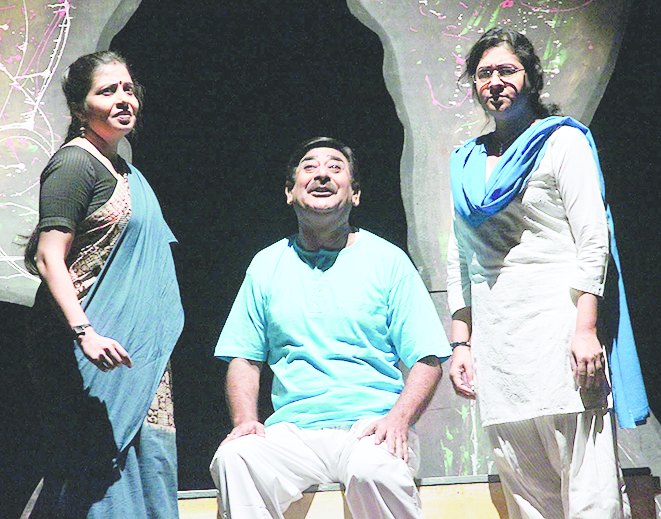
The simplest way to assess Muhammad bin Tughlaq is to label him mad, but Rudrarup resists this, rightly asking why then did his people accept him for 26 years? Consequently, he characterizes his protagonist as sensible and humanistic, thinking of the subjects’ welfare, sacrificing personal and family ends, until circumstances and opponents’ deviousness force his change of personality. Arna (picture, with his mother) utilizes this opportunity to exercise all his acting faculties, and directs with his usual eye for spectacle.
He returns to the old method in Bishkal, reducing Shib Mukhopadhyay’s translation of Euripides’ brilliant The Bacchae into an anti-licentious tirade. Although an Athenian Sceptic, Euripides placed Bacchae in ambivalent equipoise, apparently affirming both Apollonian and Dionysian principles of life. By converting it into an unequivocal attack on sex and alcohol in our times, Arna turns moral police, like his Pentheus (Arpan Ghosal). Youthful and revolutionary, The Bacchae shows that the rational Pentheus’ weaknesses resulted in his dismemberment. But Arna, bent on indicting Dionysian capitalism as the devil’s celebrity cult, also rejects Euripides’ macabre ending.
The old men, Cadmus and Teiresias, opportunistically accepting Dionysus, receive the best performances, particularly from Rudrarup portraying Teiresias as a typically shifty intellectual. But Sumit Panja (Dionysus) does not get enough scope to convey how ecstasy and violence converge dangerously in his revelry, or his deception in masquerading as his own priest. Nor does Arna grab the chance to present a women’s chorus of Bacchantes, therefore presenting just one female character in Agave. However, I like the physicalization and experimental stagecraft, using only PVC pipes that surprise with their flexibility.