
In the first-ever strike in Punjab in nearly eight years, three suspected Pakistan-based terrorists attacked a passenger bus and stormed a police station in Dinanagar in Gurdaspur. They killed nine people, before being gunned down after a 12-hour-long fire-fight. This takes India-Pakistan ties right where they have been for a long time - in a state of suspended animation.
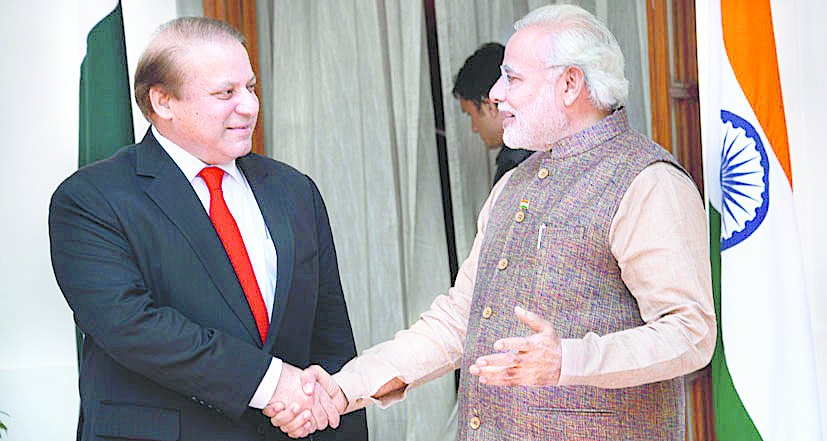
The Indian prime minister, Narendra Modi, had met his Pakistani counterpart, Nawaz Sharif, in Ufa, Russia, on the sidelines of the Shanghai Cooperation Organization summit. They had issued a joint statement in which they "condemned terrorism in all its forms and agreed to cooperate with each other to eliminate the menace of terrorism from South Asia." It would have been an ordinary meeting but for the fact that the two leaders were meeting for the first time since May 2014 .The meeting came after increased border hostilities in the past few months and in the backdrop of India having cancelled secretary-level talks last year. When Modi had held his first meeting with Sharif in Delhi soon after becoming prime minister in May 2014, the two had decided to hold secretary-level talks which were scheduled for August 2014. But those talks were cancelled by India after Pakistan's engagement with Kashmiri separatists. The government's decision to re-engage Pakistan had generated the usual hype of being a 'game-changer' and a 'breakthrough'.
The two sides agreed to hold a meeting of their top security advisors to discuss terrorism. But there were other steps as well, including meetings between the director generals of the Border Security Force and the Pakistan Rangers to stabilize the border, the release of fishermen in each other's custody, and a mechanism for facilitating religious tourism. Additionally, Modi accepted Sharif's invitation to the Saarc summit, which is going to be held in Islamabad next year. The trip will not only be Modi's first visit to Pakistan but it would also be the first time an Indian leader would visit Pakistan since Atal Bihari Vajpayee's trip in 2004.
Pakistan's agreement to expedite the 2008 Mumbai terror attack trial and the absence of a specific mention of Kashmir were viewed as a major diplomatic victory for India and as a sign of the changing mindset in Pakistan. But the euphoria collapsed within hours as Pakistan went back on a number of its commitments. Sharif's national security advisor made it clear that more information would be required to resume the trial of Zakiur Rehman Lakhvi, the alleged mastermind of the Mumbai attacks. Lakhvi, the operational commander of the now banned Lashkar-e-Toiba, is among the seven persons charged with planning and overseeing the attacks on Mumbai. Much to India's consternation, he was released from jail in April after a court dismissed detention orders issued against him. Sartaj Aziz also underscored that there could not be any dialogue with India unless the issue of Kashmir is on the agenda.
There is some disappointment in Delhi at this turn of events but nothing significant as unlike its predecessors the Narendra Modi government seemed to have understood from the very beginning that a quest for durable peace with Pakistan is a non-starter. All that matters is the management of a neighbour that is, more often than not, viewed as a nuisance by Delhi even though sections of its military establishment threaten to unleash nuclear weapons against India. For India, the real challenge is China, which has pledged $46 billion worth of investment in Pakistan and, recently, blocked India's move to seek action against Pakistan for the release of Lakhvi in the 26/11 trial in violation of a United Nations resolution at a meeting of the UN sanctions committee.
However, Modi is a pragmatist and his agenda of enhancing regional cooperation in South Asia will remain unfulfilled without a thaw in India-Pakistan tensions. At a time when interconnectivity is the norm across the world, the two neighbours cannot remain forever locked in a spiral of perpetual hostility and violence.
The Pakistani army is clearly stretched as it battles terror groups that are targeting the country even as it continues to make a distinction between "good terrorists" - who only target India - and "bad terrorists" - the ones that attack establishments in Pakistan. So long as Pakistan's military continues to view terrorism as a vital instrument of State policy, there is very little that India can hope to achieve by discussing terrorism with Pakistan. Nawaz Sharif, howsoever well-intentioned, is yet to demonstrate that he can take on the all-powerful military when it comes to India. This was evident when border tensions rose after the Modi-Sharif meeting, with heavy firing from Pakistan. There were even suggestions from the Pakistani army that it has shot down an Indian drone, which turned out to be the Chinese-made DJI Phantom 3. Pakistan has also alleged that India was involved in the December 2014 Peshawar school massacre, even though the Tehrik-i-Taliban Pakistan claimed responsibility for the assault.
Pakistan has a revisionist agenda, and would like to change the status quo in Kashmir while India would like the very opposite. India hopes that negotiations with Pakistan would ratify the existing territorial status quo in Kashmir. At its core, these are irreconcilable differences and confidence-building measures are unlikely to alter the situation. India's premise has been that the peace process will persuade Pakistan to cease supporting and sending extremists into India and start building good neighbourly ties. Pakistan, in contrast, has viewed the process as a means to nudge India to make progress on Kashmir, a euphemism for Indian concessions.
The debate in India on Pakistan has long ceased to be substantive. The choice that India has is not between talking and sulking. The Centre is coming to the view that India should continue to talk (there is nothing to lose in having some level of diplomatic engagement after all) even as it has decided to underline the costs of Pakistan's dangerous escalatory tactics on the border with massive, targeted attacks on Pakistan Ranger posts along the border.
Smart policy for India means not being stuck between the talking-not talking binary. It's not talking that matters, but under what terms that does. After years of ceding the initiative to Pakistan, the government wants to dictate the terms for negotiations. It is far too early to tell if this strategy will work.
The author is Professor of International Relations, Department of Defence Studies, King's College, London