Cometh the election, cometh the violence in West Bengal; 2026 is no exception.
Bengal’s tryst with poll violence spans from the 1950s to the present, with the ruling party – whichever one is in power – breaking the backs of opposition parties in the most ruthless manner possible.
While the common narrative tends to blame the Left Front for entrenching this culture — later taken over and refined by the Trinamool Congress, allege critics — political scientists and experts argue that violence has long been embedded in Bengal’s socio-political fabric.
Since 2006, the state has recorded hundreds of deaths linked to election-related violence, based on compiled figures from multiple election cycles reported by national media and official data.
Zaad Mahmood, professor of political science at Kolkata’s Presidency University, attributes the political violence to the characteristic Bengali revolutionary sentiment, a community which worships its rebel leaders such as Netaji Subhas Chandra Bose and Master da Surya Sen.
“In Bengal, violence is justified if it is for a noble cause”, Zaad says.
Here is a brief history of political violence in Bengal in the last two decades, told through some of the bloodiest episodes.
Bloodshed during CPM rule (2006-2011)
It was during the 34-year rule of the CPI(M)-led Left Front that political brutality became "institutionalised" with the “party-society” matrix becoming the dominant aspect of rural Bengal.
“Violence was there even during Congress rule under Bidhan Chandra Roy,” says Sourish Ghosh, faculty at St. Paul's College, referring to attacks on Jyoti Basu during the Naxalbari protest.
“Even if the BJP comes to power, this culture won’t change,” Ghosh adds.
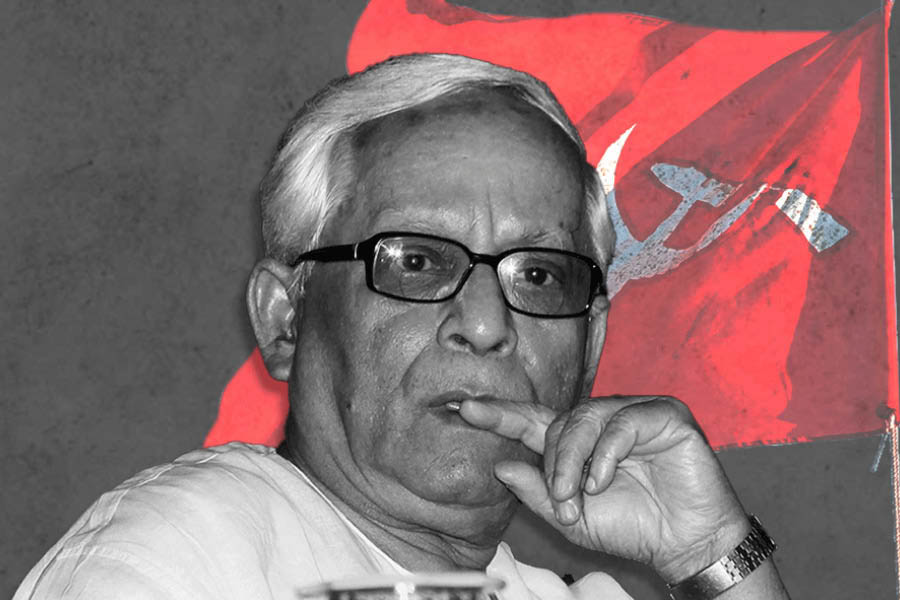
Buddhadeb Bhattacharjee
2006 Assembly polls: That election, which saw the Left government returning to power with a historic mandate of 235 seats in the 292-member Assembly, was relatively peaceful, with stray incidents of clashes between grassroots workers of TMC and CPM. Although no consolidated data was available, around five to six people ended up dead as per Election Commission records cited by local media.
2008 Panchayat polls: This period was marked by the Trinamool’s rising challenge to the Left's rural hold. Heavy clashes in Nandigram and Singur signalled major political shifts. At least 14 people lost their lives in police firing during the 2007 land acquisition protests, and the unofficial death toll after the 2008 polls was pegged around 45.
The Singur movement had no consolidated death toll, but was marked by several cases and, in particular, the gangrape of a teenaged land activist and the police assault on Rajkumar Bhul, who later succumbed to his injuries.
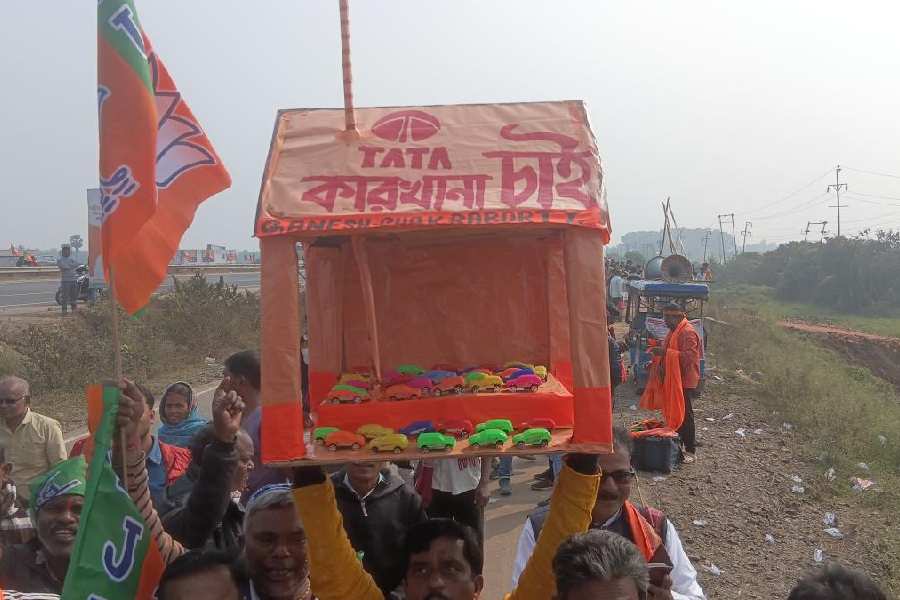
BJP supporters walk to Modi’s rally with a handmade model of a Tata car factory in Singur in January, 2026.. Picture by Amit Kumar Karmakar
2009 Lok Sabha polls: A three-sided clash between the CPM, TMC-Congress workers and Maoists unfolded in the Junglemahal belt. At least 15 deaths were reported between March and May during the campaign, but the post-poll violence that followed escalated to shocking levels.
According to a 2009 editorial in EPW, political killings after May 16, 2009 had crossed the 150 mark. Left Front chairman Biman Bose had verified to The Hindu a list of 269 supporters killed since the 2009 Lok Sabha polls up until the mid-2010 period.
TMC era
Although pre-poll and post-violence data and facts often get jumbled up, the reasons for the two are very different, says Mahmood. While post-poll violence is often the handiwork of the winning party, pre-poll violence can be perpetrated not just by the ruling party but by Opposition cadres as well.
It is often a signal to those in power that the Opposition has the required ground strength to challenge them.
“If you look at Trinamool, their cadres have unleashed violence while they were in the Opposition shortly before coming to power,” Zaad points out.
“Violence just one or two days before polling is an effective measure to intimidate voters and ensure they don’t even step out of their houses on polling day,” Ghosh says.
2011 Assembly polls: While Mamata Banerjee finally brought an end to the 34-year Left rule, poll violence continued as per practice. At least 17-25 deaths, along with multiple cases of sexual assault and intimidation, were reported.
According to a booklet released by CPM leaders, 183 Left workers were killed between May 2011 and July 2016.
2013 panchayat polls: The unofficial death toll was put at 20 to 30, along with hundreds of cases of physical assault, even with a five-phase central force deployment. At least 17 deaths were recorded on the polling day. That election was also marked by a protracted legal battle between the State Election Commission and the state government over the deployment of central paramilitary forces.
2014 Lok Sabha polls: Bengal had the highest count of violence cases in the country, with 7-16 deaths and 1,298 political-party workers injured. The Election Commission recorded that all 1,354 onlookers (civilians not affiliated with parties) injured in poll violence across India were from Bengal.
2016 Assembly polls: A massive deployment of central forces across Bengal’s polling booths ensured that violence was “contained”, but it surged dramatically in the post-poll phase. While 8-12 deaths were reported during the polling phase, large-scale displacement and arson cases were recorded. Crude bombs and physical clashes left hundreds injured.
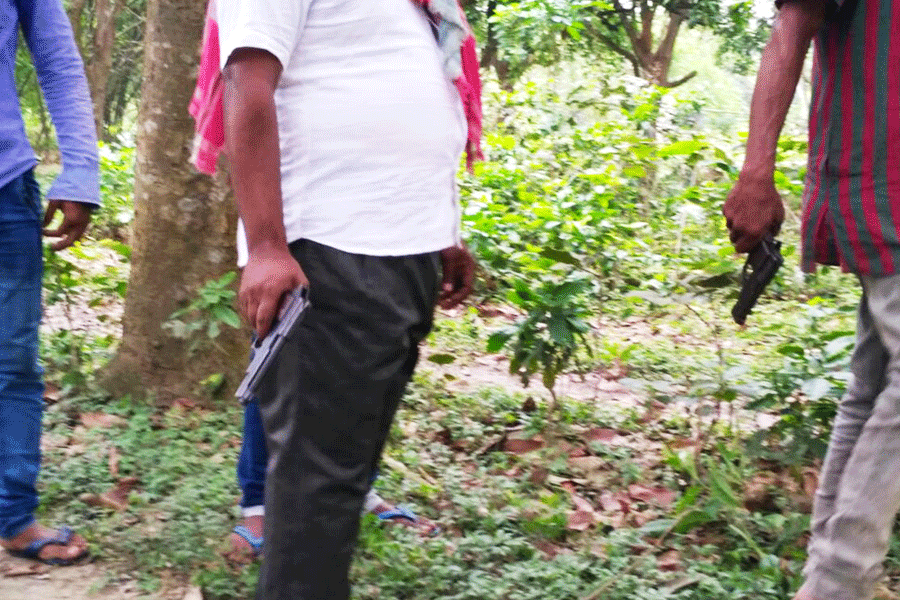
A miscreant carrying a gun near a polling booth during the 2018 Panchayat election at Nowda, Murshidabad. Library Picture
2018 panchayat polls: Zaad says violence is not measured solely by bloodshed, but also by indicators like uncontested seats. In this election, 34 per cent of seats went uncontested, most of which were won by the TMC. A total of 75 deaths were reported in pre-and poll-day violence, with 13 on polling day. The elections witnessed crude bomb attacks and booth-capturing across districts.
“2018 panchayat election broke all records. The state had never witnessed this level of violence before,” Ghosh says.
2019 Lok Sabha polls: The BJP emerged as the principal challenger to the Trinamool as major clashes were reported in north Bengal and Barrackpore near Kolkata. At least 12 to 15 deaths and over 700 injury cases were reported during the seven-phase election cycle.
2021 Assembly polls: The election saw the TMC returning to power for the third time after a high-decibel contest with the BJP. At least 1,300 incidents of violence, 17 deaths and 7,000 cases of molestation were reported as per a Call of Justice fact-finding committee report.
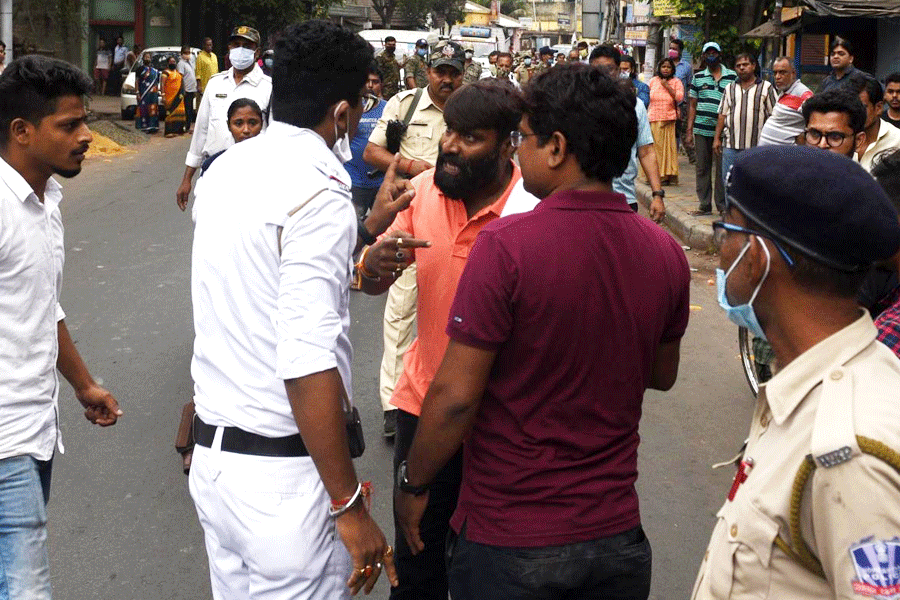
BJP supporters argue with the police during the 2021 Bengal Assembly election near the polling booth at Lalbaba College, Bally. Library picture
Union home minister Amit Shah claimed that more than 130 BJP workers had been killed in Bengal between 2019 and 2021.
The incident prompted scrutiny from central bodies like the Election Commission and a directive from the Calcutta High Court to the CBI to probe the most serious crimes like rape and murder.
2023 panchayat polls: Bengal witnessed one of the most violent local polls in recent history, characterised by a high death toll that began as soon as nominations opened and continued through the counting of ballots. Around 45 to 55 deaths were reported, with 12 to 18 killed on polling day.
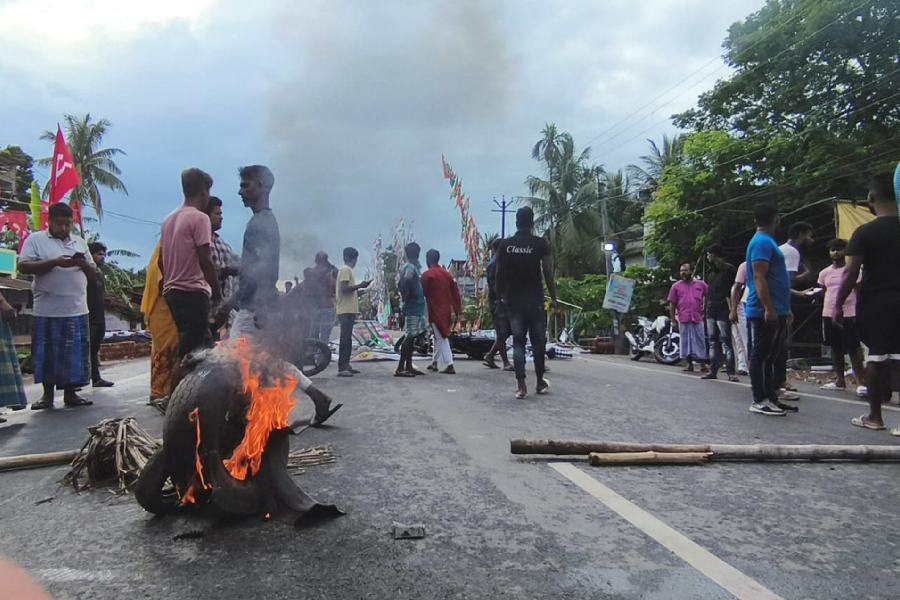
Supporters block a road in protest against the killing of an independent candidate during panchayat polls, at Barasat in North 24 Parganas district, Saturday, July 8, 2023 PTI
2024 Lok Sabha polls: Over 900 companies of Central Armed Police Forces helped prevent the industrial-scale casualties seen in the 2023 panchayat polls. National media outlets reported six to 10 deaths and over 100 incidents of assault and multiple incidents of EVM vandalism.
Professor Ghosh compares Abhishek Banerjee’s historic victory margin of 7,10,930 votes from Diamond Harbour constituency in the 2024 Lok Sabha election to the CPM candidate from Arambagh, Anil Basu, who demolished his rivals with a victory margin of 5,92,502 votes in the 2004 Lok Sabha election.
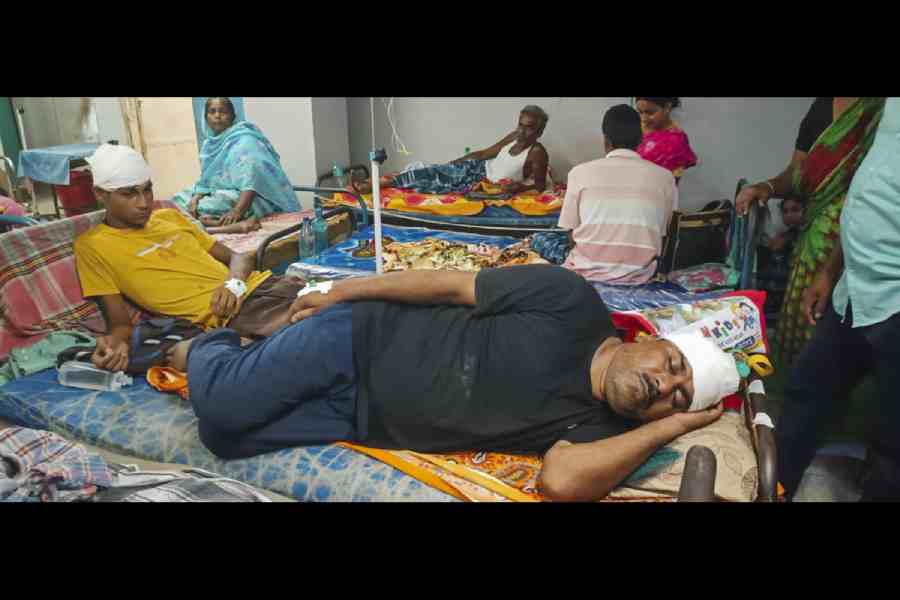
Injured receive treatment after incidents of violence during the fourth phase of Lok Sabha elections, in Bardhman, Monday, May 13, 2024. PTI
Elections in Bengal are not just about politics, it is connected to people’s livelihood and basic survival, where the “winner (of elections) takes it all,” Zaad says. “If you lose the election, you lose your livelihood, your home, your village.”
He makes a distinction.
“Previously, there used to be only political violence. Now, there’s communal violence as well. One shouldn’t mistake violence, which is a natural by-product of social change, like during the land redistribution efforts by the Left, with violence over a turf war, which happens often under TMC rule,” Zaad says.
As no uniform data set exists on the actual death toll throughout Bengal’s political history, it is difficult to compare the CPM and TMC’s track record in Bengal’s bloody political history. Ghosh feels that despite reduced press coverage of Bengal politics during Left rule, the actual volume of cases of poll violence may be higher under the Trinamool.