
Since the 18th century, Jaipur's visual arts tradition has been informed by the dual role of its rulers. The latter commissioned works from the artists in their courts; they also collected art from elsewhere. It is this tradition, and the resulting body of art, that PAINTING & PHOTOGRAPHY AT THE JAIPUR COURT (Niyogi, Rs 4,000) aims to explore. Edited by Giles Tillotson and Mrinalini Venkateswaran, this book is divided into segments that cover the 18th-century paintings and move on to the growing use of the camera in the 19th century. It also examines the art created in the tumultuous years leading up to Independence and the period that followed, right up to the mid-1950s.
An interesting facet of the book is the exploration of the photographic experiments of Maharaja Sawai Ram Singh II, who was an accomplished amateur photographer. The images from his collection have not been widely available to the public. However, one would be hard pressed to find anything else of uniqueness in this work. The relationship between the ruler and the court artist was a symbiotic one: the patronage of skilled artists augmented the rulers' stature, and the artists benefited from the opportunities they received. Their mastery grew, as did the expertise of their patrons. In the text accompanying the artwork, the editors had the scope to examine and analyze this mutually beneficial association. This, regrettably, does not happen; barring the sections dealing with photography, there is little of the editors' own voices in the work. Readers have to make do with the insubstantial textual explanations accompanying the images.

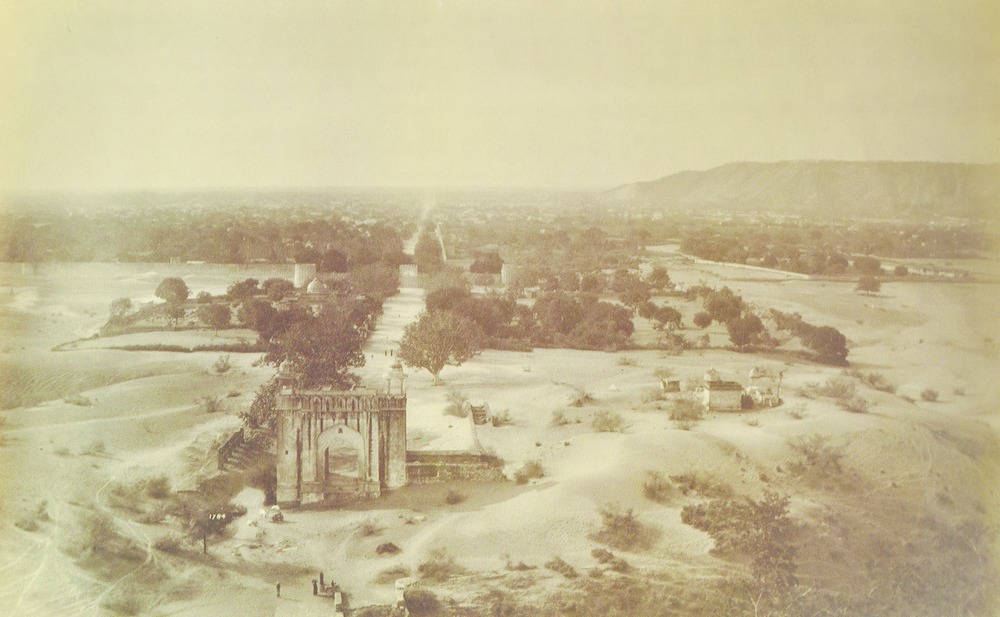
Above is Khawas Ghasi with a child, which is attributed to Ramji Das. It was common for the artists in the Jaipur court to sketch everyone they saw around them, from noblemen and members of the priestly class to tailors and personal attendants. These sketches offer meaningful glimpses into the daily lives of the people at the court, and the feudal practices that informed inter-personal relationships. This drawing depicts Khawas Ghasi holding Sheo Narayanji's son. It is evident that the child is throwing a tantrum: he is scratching his attendant's face with one hand and ripping off his turban with the other. Below is a portrait of Maharaja Sawai Ram Singh II. The bespectacled maharaja is depicted sitting with ease by a circular table. The painted portrait of a woman from the zenana (bottommost) is similar in composition. Of particular interest are the subject's confident pose and her unique garments. Below middle is a portion of a cartes-de-visite bellows camera belonging to Sawai Ram Singh II, dating approximately from the 1860s. Top is City View from Galta ridge by Lala Deen Dayal. This was an unusual direction from which to photograph the city - it was taken from the hill on the eastern side.