|
|
 |
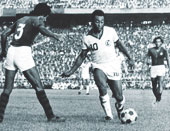
| Then and Now: Pele in action at a packed Eden Gardens in 1977 (above); Bhaichung Bhutia on his way to scoring a goal during a National League match in the city |

Once upon a time, not so long ago, something in the collective consciousness of the Calcuttan prevented the perennially road-raged resident from screaming at the truckloads of football fans who routinely held up the evening traffic on Derby days. Instead, he asked, “Dada, winning goal ta ki Bhaichung diyechhe (Bro, did Bhaichung score the winning goal)?”
Of late, however, such questions surface less and less. That’s not just because of the Calcuttan’s declining interest in winning goal scorers. Players such as Bhaichung Bhutia are more interested in playing a game of different dimensions, to begin with. But among the murkiness of deals and counter deals, the Calcutta football fan finds that the one thing that has suffered is the game itself. ‘Football is dead, long live football politics’ is the word on the Maidan these days, with a spat or two ? like the one between India’s former football captain and his club East Bengal ? thrown in.
What is more, audiences are no longer keen to visit stadiums anymore. Ticket sales figures show that attendance at the Premier League matches in the city came down to 20 lakh last year from 30 lakh in 2003. The attendance at the IFA Shield dropped to 6.5 lakh from 7.5 lakh during the same period.
Early last week, when Bhutia decided to air his grievances about how East Bengal had yet to clear his salary dues, it provided grist to the mill for those planning a thesis on the death of football in Bengal. East Bengal, which in recent times personified the corporatisation of Indian football, had gone on a professionalism overdrive and was known to all as a well-managed and affluent outfit. Neither was it an institution that scored on face-offs ? so commonplace in the tent of its arch-rival, Mohun Bagan.
Bhutia was leaving for Malaysia, where he reportedly had an offer, despite the two best clubs in the city fighting tooth and nail for him. It is another matter that East Bengal succeeded in wooing Bhutia back by prompt payment and by soothing ruffled feathers. But the incident, short as it may be, further exposed the decline of football in West Bengal.
Historical accident
Just why, how and when football became an intrinsic part of Calcutta’s culture still remains a much-debated topic. Sociologist and historian Ramachandra Guha attributes it to a “historical accident”, whereby a game introduced by British soldiers was picked up and mastered by the native population. “Football in Calcutta subsequently evolved out of the socio-cultural differences among the city’s residents, since there were three different institutions ? Mohun Bagan, East Bengal and Mohammedan Sporting ? representing the bhadralok, the plebeian East Bengali settlers and the Muslim populace respectively,” he says.
While north Calcutta was a resident-Calcuttan stronghold, the newer quarters down south was where people moving in from Bangladesh in the years after Independence set up their colonies. Geography and cuisine, along with a host of other issues, found their way on to the football field, and Guha says inter-cultural politics did play a part in the internalisation of football in Calcutta’s psyche. “The tripartite rivalry in the city really took off in the years after Independence, following a huge influx of East Bengali settlers,” he points out.
Calcutta’s football stalwarts, on the other hand, have different views. Veteran footballer P.K. Banerjee claims, like many of the city’s fans, that the city’s football is known for its biggest historical moment in 1911 when the 11 barefoot players of Mohun Bagan defeated the British team East York to lift the IFA Shield. However, writer Moti Nundy, who has been following the game closely since 1944, and has based several of his Bengali bestsellers on the sport, says the Mohun Bagan victory was a fluke, as the team went on to fare terribly in subsequent years. “Calcutta’s best football years were between 1934 and 1941, when Mohammedan Sporting consistently defeated British teams, but the victories were not much publicised, largely because the city’s Hindu press chose to ignore such achievements,” he says.
Fan following
Personal favourites aside, the most important part of the city’s football culture has been its fan, the man who will stop at nothing to ensure that his team wins. The truckloads of green-maroon Mohun Bagan supporters and red-and-gold East Bengal followers hurling the choicest of abuses at each other was as commonplace as city life itself. The legendary stories ? of north Calcutta homes not lighting their ovens until the men brought news of a Mohun Bagan victory ? are still aired. An old fan, Pannalal Chaudhury, recalls how a Mohun Bagan supporter attempted suicide after his team lost a derby to arch-rivals East Bengal in the Seventies.
The passion is much diminished now and the relationship between fans and players has become strained over the years. The fan following was why players such as Chuni Goswami, one of the biggest crowd-pullers of the Sixties, would go on playing for Mohun Bagan at a salary of Rs 8,000 a year, paltry even by the Sixties’ standards.
Former East Bengal captain Sukumar Samajpati says, the fact that people from mofussil areas would catch local trains to come and watch him practise enthused him. Now, however, these veterans rue that it has all come down to which club pays footballers more.
The Seventies saw a phenomenon called dolbodol (changing clubs) emerge, which continues, and at times sees clubs resorting to such dirty tactics as kidnapping players and making secret deals, effectively captured by Nundy’s novel Dolbodoler Pala. Even last week, when Bhutia announced he wouldn’t play for East Bengal, Mohun Bagan began courting him, even as East Bengal was getting him to agree to a new pact via SMS. When The Telegraph contacted Bhutia this week, after news of his deal with East Bengal broke, all he said was, “I’m really busy,” before the line went dead.
These are not the only reasons football in Calcutta is dying. Guha points to two major developments in the past three decades that have spelt doom for the game in the city. “The first was TV,” he says. “Once the local audience got to see the 1982 World Cup on TV, local heroes were quickly forgotten,” he says.
Even as exposure to world football made the Bengali question the abilities of home-grown stars, TV channel ESPN was forced to withdraw the telecast of local matches after a single season 10 years ago because “the standards were too low”, despite a $3,00,000 contract with the Indian Football Association.
For the city fan, it meant further alienation from local football along with an overdose of the Beckhams and Ronaldos.
Games they play
Sociologist and historian Partha Chatterjee, director of the Centre for Studies in Social Sciences says, “Lack of TV coverage of local football has contributed to the decline in interest. Secondly, the local matches stand nowhere if you compare them with what you see at the international level.”
The other ? and more recent ? reason, feels Guha, was the rise in popularity of cricket, a game that was being radically promoted in the country. And to that effect, Calcutta had a national icon in the form of Sourav Ganguly. “Having one of their own folks play for and then lead the country helped popularise cricket among the masses,” he says.
Cricket was by itself a television-friendly game. “Consider this,” says Banerjee. “A fast bowler takes 45 seconds for each delivery. In between deliveries, you can show up to three commercials. In football, the two sides could have scored a goal each in those 45 seconds. It all boils down to how much money you can make out of a sport,” he says.
The doing away with football from Eden Gardens in the Eighties and literally pushing it to the fringes of the city, all the way to the Salt Lake stadium, is a reason cited by many for the falling attendance figures during matches. But ticket sales, defends IFA secretary Subrata Dutta, are linked to the performance, or the lack of it, by the big three clubs. “Generally speaking, this is not an indication that football is losing ground in Bengal,” he says.
A quick look at the national figures drives home the point. The National Football League 2004-05 ended with six Goan teams finishing in the top 10, with Dempo SC as champions and Sporting Clube de Goa as runners-up. Only two Bengal teams figured in the top 10, East Bengal finishing third and Mohun Bagan eighth. And the sponsors are taking note. While Goan teams have sponsors galore, the United Breweries’ sponsorship amounts for East Bengal and Mohun Bagan have been halved over the years. It now stands at just Rs 1.55 crore a year, as against Rs 3 crore when the deal was struck a few years ago.
As a result, clubs find it difficult to make players’ payments. Ergo, Bhutia’s face-off with East Bengal. Two years ago, Jose Ramirez Barreto, Mohun Bagan’s star striker, left for Brazil in a huff after the club failed to clear some of his dues and the officials allegedly abused him verbally. This year, Mohammedan Sporting managed to find just one team sponsor with IFA’s assistance, only because it finally made it to the National League.
“The Big Three’s financial problems are just the tip of the iceberg. Consider the first or the second division clubs, which don’t have money to even start paying its players,” says Nundy.
The lack of money is yet another reason the middle and upper classes are moving away from the game. “Earlier on, most families had five or six sons, and one or two would invariably end up playing football,” says Banerjee. “But now, in single-child families, parents don’t want their children to take up this body-contact, non-paying sport.”
That apart, the city itself has changed. “Going to the stadiums was our one source of entertainment,” says Nundy. These days, there are multiplexes and malls, television and film festivals galore. “The educated Bengali has ceased to be a football fan,” says Banerjee. Now, the techie in Salt Lake’s electronic complex isn’t even bothered if there’s a Derby match on next door. All he wants to do is go home and avoid the “lunatics” in coloured jerseys holding up traffic ahead.