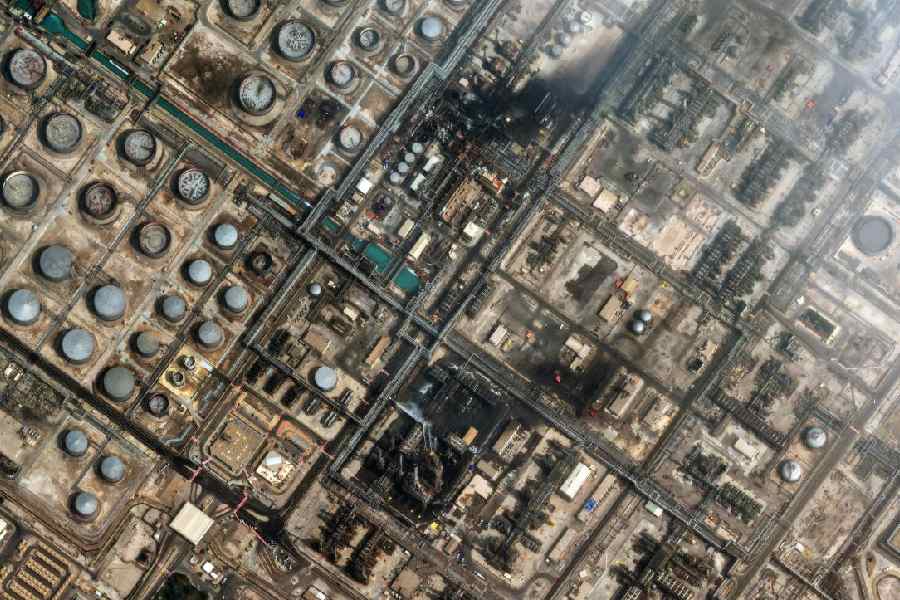
The assassination of Iran’s Supreme Leader in a coordinated strike by Israel and the United States of America has plunged West Asia into a major crisis. The military strike came at a time when progress was being made in the nuclear talks between Iran and the US mediated by Oman. This showed that war aims had expanded beyond the nuclear issue to regime change. Iran made retaliatory strikes on Israel and US bases in Bahrain, Qatar, Kuwait, the United Arab Emirates, and Saudi Arabia. The Saudi Aramco refinery in Ras Tanura was hit. Qatar has stopped LNG export following a hit on a gas processing facility in Ras Laffan. This has, at one stroke, removed 20% of global LNG supplies. Gas prices in Europe have jumped by 50%. An oil tanker has been set ablaze in the Hormuz Strait. The closure of the waterway, which carries 20% of the world’s oil supply, has resulted in a sharp oil price hike.
The military strike that began on February 28 was preceded by the third round of indirect talks between Iran and the US mediated by Oman. In parallel, there was an unprecedented military build-up by the US, including the deployment of two aircraft carriers, USS Abraham Lincoln and USS Gerald R. Ford. The Islamic Revolutionary Guard Corps Navy had also carried out exercises in the Hormuz Strait to demonstrate its capacity to block the strategic waterway. Iran had also conveyed to the United Nations Security Council that in the event it is attacked, it will retaliate against Israel and US bases in the region.
The indirect talks between Iran and the US mediated by Oman had concluded on a positive note on February 26 in Geneva. On February 27, Oman’s foreign minister, Al-Busaidi, disclosed in an interview to CBS that Iran had agreed not to stockpile its enriched uranium. Without a stockpile, it is not possible to build the bomb. Al-Busaidi added that Iran had also agreed to convert the existing stockpile of highly enriched uranium into “fuel, and that fuel will be irreversible”. According to reports by The Wall Street Journal, US intelligence agencies had confirmed that Iran did not have the missile capacity to hit the US. There was no ‘existential threat’ to Israel or ‘imminent danger’ to the US as subsequently claimed by them as justification for the military intervention. In the event, the military action pre-empted a diplomatic option.
The military strike was accompanied by an exhortation to the Iranians by Israel and the US to take over the government. The bet is that the protesters who took to the streets in recent months will rise against the government. At the time, President Donald Trump had promised that help is on the way. This did not materialise. The continued sanctions and bombing campaign do not endear the foreign aggressor to the people.
President Trump has said that the bombing campaign may go on for five weeks. Will the US succeed in bringing about regime change in Iran? If so, will the new regime be more amenable to Western pressure? The Venezuela model does not seem to be working in Iran’s case. The Iranian position has hardened. The retaliatory strikes across a wide front, extending from Israel to Saudi Arabia and Gulf states, show that Iran is able to prosecute the war in the midst of leadership transition.
Iran has announced the formation of an interim Guidance Council consisting of President Masoud Pezeshkian, the head of the judiciary, Mohsen Ejahi, and one jurist from the Guardian Council. The election of a new Supreme Leader is also expected soon. Iran has a widely-distributed power structure. After the experience of the June war last year, the government has also decentralised more powers.
Before the outbreak of hostilities, the heads of nine governments had written to President Trump advising against the military option. Saudi Arabia and the UAE stated that their airspace cannot be used. The Gulf states were apprehensive that their oil installations would suffer collateral damage in case of war. Subsequent events have vindicated their fears.
The Hormuz Strait carries 20% of the global oil supply. There is no alternative source that can compensate for the loss of supplies on this scale. India depends upon nearly 50% of its oil imports on countries in this region. There has been a sharp increase in oil prices. Since the beginning of February, there has been an increase of $4.54 per barrel in the price of Brent crude, an international benchmark. After the war broke out on February 28, there has been a further increase of $8.45 per barrel. A one-dollar increase in crude oil price can result in an increase of India’s annual crude import bill by Rs 14,000 crore.
India also imports 55% of its LNG requirement from Qatar and the UAE, which lie inside the Hormuz. Qatar, which accounts for 40% of India’s LNG import, has stopped LNG production and export. This has resulted in the spot price of Asian LNG tripling from $10.73 per mmbtu to $35 per mmbtu. Seven out of twelve insurance companies, which are part of international Protection and Indemnity club have stopped covering war risk insurance in the Persian Gulf. The combination of attacks on oil and gas infrastructure, the closure of Hormuz, and sky-high insurance costs is likely to drive up oil and LNG prices further. To avoid the closure of the Hormuz Strait affecting LNG supplies, we need to explore the idea of an undersea pipeline from the Gulf region to India. This can avoid the geopolitical risks surface transport faces.
As Ambassador to Iran, I had the privilege to negotiate the memorandum of understanding for Indian participation in the Chabahar port. Even though it is difficult to continue the development, the port is critical for future access to Afghanistan. The International North-South Transit Corridor also passes through Iran. The route can substantially cut down costs and time for trade with Russia and Central Asia.
President Trump has said that the war can go on for four or five weeks. The history of past interventions in Afghanistan, Iraq, and Libya holds lessons for the future. Iran represents a much bigger challenge. While the military campaign can be decided quickly, stability may prove to be elusive. There is also disquiet in the US. The challenge not only comes from the Democrats but also from MAGA, the president’s own constituency. If the world has to avoid the third oil price shock, there is a need for an urgent ceasefire followed by a return to the negotiating table. The indirect talks with Oman’s mediation had achieved considerable progress on the nuclear issue. This process can be taken forward. The alternative would be prolonged instability in a region critical to global energy supplies. This will drain American resources needed to meet the Chinese challenge in the Taiwan Strait. It could also prove to be a risky bet in domestic politics. The Congressional elections are scheduled later this year.
As Ambassador to Iran, D.P. Srivastava negotiated the Chabahar agreement