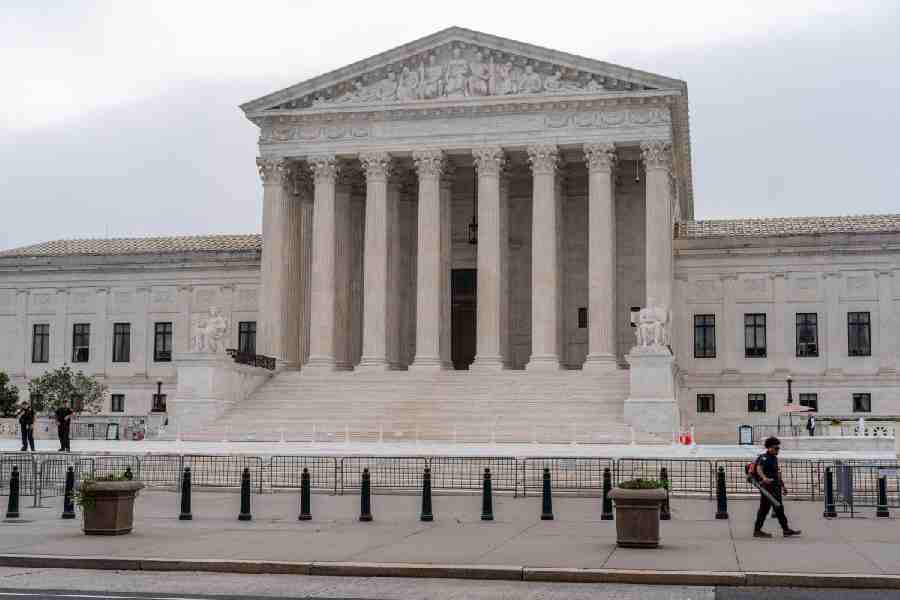
The US Supreme Court on Monday dramatically expanded presidential power, backing President Donald Trump's firing of Democratic Federal Trade Commission member Rebecca Slaughter and overturning a 91-year-old precedent that had shielded leaders of independent agencies from removal, while preserving the Federal Reserve's independence for now.
The justices, in a 6-3 decision powered by the court's conservative majority, invalidated tenure protections for FTC members enacted by Congress more than a century ago. In doing so, they overruled the court's landmark ruling in Humphrey's Executor v. United States. Trump fired Slaughter and fellow Democratic commissioner Alvaro Bedoya earlier this year over policy differences.
The court, however, signaled that its ruling should not be seen as undermining the Federal Reserve's independence, describing the US central bank as possessing a unique historical tradition.
In a separate 5-4 decision, the justices allowed Federal Reserve Governor Lisa Cook to remain in her post while she challenges Trump's attempt to remove her over allegations of mortgage fraud, which she has denied.
The ruling could affect a wide range of independent agencies across the federal government, including the National Labor Relations Board and the Merit Systems Protection Board, significantly expanding presidential control over bodies that Congress had sought to insulate from political influence.
Writing for the majority, Chief Justice John Roberts said the Constitution vests executive power in the president and that restrictions preventing the removal of FTC commissioners conflicted with that authority.
"The president's authority to remove executive officers is a core component of the executive power vested by the Constitution," Roberts wrote, adding that the power to remove executive officials has long been regarded as central to the functioning of the presidency.
Roberts said the Constitution does not permit Congress to insulate principal officers exercising executive authority from presidential supervision merely by placing them in multimember commissions.
The majority concluded that the court's 1935 Humphrey's Executor precedent could no longer be reconciled with modern separation-of-powers principles and formally overruled it.
Liberal Justice Sonia Sotomayor, writing in dissent on behalf of the court's three liberal justices and reading portions of her dissent from the bench, accused the majority of discarding settled law and dramatically reshaping the balance of power between Congress and the presidency.
Sotomayor said the ruling dismantled a precedent that had underpinned the functioning of numerous independent agencies for nearly a century.
"The majority's decision today dismantles a nearly century-old precedent that has safeguarded the independence of numerous federal agencies," she wrote.
She warned that the ruling significantly curtails Congress' ability to create agencies insulated from direct political influence and could expose independent regulators to pressure from the White House.
The case centred on Humphrey's Executor v. United States, a 1935 ruling that arose after President Franklin D. Roosevelt removed FTC Commissioner William Humphrey before the expiration of his term.
In that case, the Supreme Court held that presidents could not dismiss FTC commissioners without cause, such as inefficiency, neglect of duty or malfeasance in office, because the agency exercised quasi-legislative and quasi-judicial functions.
The precedent became a cornerstone of the modern administrative state, helping shield numerous federal regulatory agencies from direct presidential control.
Slaughter and Bedoya sued after Trump removed them, arguing that federal law permits FTC commissioners to be dismissed only for cause and that allowing presidents to fire commissioners at will would undermine the agency's independence.
The FTC, established by Congress in 1914, enforces antitrust and consumer protection laws. Its five-member commission has traditionally included members from both major political parties.
Trump hailed Monday's ruling as a victory for presidential authority, saying it restored accountability within the executive branch.
The justices' separate decision involving Cook leaves intact, at least for now, the Fed's longstanding insulation from political interference. Roberts noted, however, that the administration could seek Cook's removal again through other legal avenues.
The court stressed that the Federal Reserve occupies a distinctive position in the constitutional structure and that its historical pedigree sets it apart from other independent agencies.
Cook, who was nominated to the Fed's Board of Governors by former President Joe Biden, has denied allegations that she committed mortgage fraud.
The Fed case has drawn intense scrutiny from financial markets and economists, who regard central bank independence as critical to maintaining confidence in US monetary policy and insulating interest-rate decisions from partisan politics.
Legal experts said the ruling marks one of the most significant expansions of presidential authority in decades and is likely to trigger fresh challenges involving other independent federal agencies.