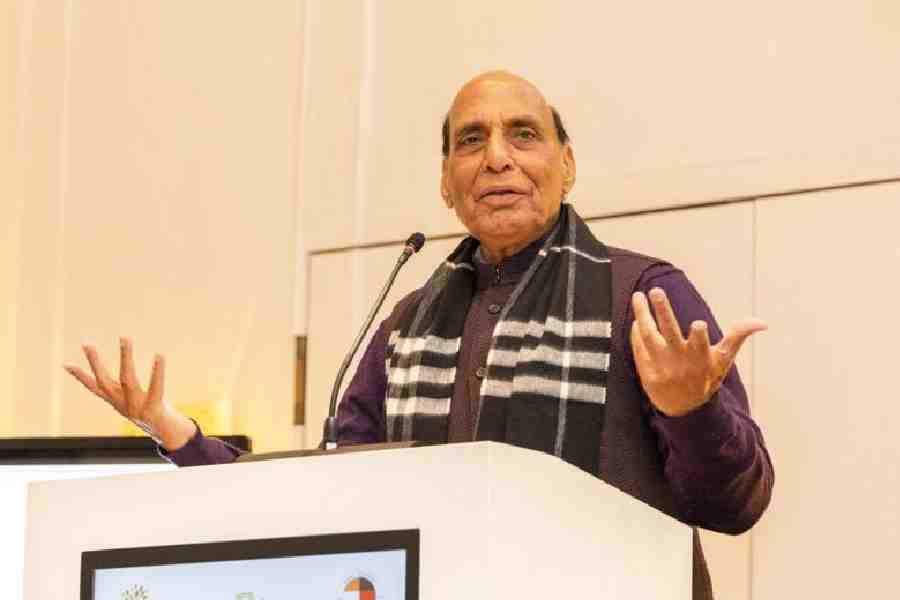
Speaking at a meeting of the Shanghai Cooperation Organisation, the defence minister, Rajnath Singh, condemned terrorism and called for the grouping to act against it in one voice. But it appears that one sentence from his speech has caused heartburn in some quarters. Mr Singh had said that terrorism has neither religion nor country. His comments — unsurprisingly — drew outrage from many online warriors, some analysts, and sections of the political class, especially those affiliated with the Hindutva politics of Mr Singh’s Bharatiya Janata Party. Some critics alleged that Mr Singh had given a clean chit to Pakistan, also a member of the SCO and the source of much of the terrorism that India has been a victim of over decades. Others compared the incident to India’s acceptance of a joint statement with Pakistan in 2009 in the Egyptian resort town of Sharm El-Sheikh that spoke not only of India’s concerns over terrorism but also of Pakistan’s worries about Balochistan — in effect, treating Islamabad as a victim, and not just a perpetrator, of extremism.
But the more worrying criticism came from those who insist that the Indian government must openly speak only of Islamic terrorism, thereby tying militant violence to one faith. That is dangerous, factually wrong, and a breach of India’s long-standing approach to tackle terrorism. Indeed, modern India’s journey is filled with examples of terrorism perpetrated by individuals and groups belonging to multiple religions. This includes the assassinations of national leaders, attacks on trains, buses, and public infrastructure, and the cold-blooded killings of civilians by gunmen or mobs claiming to act in the name of their faith. For the Indian government to link terrorism to a religion would also be dangerous in a diverse country whose national security hinges on unity cutting across communities that act as the nation’s eyes, ears and guards. External enemies would like nothing more than an India divided along the lines of faith. India is not Pakistan; that is principally because India has shown that it can cherish and support its diversity rather than cannibalising itself. To link terrorism to any particular religion would be to accept the terrorists’ narrative that they are fighters for a faith, rather than plain murderers. This gives militants the legitimacy they seek. The Indian government must resist domestic political and ideological pressures and stick to facts and national interest. Mr Singh must be lauded for his view.