|
|
| HOT SHOTS |
| Indian entrepreneurs involved in foreign acquisitions: • L.N.Mittal: He acquired International Steel Group of Ohio in 2004 for $4.5 bn • Ratan Tata: His Tata Steel acquired NatSteel of Singapore in 2004 for $486.4m • Ambani brothers: Reliance Gateway acquired FLAG Telecom in 2003 for $207m. |

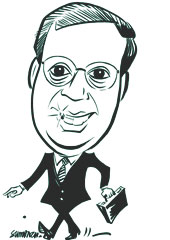
Purnendu Chatterjee was just a young boy when he devised a novel way of making money. Every day, once his neighbours in Calcutta’s Manoharpukur locality had finished reading their newspapers, he would pick them up, then rent them out for a small fee to those who either did not buy a newspaper or wanted to read more. The papers were returned to the young lad by the evening so that he could, in turn, hand them back to their rightful owners.
A relative recalls the story as Chatterjee ? clearly, a born entrepreneur ? hits the headlines for his $5.7-billion takeover of Basell Polyolefins ? the biggest foreign acquisition involving an Indian. Little wonder that the canny boy one day became a close associate of global investor George Soros, who, it is said, trusted him so much that he didn’t mind pouring in millions ? practically sight unseen ? to bring the comatose Haldia petrochemical project to life.
It was, Chatterjee stresses, the success of Haldia Petrochemical Limited that gave him the ?confidence? to go for Basell, a Netherlands-based plastics company owned by Royal Dutch/Shell and BASF. A group of investors led by The Chatterjee Group, his New York-based company, and Russian-born billionaire Leonard Blavatnik sealed the deal in London on Thursday.
The Basell deal might be the biggest plume yet in Chatterjee’s cap, but in the corporate world, where he is known as PC, he has always had a fearsome reputation for buying, running and, at times, breaking apart companies.
And it hasn’t always been smooth. In the early Nineties, the (US) Securities & Exchange Commission accused him of insider-trading after he, with Soros, acquired stakes in a Massachusetts-based industrial instruments-maker. Without admitting any wrongdoing, he, however, paid a hefty fine in a consent decree with the commission. Earlier, in 1986, a hostile takeover attempt had taken him to court in the US.
At the moment, whispers from Writers Buildings suggest that the Bengal government is not entirely in favour of Haldia Petrochemicals participating in the acquisition of Basell, as Chatterjee reportedly wants. The government, keen to get out of Haldia, feels Chatterjee should first accept its offer and buy its stakes before involving Haldia in the Basell acquisition.
Chatterjee would not like to dwell on this at his moment of glory: after all, the Basell takeover has eclipsed all other foreign acquisitions by Indian companies in recent times.
Chatterjee would rather talk about how Bengal is turning around with Haldia. For the 55-year-old entrepreneur ? who lives with his family in an apartment overlooking Central Park in New York but loves to gift cassettes or CDs of Rabindrasangeet ? it’s a matter of ?great pride?.
Still, from South Suburban School and Narendrapur Ramakrishna Mission to Indian Institute of Technology (IIT), Kharagpur, and the University of California in Berkeley, it has been a long journey. But the signs were all there ?friends recall that he always studied with the same tenacity and devotion with which he clinches business deals now.
?I know his struggle, what he went through while he was trying to go to the US after graduating from IIT,? says politician Sougata Roy. ?He never gave up.?
Chatterjee never misses a chance to stress his humble background. In 2000, after he had pumped money into Haldia, he called reporters for interviews not, as many expected, to a five-star hotel, but to his sister’s modest house near Sealdah station.
Chatterjee screened a short film on Haldia then, with footage of him wandering around the station complex. When asked why, Chatterjee ? who is married to the daughter of steel magnate and former Bengal governor Viren Shah ? had replied that he wanted to show he was no different from the common man.
Canny, meticulous and equally at home in American and Indian cultures, Chatterjee worked for a while at Stanford Research Institute after getting his PhD in engineering from Berkeley. He then joined McKinsey, where he spent 10 years ? the last two as a partner.
Many? in both business and political establishments in Bengal ? were sceptical when he took up Haldia as ?a challenge? in the mid-Nineties.
But the move paid off in less than 10 years, with Haldia making a profit since 1993. In the last year, profits rose from Rs 134 crore to Rs 550 crore.
Currently, The Chatterjee Group and its associates hold nearly 49 per cent equity, while the state government has almost 47 per cent and the Tatas the remaining four per cent.
The profits underscore Chatterjee’s financial wizardry, but colleagues stress that there is little of the steamroller in him. On the contrary, they aver, he is polite, always willing to listen to others, and has the patience of a saint.
But, they warn, don’t think you can take him in. ?He is quick to see through a ploy and cuts through nonsense,? says Haldia Petrochemicals managing director Swapan Bhowmik. Not for nothing do they call him a negotiator par excellence.
But, then, he started young. It would have taken some negotiation to make his neighbours part with their newspapers for nothing in return.