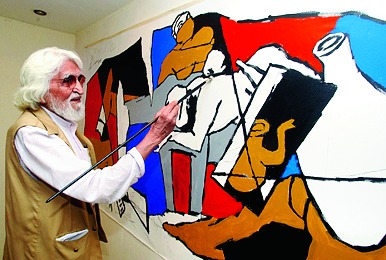

Oscar Wilde had once written that "every portrait that is painted with feeling is a portrait of the artist, not of the sitter". Ila Pal's latest biography of M.F. Husain exemplifies this idea. It is imbued too heavily with her idolatry of the artist, a close acquaintance of the author, and her own moral stance for an objective image of the artist to emerge.
Notwithstanding frequent interruptions and digressions, the book traces the journey of the artist from his first tryst with art to his wilful creation of "Husain" as a brand of global renown. It addresses his constant pursuit of the image of the "ideal woman" as well as his ever-changing romantic interests. It also presents a comprehensive overview of all his prolific artistic ventures. It engages in a reconstruction of Husain's personality by deliberately associating the implications of his life experiences with his evolution as an artist.
One remarkable aspect of the book is that it is a trove of priceless details about Husain's life, with a number of hitherto unavailable photographs, letters, poems, doodles and sketches to which the reader is now privy. Pal's research uncovers surprising revelations about his change of nationality. She also provides Husain's own views on painting techniques, use of symbols and colours, and artistic vision. Although the prospect of catching such glimpses of the artist's mind is appealing, the self-indulgence of the author in relating anecdotes makes the book a tedious read. Furthermore, the content is often repetitive, and the reader is left baffled by the sheer number of typographical and grammatical errors in the book.
The dominant tone of the book is more defensive than discursive or analytical. Although she justifiably posits Husain as a nationalist persecuted by jingoists, Pal compromises her credibility as a critic as she abets Husain's regressive perspectives of women and, in trying to establish him as a family man, contradicts the facts that she herself furnishes.
What one can take away from this book is a wonderfully human image of the great artist, whose fascination with blockbuster films is endearing; his relentless spirit even in his nineties, inspirational; and desolation in old age, heartrending. Unfortunately, this image appears only in fragments as, in her attempt to highlight Husain's iconoclastic role in the Indian art scene, Pal inadvertently paints over most of the subtle shades of his human frailties with too heavy a hand.