|
|
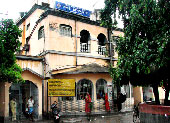
| Behrampore Sadar Hospital: darkness visible |

“Done because we are too menny.” In Thomas Hardy’s Jude the Obscure, this is a suicide note. But nothing could better express the spectacle of stark and abounding misery that is presented by the state-sponsored health institutions in West Bengal.
Certainly, one billion people is a lot to deal with, and West Bengal accounts for 8 per cent of them. But while the government works itself into a tizzy over industrialization and its newfound Left-liberalism, an impenetrable apathy towards its people shows through on a visit to state-run hospitals in Murshidabad.
A lone goat bleats pitifully outside the entrance to the general ward (male) in Behrampore Sadar Hospital. Inside, the large red building is dark and horrific. The pungent smell of a combination of anaesthetics, goat and urine suffuses the damp air. Beds are lined along the stained walls, with not so much as an inch of space between them. Bodies — sometimes two or even three to a single bed — lie numbed by their subhuman existence. A corpse, shrouded in a dirty old blanket, is left next to people alive, though alive only in strictly clinical terms. Discarded beds and mattresses are abandoned in a mountainous heap in a corner of the ward that could well be utilized to accommodate more patients. Visitors lean against saline stands and fuss over their ailing relatives while nurses make themselves invisible for the most part. Bedpans have not been cleaned of blood and urine, patients sleep not even a foot away from their effusions. A leaking basin makes the floor slippery and dangerous.
Tubercular and emaciated, patients at Behrampore New General Hospital are no better, though, at first glance, the infrastructure seems to be a little more advanced here. The story is the same inside. While a battalion of uniformed nurses take in the autumn air on the expansive hospital compound, a harried relative physically carries his ward out of a room and another man, with his leg in a plaster, limps in evident pain onto a stretcher, with no one to help him. A third, lucky to have got a bed all to himself, stretches his legs and lights a defiant bidi. An unbearable stench from one of the rooms prevents further investigation, and, clinging to dim hope, one makes one’s way to the female ward. It is in better condition, in that bodies do not lie nearly atop one another for want of space. A bunch of attendants proffer help to us, but ignore a couple of bedridden women, one of whom balances her food tray on her belly and manoeuvres food into her mouth while lying on her back. Another cradles her tray almost like a pillow and barely manages to eat a few mouthfuls. It is essential to tread carefully, as faeces lie on the floor of the corridor. Bedpans double up as dustbins.
The chief medical officer of health (Murshidabad), Mangobinda Mondal, lives in a sprawling 12-room bungalow. Fawning officers surround Mr Mondal in his office, located at careful remove from the hospitals. The doleful strains of a film song playing on his mobile phone — perhaps in ironic empathy for the state of the machinery he operates — interrupt his business of flipping through files. With the practised evasion of one accomplished in disclaiming responsibility, he avers that it is the prerogative of the individuals relieving themselves on hospital corridors to clean up the mess they leave, and not that of the cleaning staff. The incompetence of the cleaners is understandable when one sees how old some of them are. Concealing one’s actual age, one learns, is common practice, used to extend an employee’s service period interminably. Mondal speaks of the shortage of hospital staff and doctors with the same indifference with which he dismisses questions about the allocation and utilization of funds at the health centres in the district. His oily retinue echoes his denials of things being amiss with greater, more theatrical, vehemence.
The Gokarna block hospital has been mired in controversy since the recent death of a young girl, allegedly due to procedural delays in transferring her to the Behrampore Sadar hospital in an ambulance. Personal grudges held by the block medical officer and the doctor on duty led to fisticuffs, and a life was lost in the juvenile scuffle. Insiders at the hospital, however, insist that the girl’s condition was too far gone for recovery. Both the sparring doctors were away at the time of our visit, and would possibly be transferred, we were told. In all likelihood, the resultant shortfall would be compensated for by doctors at present attending one or other of the primary health centres, which would then go without professional medical supervision.
One of 26 block hospitals in the Murshidabad district, Gokarna’s main ward is in a hall on the ground floor of a one-storey building where men and women share the same room. While this progressive outlook is appreciated, the fact that lack of infrastructure on the otherwise sizeable grounds is the cause for this open-mindedness is not missed. The hospital conducts basic tests for malaria and tuberculosis, but something as common as a pregnancy kit is not available, and patients must go to the sub-divisional hospital for a pregnancy test as for other tests.
The doctor on duty, who chooses to remain anonymous, mentions that most ailments stem from a lack of hygiene among the villagers — worms and diarrhoea are the commonest afflictions. Snakebite and rabies patients are also frequent. Stomach ailments come from unhygienic methods of cooking, often in unwashed utensils, and this includes midday meals served in schools, the only incentive to education for most. Regular awareness campaigns about issues ranging from hygiene to family planning and AIDS are conducted, and weekly as well as monthly meetings are held between health officials (like those from the Block Health & Welfare Samiti or the National Rural Health Mission) and representatives from the gram panchayat. But what sounds dandy in theory is crushed under the overbearing reality of the scenes at the main hospitals in Murshidabad. Before every election, health becomes a rallying point in the election campaign, and dies out once its vote-procuring purpose is served.
It is only a handful of people, choosing to operate silently, to remain unnamed, who hold the medical system in Murshidabad together. Mostly doctors, they have often left lucrative practising opportunities in Calcutta to come and work in this atmosphere of lack. Infrastructural problems and the unhealthy politics of health in the state do not deter them. Yet, there is an undeniable complacence in the way unique methods of diagnosis are applied to gloss over this lack. There seems to be an imaginary roster of illnesses, and, in the absence of adequate facilities to conduct tests, especially at the rural health centres, each patient is assumed to be affected with either one or the other ailment, based on the symptoms they complain of. And when one doctor says, “Treatment here is easy. If you watch us for a month, you can do it too,” this lax, do-it-yourself approach to health in the districts becomes shockingly apparent.