|
|
| Awesome burden |

Rudyard Kipling wrote Kim over 105 years ago. It became his most successful work of fiction. Many generations of the English-speaking world came to know about India through this novel. It has gone into hundreds of editions and been translated into every language of the globe. It was cited when Kipling was awarded the Nobel Prize for literature. In short, Kim is regarded as a world classic. When my daughter, Mala, was about to leave for Cambridge, I bought her a copy and told her that it was a must read before she went to England. She never bothered to read it. I found it in my shelf of unread books and decided to take a second look at it.
I must have read Kim over 50 years ago. I recollected it was about an Irish orphan, Kim O? Hara, and a Tibetan Llama, walking from Lahore eastwards along the Grand Trunk Road. My memory had betrayed me. They went to Ambala by train and loitered in the countryside. The more I proceeded with the novel, the more irritated I became with the language Kipling used ? thee, thou, hast, moveth etc ? which had become outdated by the time he wrote. Most of his characters were drawn from his earlier writings ? a Pathan horse-trader, a Bengali babu who mispronounced English words (even the mispronunciations are incorrect) to show his inborn contempt for the educated Bengali bhadralok. Kipling packed as many castes as he could think of to show off his knowledge of India. Characters come and go. There are an appropriate number of kothawalis and wanton women with little relevance to the theme, which in any case, is the much-hackneyed obsession of the British or Russian conspiracies to invade India. All the so-called spies, Russian, French, and Indian are unbelievably amateurish. However, I plodded on and on till the end, hoping to find out why Kim had been rated so high. I failed to do so.
I turned to Professor Jamiluddin?s seminal work on Rudyard Kipling, The Tropic Sun. He devoted a whole chapter to Kim. He had rightly quoted a few lyrical descriptions of dusk descending on Punjab villages, paraos (halting places) and serais. Also, foreign authors extolling the novel as a masterpiece of informative fiction. I remain unconvinced of its greatness. It is an utterly contrived tale full of unlikely coincidences. I hope I am wrong in my assessment as I have a high opinion of Kipling as a poet.
Start at the very beginning
A Punjabi fluent in Bengali and Sanskrit, professor of English literature, poet, calligrapher, translator, transcreator, publisher and guru to a generation of bhadralok and Marwari chelas ? all in one person in Professor P. Lal, owner of the Writers Workshop of Calcutta. He attires himself in long chogha, befitting a guru, and holds weekly readings of his translation of the Mahabharata for anyone who cares to join in. He has become a cult figure in Calcutta?s literary circles.
Among P. Lal?s many translations (he likes to describe them as transcreations) his favourite is the Mahabharata. In 1980, he produced a condensed, readable prose version of the epic. Earlier, in 1968, he had published the first volume of the complete translation of the adi parva (The Book of the Beginning). And now, ?a heavily, scrupulously revised edition?. It is a transcreation of the complete text of the adi parva. It includes stories other than the central narrative of the conflict between the Kauravas and the Pandavas, such as that of the feud between Garuda and the snakes, as well as passages regarded as interpretations that are often deleted (for example, the story of Ganesha writing down Sage Vyasa?s text, which is omitted in the Poona edition).
Like all Writers Workshop books, the Mahabharata is produced in a style unique to this publishing house. It is beautifully produced, and has a hand-painted front page scene of Krishna and Arjun at Kurukshetra. And as usual, P. Lal writes in a highly readable style. After having sampled the adi parva, readers will look forward to reading the complete text, hopefully by 2008.
Drinking from the spring of youth
Having finished the first draft of the translation of my favourite couplets of Urdu poetry in collaboration with Kamana Prasad, I am satiated with praise of wine and women. Mirza Ghalib and Meer Taqi Meer made no secret of their love of wine. More surprising than them are Mohammed Rafi Sauda (1706-81), who I am not sure was a drinker, and Akbar Ilahabadi (1846-1921), who I am certain was a teetotaller. Sauda has these memorable lines: ?Saaqi gayee bahaar, dil mein rahee havas/ Too minnaton say jaam day aur main kahoon kay bas (O Saqi, gone is the spring of youth/ Remains but one regret in the heart of mine/ That you never pressed a goblet in my hand/ And I protested, ?I?ve had enough of wine?.? Akbar Ilahabadi?s lines have his usual touch of humour: ?Saaghar-e-mai hai saamney, Sheikh say keh rahey hain sab/ Deykhta kya hair har taraf? Mard-e-Khuda charhaa bhee jaa (The jug of wine lies before the Sheikh/ As well as the cup/ Why look here and there? They ask Man of God/ Bottoms up?.
To the Chief Minister of West Bengal
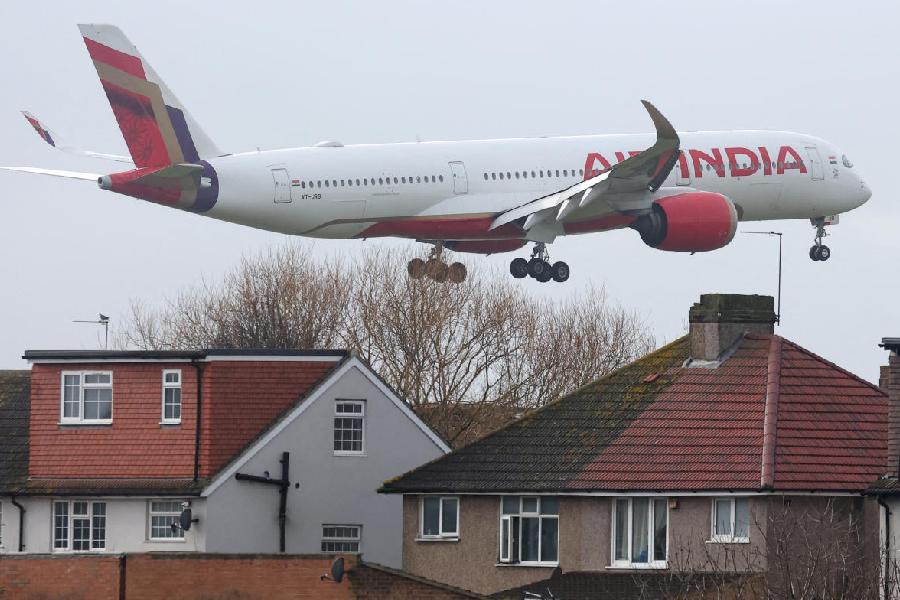
May I request you ? a great communist ? to change the already mutilated name, Kolkata, to Kolkatai. This minor change of ?i? after Kolkata will dramatize the journey from the Middle East to the Far East. Look at it this way. One leaves Dubai and lands at Mumbai, and from there, at Chennai. And from Chennai to Kolkatai (if you kindly agree), and from there to Shanghai. All the five airport names will end in ?ai? and give a boost to our failing AI (Air India).
Contributed by Jai Deb Bajaj, California, US