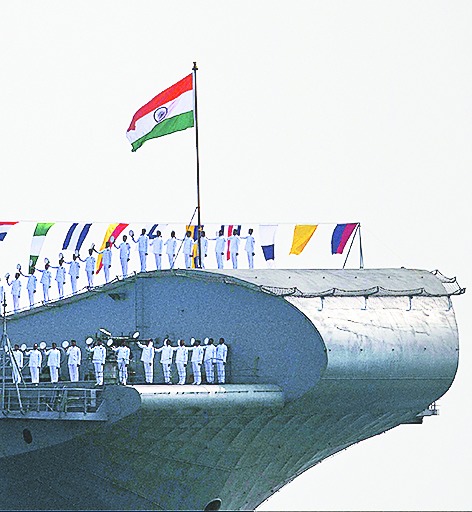

The Indian navy underlined its growing prowess at the International Fleet Review 2016 recently. Even though it was largely a ceremonial inspection of naval warships by the head of the Indian State, it provided an opportunity for the Indian navy to showcase its might and rapidly expanding capabilities. It was in 2001 that an event of such a scale was held in India, and since then it has only grown bigger with a fleet comprising of 75 frontline ships and submarines besides 24 ships from across the world. This year saw the participation of naval contingents from around 50 nations including Australia, Bangladesh, Brazil, China, France, Indonesia, Iran, Maldives, the United Kingdom and the United States of America.
Flagging the threat of sea-borne terror and piracy as the two key challenges to maritime security and underlining the need to respect freedom of navigation against the backdrop of the South China Sea dispute, the Indian prime minister, Narendra Modi, declared during the IFR that India will be hosting the first-ever Global Maritime Summit in April. He made it clear that the Indian Ocean region remains his government's priority, given India's 1,200 island territories, its huge exclusive economic zone of 2.4 million square kilometres and the region serving "as a strategic bridge with the nations in our immediate and extended maritime neighbourhood". Underlining the need for a "modern and multi-dimensional navy", Modi stressed that India would continue to actively pursue and promote its geopolitical, strategic and economic interests on the seas, particularly in the Indian Ocean.
The Indian navy has emerged as an indispensable tool of Indian diplomacy in recent years, making it imperative for policy-makers and naval thinkers to think anew the role of the nation's naval forces in Indian strategy. Despite a general understanding among the Indian political elite that it was the littoral dominance by the European powers that had led to their colonial ascendancy in the Indian heartland, the focus on land frontiers led to the dominance of the Indian army in the national security discourse.
Until the end of the Cold War, the maritime dimension of India's security did not figure adequately in the national consciousness. Indian policy-makers did not perceive the advantage of building up the nation's maritime sinews as the country remained concerned with the north and northwestern frontiers after Partition rather than with its sea frontiers. Yet, despite Indian navy's marginalization and the preoccupation of the policy-makers with safeguarding the integrity of the nation's land frontiers, the navy was largely successful in maintaining a credible force in the region.
Today, the Indian navy's original local sea control and shore defence orientation, which largely focused on preserving the integrity of Indian coastal waters from regional threats, has given way to a more ambitious naval posture. India's naval policy is geared towards ensuring the freedom of navigation for shipping and the safety of sea lines of communication as well as safeguarding its interests in contiguous waters, its exclusive economic zone and island territories. The Indian navy would eventually like to emerge as a world-class blue-water force, equipped to meet regional challenges and threats and to safeguard India's maritime interests.
Indian naval expansion is being undertaken with an eye on China, and INS Arihant and INS Vikrant notwithstanding, India has nautical miles to go before it can catch up with its powerful neighbour, which has made some significant advances in the waters surrounding India. The launch of an aircraft carrier is seen as critical for the Indian navy as it remains anxious to maintain its presence in the shipping lanes of the Indian Ocean and the Arabian Sea, especially in the light of China's massive naval build-up.
Indian naval planners have long argued that if the navy is to maintain continuous operational readiness in the Indian Ocean, protect sea lanes of communication in the Persian Gulf and monitor Chinese activities in the Bay of Bengal, it needs a minimum of three aircraft carriers and a fleet of five nuclear submarines. There are some suggestions that the Indian navy could be close to realizing the dream of operating three carriers by the end of the decade but that may be rather optimistic.
Other serious challenges remain, as exemplified by the enduring problems of safety and reliability which the Indian navy has been grappling with for decades. The Indian navy has a poor accident record with several mishaps in recent years. Even though the navy's surface fleet expansion has been progressing well, the submarine fleet is not only ageing but also depleting fast with the induction of new submarines not on track.
Despite some recent successes, India's indigenous defence production has been marred by serious technical and organizational problems, leading to significant delays in the development of key defence technologies and platforms. The Indian navy, much like the other two services, has found it difficult to translate its conceptual commitment to self-reliance and indigenization into actionable policy, resulting in a perpetuation of reliance on external sources for naval modernization. Yet, India's reliance on its navy to project power is only likely to increase in the coming years as naval build-up continues apace in the Indo-Pacific.
There is a long tradition in India of viewing the maritime dimension of security as central to the nation's strategic priorities. With India's economic rise, New Delhi is trying to bring that focus back, making its navy integral to national grand strategy. While China remains a significant worry, the bigger problem that remains is of introducing organizational changes and doctrinal evolution. How India manages these issues will be significant not only for its navy's future but also for its rise as a credible global military power.
The author is Professor of International Relations, Department of Defence Studies, King's College, London