
Cuttack, April 4: Heat wave conditions and scarcity of drinking water have adversely affected the lives of people at jaundice-hit pockets, especially in and around Jobra, under ward No. 41 of the municipal corporation here.
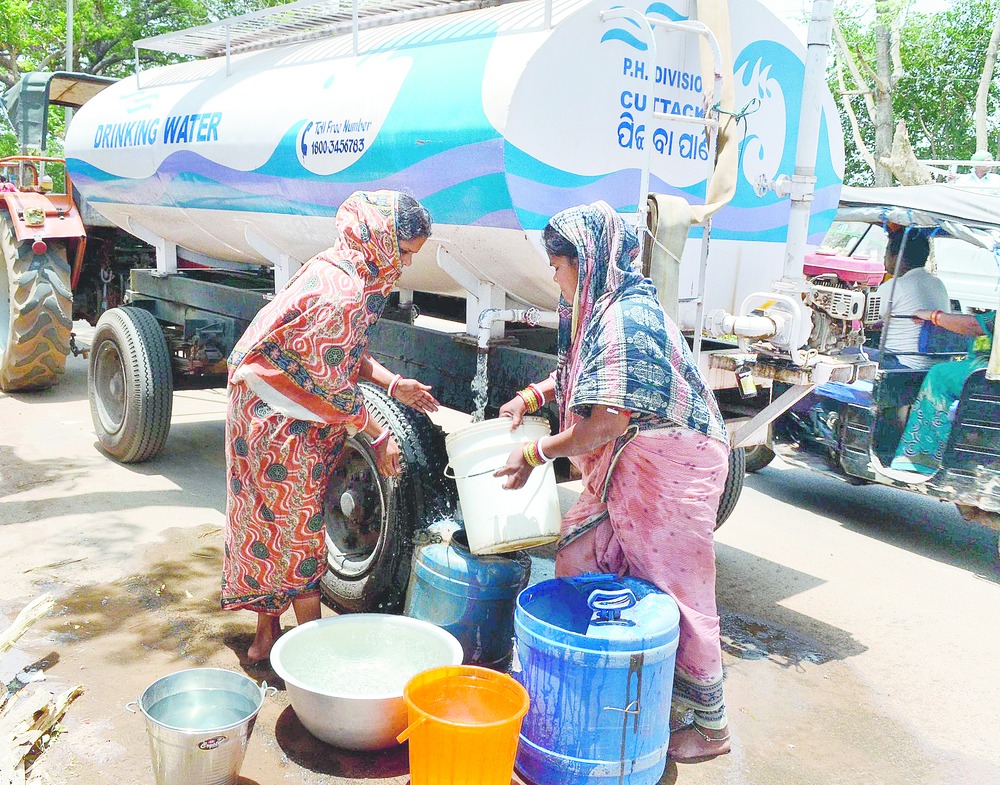
Though the public health engineering department has installed 33 plastic tanks for supplying drinking water at Jobra as a precautionary measure, it has failed to meet the water requirement of the local residents.
Nearly, 90,000 litres of drinking water is being supplied through water tankers every day at the four jaundice-hit pockets of Jobra. The water is filled into 33 plastic tanks (1,000 litres capacity each) and three big containers (4,000, 2,000 and 1,000 litres) at Jobra twice a day with the help of five water tankers.
The total water requirement at Jobra is more than one lakh litres a day, sources said.
"The water filled in the plastic tanks is hardly able to meet the drinking water requirements till 3pm. With more than 3,500 people depending on the water tanks following the jaundice outbreak here, the authorities should install more tanks," said local resident Santosh Sahoo.
"We are filling up the plastic tanks twice a day, but as the water from these sources are being used for other purposes, including in the construction activities for the Jica project, the water is not enough," said the department's assistant engineer Bhawani Shankar Mohanty.
The lack of adequate infrastructure in the form of water tankers has also aggravated the problems as the department has only six tankers and three more have been procured on rent from Bhubaneswar.
Apart from Jobra, 82 additional plastic tanks have also been installed in other parts of the city, including Mehendipir, Mahidas Bazar, Jagatpur, Sutahat and Patapole.
On an average, the water tankers make between 30 and 50 trips a day to fill 135 temporary water tanks installed at various places of the city. Water tankers are vital because only 44 of the Cuttack Municipal Corporation's 59 wards are fully covered by pipe water supply while rest are only partially covered. At present, 101.29 million litres of potable water is being supplied through 170 production wells installed at various parts of the city every day.
The drinking water (ground water source) is supplied through a 585.24km pipeline network.
"We have already invited tenders for hiring eight additional tankers that will be shortly pressed into service for proper supply of drinking water at the wards that do not have pipeline network keeping in view the heat wave conditions," Mohanty said.
So far, 53 persons have tested positive for jaundice, including 45 at Jobra. The remaining cases have been reported from Sutahat, Mehendipir and Patapole.
Housing and urban development secretary G.M. Vathanan today admitted that the hepatitis outbreak in Cuttack was mainly due to water contamination. Poor sanitation due to lack of adequate public toilets, direct discharge of sewage water and open defecation are to be blamed for the hepatitis outbreak in the city, he said.
Vathanan, along with other senior officials of district administration and the civic body, had visited the jaundice-affected localities at Jobra and had reviewed the arrangements here. "The ground water is getting contaminated by open defecation and release of sewage into the drains. We will conduct a survey at Jobra to assess the number of households with toilets and those without septic tanks. Steps will be taken to construct more public and community toilets," Vathanan said.