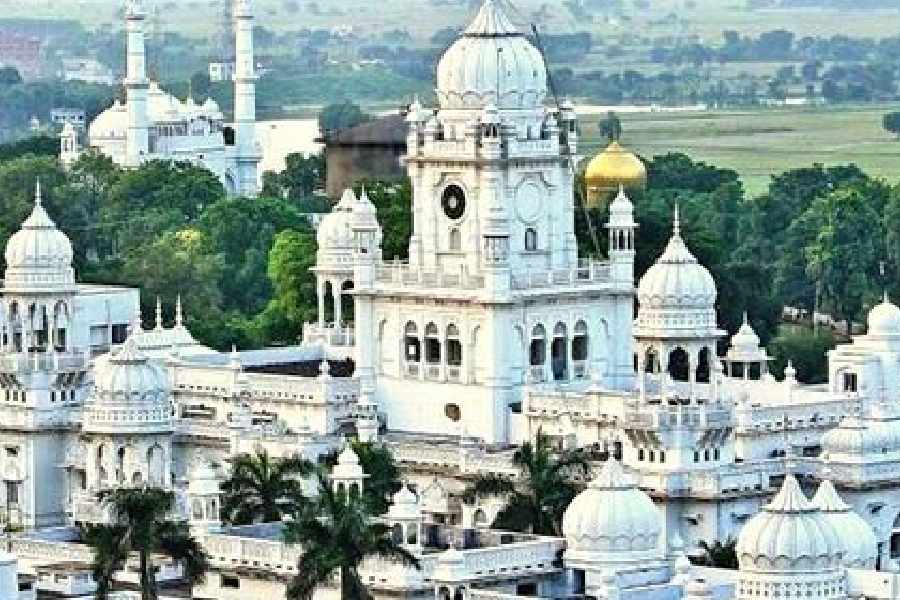
Five mazars located on the King George Medical University (KGMU) campus here are staring at demolition as their management committees have failed to furnish legal proof of ownership or land rights within the deadline that expired on Friday.
The university administration had served notices to the committees 15 days ago, threatening demolition of the structures in the absence of a satisfactory response.
Local BJP leader Abhijit Mishra had claimed in a complaint to the KGMU administration that the mausoleums were built illegally and should be razed.
The management committees of the mazars have, in their reply to the notices, said the structures predate the medical college by over six to seven centuries. The KGMU was originally established as a medical college and later upgraded to a university.
According to the KGMU website, Raja Sir Tassaduq Rasul Khan, a taluqdar of Jahangirabad in Barabanki district, conceived the
medical college in 1905. Its foundation stone was laid by Prince George (later King George V) on December 26, 1905, and it became functional in 1911.
Khalid Rasheed Firangimahli, the shahi imam of the Lucknow Eidgah and member of the All India Muslim Personal Law Board, said: “It is beyond doubt that these mazars are many centuries older than the medical college. The land was provided by a Muslim taluqdar (Tassaduq Rasul Khan) and the British government decided to let those structures exist. Currently, they are registered waqf properties. There had been no controversy surrounding them all these years. All of a sudden, this government wants to remove them.”
Firangimahli said there was no such department centuries ago to permit the construction of such structures. “The KGMU is making itself a laughing stock by issuing such notices,” Firangimahli added.
Mahmood Madani, president of the Jamiat Ulama-i-Hind, expressed concern over the attack on the shrine of Hazrat Haji Harmain Shah, located adjacent to the university, and the issuance of demolition notices against “centuries-old shrines situated in the precincts of Hazrat Makhdoom Shah Meena”.
“We warn the university administration against violating the laws of the land governing waqf properties under the cover of misleading propaganda and demand the immediate withdrawal of all such notices,” he added.
Shah Meena was a 15th-century Sufi saint of the Chishti-Nizami order based in Lucknow. Some of the mazars bear no specific name.
Madani said the shrines were more than 700 years old, adding that a couple of them had already been “damaged by the university administration at the behest of the
BJP leaders”.
K.K. Singh, a professor of KGMU, who has been tasked with taking action against the mazars, said: “The unnecessary gathering of people (to pray at the mazars) creates problems in the day-to-day functioning of the university. We had pasted demolition notices on their walls.”
“There were eight mazars and three of them have already been demolished in
the last one-and-a-half years. Notices have been served to the remaining five located near the microbiology, orthopaedics and respiratory
medicine departments and trauma centre,” Singh said, adding that they made it difficult for ambulances to reach the departments.
Maulana Yasub Abbas, a Shia cleric, denied the allegation that the mausoleums were obstructing the movement of ambulances. “The college was established on the land of the Muslim community, and now they want to remove us from there,” he said.
Mohammad Shakeel, member of the management committee of a mazar, said: “The government must ask the KGMU to withdraw its illegal notices to us. People occasionally gather here to offer prayers, but that has been going on for centuries.”