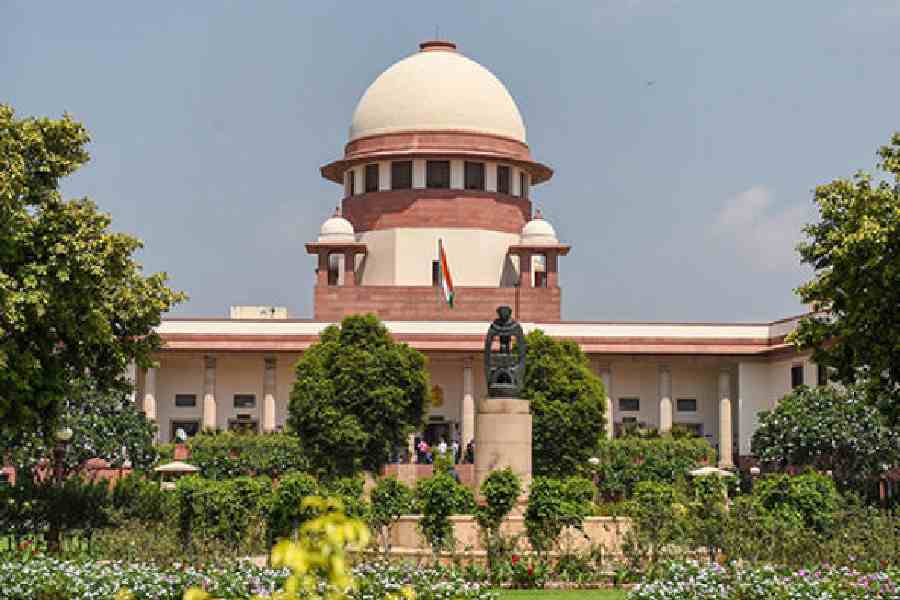
The Supreme Court on Friday asked the organisers of the nationwide postgraduate medical entrance test to explain why they had drastically slashed the qualifying marks, after petitioners argued this would hit the quality of medical services.
The National Board of Examination in Medical Sciences, which conducted the NEET-PG 2025-26 and says a lack of enough interested candidates forced it to reduce the cutoff marks midway through the counselling process, will have to explain its stand on February 23.
“We only want that our conscience is satisfied that there is no devious reason behind it. That is all we want,” Justice P.S. Narasimha, who headed a bench that included Justice Alok Aradhe, told additional solicitor-general Aishwarya Rai.
Rai was representing the exam board, which comes under the overall supervision of the Union health and family welfare ministry.
The board had through a notification on January 13 — after the first two rounds of counselling — reduced the minimum qualifying cutoff marks for general candidates to 103 from the original 276 (out of 800).
For SC, ST and OBC candidates, the cutoff was lowered from 235 to 40, and for candidates with disabilities, from 255 to 90.
Representing the petitioners, senior advocate Gopal Sankaranarayanan told the bench that such drastic reductions in the cutoff marks would affect the quality of medical services for future generations.
Sankaranarayanan said that although the rules allow such reductions, this should be done in exceptional cases, for example, when there are not enough candidates.
But this year, he said, there are 80,000 postgraduate seats while over 1.28 lakh candidates had qualified, going by the original cutoff marks. Therefore, he argued, the reductions were arbitrary.
During counselling, many candidates may decline the seats offered to them if the course or the institution do not suit them.
Sankaranarayanan cited a 1999 Supreme Court judgment to contend that higher study demanded higher standards of evaluation.
“We have this competing value to ensure that seats should not go waste but at the same time, there is another pressure that there are not enough candidates,” Justice Narasimha said.
“Then there is the argument that the standards are being lowered and the counter argument is that seats are going vacant. So, somewhere, we have to strike a balance.”
Harisharan Devgan (social worker and farmer leader), Saurav Kumar (neurosurgeon), Lakshya Mittal (president, United Doctors Front) and Akash Soni (member, World Medical Association) have jointly filed the petition, through advocate Satyam Singh Rajput.
According to the petition, the decision to reduce the cutoff marks was arbitrary and violated Articles 14 (equality) and 21 (right to life and liberty) of the Constitution while endangering patient safety, public health and the integrity of the medical profession.
It has sought a court order quashing the notification.