
Cuttack, June 19: High groundwater levels in parts of the city has become a problem for the Public Health Engineering Organisation (Pheo) even as most major cities in the country struggle with depleting levels. Pheo is, at present, replacing old drinking water pipelines.
The old pipelines are being replaced under the Atal Mission for Rejuvenation and Urban Transformation scheme.
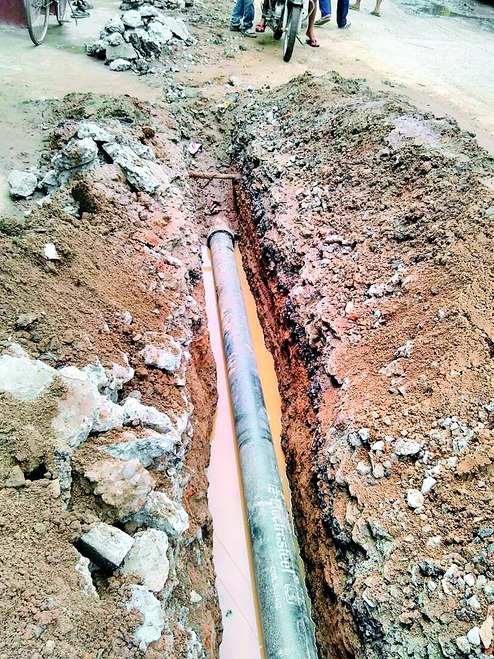
"We are facing this problem in core areas of the city where the water level is just 2ft below the surface. Replacement of the old pipelines becomes difficult as they are get submerged," executive engineer of Pheo (Cuttack Division) Sushant Ghadei told The Telegraph today.
More than half the pipelines in Cuttack were installed two to three decades ago. The Pheo took up the task of immediately replacing these old and rusty pipelines in the wake of continuous health problems in these areas, caused mainly by waterborne diseases.
The government initiated the project after the problem became pronounced in recent years. Chief minister Naveen Patnaik laid the foundation stone for the project last July to address the problem of old, rusted or leaking pipelines that led to the contamination of drinking water.
Ghadei said: "Replacement of the submerged old pipelines has become difficult and we are taking steps to realign the new ones to avoid submergence." Pheo will spend Rs 34 crore on the replacement of pipelines, especially in the older parts of the city in the Cuttack Municipal Corporation limits, where most pipelines have already outlived their service period.
The project is also facing difficulties in areas where houses release wastewater through pipelines running below the road and connected to drains. "Residents of these areas oppose the digging up of roads to get to the water supply pipelines. It is taking up a lot of our time to convince them to go ahead with the replacement work," Ghadei said.
Official sources said the project was undertaken last September. It aims to replace a 98.65-km pipeline network. "We have replaced around 64km of pipelines. We expect to complete the project by September," Ghadei said.
The project has run into other problems as well with residents of some areas expressing dissatisfaction over the way the land was being filled up after relaying the pipelines. Kathagada Sahi resident Lokanath Sahoo said: "Pheo should ensure that the teams engaged in the work of filling up the land with sand instead of the earth displaced during digging. Sand will prevent rusting of the new pipelines."
At present, Pheo supplies 102.9 millions of litres per day (MLD) against a demand of 101 MLD. However, leakage in pipelines causes a loss of 25 per cent of the supplied water.
Gamhandia resident Pra-vas Parida said: "Jaundice outbreaks could not be prevented as pipeline replacements were limited to the pockets affected. The project to fix leaking and corroded pipelines at one go will hopefully be a permanent solution."