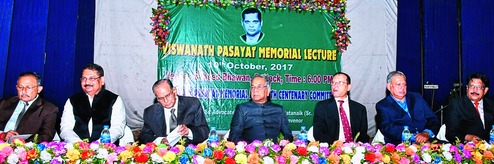

Former chief election commissioner JM Lyngdoh (extreme right) at the Viswanath Pasayat Memorial Lecture at Saheed Bhavan in Cuttack on Wednesday. Picture by Badrika Nath Das
Cuttack, Oct. 11: Former chief election commissioner J.M. Lyngdoh has advocated a change in India's voting system claiming that most voters found themselves virtually unrepresented at present.
Lyngdoh spoke in favour of a switch to proportional representation based on the percentage of votes they win.
The former bureaucrat was delivering the Viswanath Pasayat Memorial Lecture here on Tuesday. He said proportional representation would ensure fair representation of all groups.
Under the system, the whole state is turned into one constituency with each party securing seats according to its share of votes polled. Under the present first-past-the-post system, a party can bag just 30 per cent of the polled votes and still secure a majority, while another with 25 per cent of the polled votes could be left with nothing.
'Under proportional representation, assuming that there are 100 seats, the first party would get 30 seats and the second 25. Altogether, a fair and just outcome,' said Lyngdoh, who helmed the Election Commission of India between 2001 and 2004.
He indicated that the move would also be an incentive for everyone to come out and vote and guarantee a strong opposition to check the excesses of the ruling party. 'The strongest argument for proportional representation is that political parties' shares of their total votes polled are fairly stable over time and it would not be worth splurging at election time. This would greatly reduce venality all around and promote good governance,' he said.
Referring to the Election Commission's ceiling on poll expenditure, Lyngdoh said: 'There are expenditure limits for candidates, but not for political parties.'
He believes that the commission had also not been able to match the parties' expenditures with the election expenditure of their individual candidates as parties' accounts are proforma-edited and disclose very little.
'The audit of political parties could be entrusted to the CAG or independent auditors under his supervision and control,' he said. Lyngdoh also suggested 'a specific provision enabling the commission to deregister political parties' in addition to the existing provision that enabled it to register them.
Reforms from the government have been 'for liberalising elections rather than tightening them'. He said foreign donations were now allowed as well and there were no limits to the donations, both domestic and foreign. 'The donations will be in bonds. The identities of the donors will be known only to the government and banks issuing and selling the bonds - in effect only the government and the party in power,' he said.