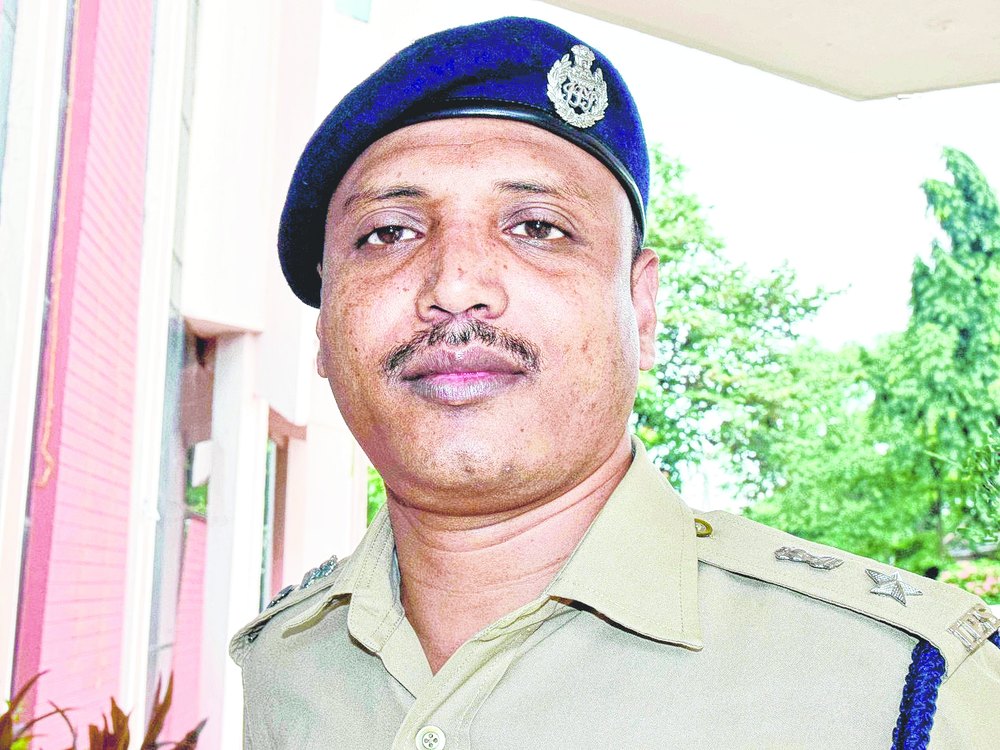

Bhubaneswar is fast emerging as a cosmopolitan city. Earlier, you had managed districts as police chief. How will you differentiate natures of crimes committed in the city and in the rural areas?
Yes, it’s different. In Bhubaneswar, the cases of anonymity are high. There are nearly two to three lakh floating population in the city because of a large number of engineering colleges and other business establishments. That’s why, it’s, at times, easier to commit a crime here and flee without being noticed. But, this is not possible in a district, where one can easily find out who are the people behind a particular crime. Identification is a major problem here. All political agitations take place here as Bhubaneswar is the state capital. You have to handle these carefully. Besides, there are also student agitations. Student related offences are noticed here because of the presence of universities, colleges and engineering institutes. However, it lacks a direct industrial unrest, which is noticed in districts. In Bhubaneswar, one can notice indirect industrial agitations. Besides the crime, the other challenges are to maintain law and order and streamline the traffic system.
Crime against elderly people seems to be on a rise. How do you propose to check it?
You cannot say crime against elderly people is on a rise. If you take the graph, you will find that those are staying alone are more vulnerable to crime. They should be cautious about their security and install CCTVs apart from taking the help of 100 (police control room helpline number) in the time of need.
How do you respond to traffic chaos in the city?
There is a growing need for deployment of more traffic personnel on the outskirts as the city is expanding. Sometimes, we divert our traffic personnel from the core areas to the new zones - which causes a lot of pressure on the manpower. To make people aware of the traffic rules, we have launched traffic awareness programmes. We are also taking punitive action the traffic rule violators. Besides, CCTVs have been installed in many key intersections. Generally, we are imposing fine on nearly four hundred to five hundred people every day for violating traffic rules such as ignoring signals, not wearing helmets and going on wrong lanes .....
Don’t you find faulty road engineering in the city is one of the contributory factors to the traffic chaos?
Yes, the faulty road engineering is a problem... particularly on the stretch connecting between Rasulgarh Square and Khandagiri Square. Commuters face difficulties in taking turns both right and left. We have taken up the matter with the National Highways Authority of India. They have assured us of carrying out the rectification, which they have already made at Vani Vihar Square. But, corrective steps have to be taken at other places such as CRP Square, Acharya Vihar and Khandagiri Square. At the same time, we have taken up the issue with the public works department on how road engineering can be developed particularly between Vani Vihar and Rajmahal Square.
On this stretch, many business establishments have come up. With the help of the Bhubaneswar Municipal Corporation, we have decided to develop more parking lots, so that these areas witness less traffic problem, particularly in the evening hours.
The land related crimes and other fraud cases in the city are also on a rise. The city has already witnessed land related murders. But, police are not able to check it.
All these fraud and land related cheating cases pertain to the past. These had taken place five years ago - even some cases are eight years old or so. No major land fraud cases are being registered. Hardly one or two cases come up, and we solve them. The number of such cases has gone down because of continuous police action, which has had a deterrent effect. Proper awareness and caution at the time of purchasing a land can check such crimes to a great extent.
It has been noticed that students are indulging in violence and sometimes in crime. How to you plan to tackle it?
There are a number of educational institutes in Bhubaneswar. So problems relating to the students arise sometimes. What we have found is that instead of students, the former students are indulging in all sorts of crimes. There are many reasons for it - sometimes, the frustration of not getting jobs, unemployment, sometimes their acquaintance with criminals lead them to the path of crime. To address the issues, we have started educating them as well as
begun interacting with college authorities.
Being the DCP of Bhubaneswar city, what’s your priority area at the moment?
The main job of policing is crime prevention and control. There are two types of crimes - preventable and unpreventable. Unpreventable take place because of sudden provocation and personal enmity. There is also white-collar crime, which is noticed in the metro cities. Our main focus at this moment is how to protect the properties, check burglaries and dacoities. We have been able to deal with these cases to a great extent. But when a crime takes place, people suddenly start talking about it. However, no one talks how to make the city free from crime for 340 to 350 days in a year.
You must be under pressure as you have to maintain the law and order and provide security to the VIPs.
We have separate manpower to provide security to the VIPs. Only in emergency situations, we mobilise forces from police stations and other areas. Both are equally important for us - providing security to the VIPs and controlling the crimes in the city.
Police are focusing on a people-friendly move. However, we have noticed that people have fear in approaching the police.
Nearly 6,000 cases are being registered here in the Bhubaneswar police limits per annum. It may touch 6,500 this year as more people are coming to lodge their complaints. While 300 to 400 cases are being registered on the basis of petitions given to the commissioner, DGP and other senior police officials, other 6,000 cases are being registered directly at police stations. It indicates that people now feel free to approach the police to lodge their complaints because of our proactive and people-friendly approach.
Has the police-public interface helped in this direction?
Police-public interface has helped us to a great extent. The crime can be curtailed if people support the police’s move. We achieved some success after forming residential committees in various parts of the city. In Rajmahal and Chandrasekharpur areas, the crime rate has come down because of the active support and involvement of the local people in the policing system.
There have been reports that many criminals operate from the city slums. How do you tackle it?
Many people usually come to slums from various parts of the state. Anonymity is high in the slum areas. People come to slums, take shelter there, and after committing the crimes, flee from the area. However, with police intervention and people’s support, the crime rate has been checked to a great extent. The good thing is that in Mumbai and Delhi, we have noticed how the mafia dons emerge from slums, but such things are not happening here. Even the Maoist infiltration to the slums has been stopped.

You are holding a key position here. The police commissioner and the director general of police are also operating from here. Besides, the state administration is functioning from here. You must be feeling the heat while discharging your duty...
It depends on the situation. The pressure is more work related. As I have handled nearly five to six districts, I can handle it. Besides, I have senior officers to guide, and there are competent junior officers to help me in executing my job.
As an IPS officer, you are submitting your property list. Why don’t you make it mandatory for officers at the level of inspectors to submit their property lists?
Inspectors are submitting their property lists to the police headquarters. Process has already been initiated that these lists also figure in the public domain.
You have been in police service for nearly a decade. Which incident has hurt you the most?
When you investigate as a police officer, you have to separate your emotion from your work. Otherwise, you cannot investigate a case. However, I remember the particular incident in which three police personnel, who were working with me in Malkanigiri, were killed by the Maoists