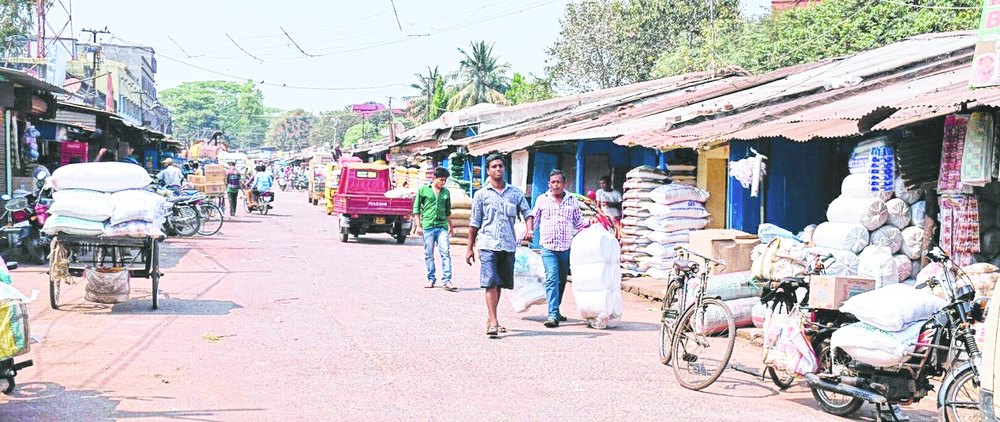

Cuttack, March 12: Traders at Malgodown have sharply reacted to the ultimatum served on them by the East Coast Railway to vacate the land on which runs the state's largest wholesale market.
The traders had organised a meeting at Malgodown, and a delegation, led by members of the Cuttack Chamber of Commerce, will shortly take up the issue with the state government.
The railway's Khurda division has issued notices to the traders to vacate the land by March 31 in order to facilitate development projects on the patch.
The traders alleged that the railway had started issuing notices for eviction from February 19, and so far, over 70 of them received it.
The eviction will have an adverse impact on the storage and supply of essential commodities as food grains procured from other states are stored here and subsequently distributed through retailers in the state, they said.
"The daily business transaction at Malgodown is around Rs 100 crore and procurement and supply of commodities will be affected if the traders are evicted without rehabilitation," said joint secretary of the chamber of commerce Srikant Sahu.
Sahu said the traders would seek court's intervention against such eviction notice.
In 2012, the then collector of Cuttack had set up a high-level committee to look for alternative place to shift the Malgodown market. But so far, the proposal has been laying the cold storage.
District collector Nirmal Chandra Mishra said: "We have formed a committee to look for an alternative venue for shifting the market."
Mishra said: "The bulk of the shops at Malgodown have come on railway land, and we have asked the committee to submit a report on the issue."
However, the traders were not satisfied. "It's unfortunate that while so far no concrete measure has been taken to set up a permanent modern commodities market, which has been a long-standing demand of the traders here, the railway authorities are evicting us," rued Sitaram Agarwal, a trader.
At present, over 800 traders, including 350 wholesalers and 450 sub-wholesalers, are carrying out trade at Malgodown that has come up over nearly 25 acres.
Malgodown was earlier set up soon after the great famine of 1886 by the British government as a precautionary measure to stock essential commodities, including food grains. Subsequently, trade licences were issued to the traders.