
Cuttack, March 1: The soaring mercury has forced the district administration to ensure round-the-clock water supply to both urban and rural areas.
As part of the contingency plan to tackle the heat wave condition, the administration directed public health department officials to boost infrastructure for drinking water supply to the localities that did not receive it from pipelines.
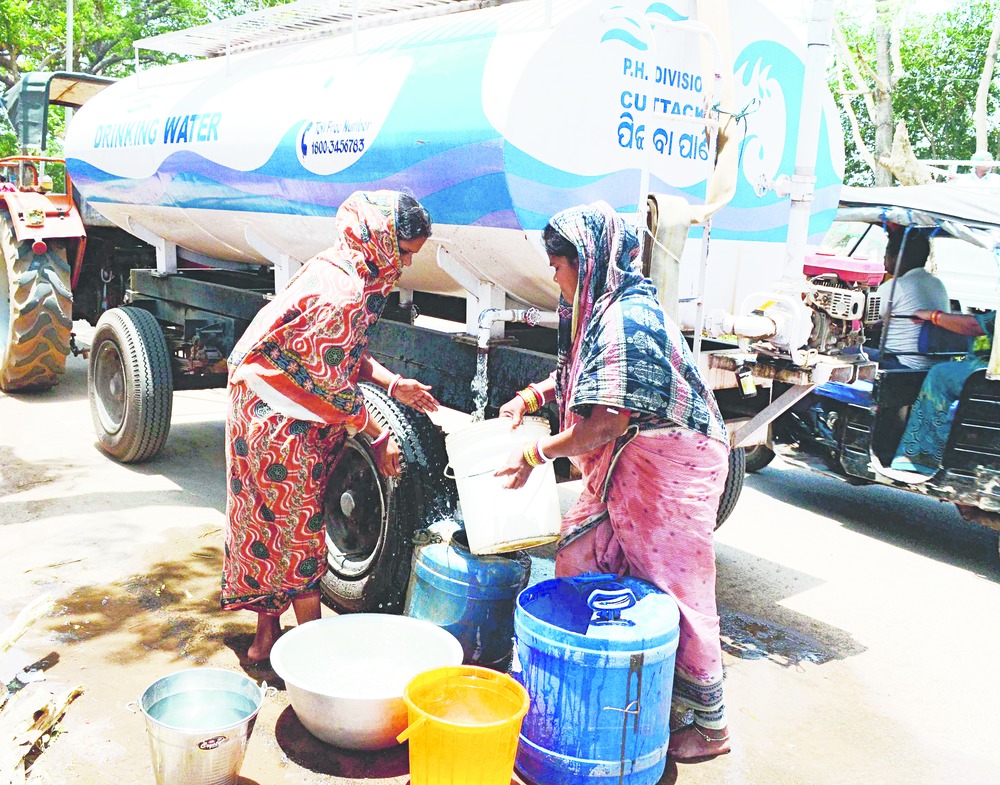
At a preparatory meeting held today, district collector Nirmal Chandra Mishra stressed on round-the-clock water supply through tankers in areas that had no pipeline network and fell in the Cuttack Municipal Corporation limits.
Official sources said adequate focus would be given in areas such as Jagatpur and Cuttack Sadar, where over 50 tankers would be pressed into service to supply drinking water.
At present, 101.29 million litres per day (MLD) of potable water is being supplied through 170 production wells that are installed across the city.
The drinking water (from ground water source) is supplied through a pipeline network of 582.24km. Of 59 wards, only 44 within the corporation limits are fully covered with piped water supply, while the remaining 15 partially covered - creating problems for Cuttack residents, especially in the summer months. "We have asked officials of the civic body as well as the public health department and other government agencies to complete repair of tube wells and make arrangements for smooth supply of drinking water at the earliest," said Mishra.
The administration has also asked the civic body officials to review its decision of installing plastic tanks at various places to provide drinking water in the city.
The corporation has been asked to set up jala chatras (traditional drinking water kiosks) using earthen pots to provide cool drinking water since water supplied through plastic tanks will not be fit for consumption during the day.
Earlier, the civic body had planned to install 50 additional plastic tanks at various parts of the city in addition with the 100 tanks that were used last year.
"We had planned to install plastic tanks with overhead covers to keep the water cool. We will shortly take a final call on the plan or switch back to earthen pots after discussion with senior officials," said the civic body's deputy secretary Nirmal Nayak.
The chief district medical officer and officials of the SCB Medical College and Hospital have also been asked to make arrangements to treat sunstroke patients. "We have made provision for 30 beds at the casualty ward for sunstroke cases. Besides, a 12-bed ward is being made at the medicine department, while two beds will be reserved at the paediatric ICU for sunstroke patients," said SCB superintendent Pratap Rath.