 |
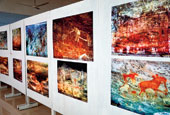
| Rock art images on display at Odisha State Museum in Bhubaneswar. Picture by Ashwinee Pati |
Bhubaneswar, May 21: The 3-D animation flick The Croods gave us an interesting insight into the artistic skills of aborigines with Papa caveman Grug imparting rock art lessons enthusiastically to his children.
But if you haven’t had the opportunity to watch the adventure comedy, there’s nothing to worry about. You can observe the evolution of carvings and scrapings over different eras at a rock art exhibition under way at the Odisha State Museum’s golden jubilee floor.
The exhibition, which has been organised by Indira Gandhi National Centre for the Arts in collaboration with Odisha State Museum, has been divided in two galleries. While one displays rock art of India, the other turns the spotlight on continents dabbling in this ancient art form.
Indian rock art, as depicted here, varies from region to region in tone and texture. The artwork in northern parts of the country such as Jammu and Kashmir was exclusively petroglyphic (a carving or line drawing on rock), especially one made by prehistoric people while those found in Leh and Ladakh exudes Buddhist affiliations. The eastern zone had characteristic monochromatic paintings. Pictures of geometric motifs and animal designs found in Sundergarh district of Odisha also adorn the cave walls.
While western India had abundance of anthropomorphic petroglyphs and paintings, south India was replete with animal figures from Neolithic age in states such as Andhra Pradesh and Karnataka and megalithic burials in Tamil Nadu.
The art and culture of Rathwa (Gujarat), Warli (Maharashtra) and Lanjia Saora (Odisha) tribes also grabbed eyeballs. “The exhibition is indeed a repository of knowledge. It helped a great deal in understanding rock art of different regions. It clarified my perception about a lot of things,” said Sushmita Naik, who is pursuing MPhil in history at Utkal University here.
Similarly, pictures and replicas put on display in the other gallery narrates how rock art was found in the dense forest of Indonesia, arid deserts of Sahara, deep caves of France, steep canyons of California, open grounds of Australia and other nook and corners of the world. It showcased artworks as simple as geometrical lines, from the panaramitee tradition of Australia to proper designs of Chumash people of California.
Superintendent of the museum P.K. Rath believes that the exhibition will create awareness about rock art among the citizens. “Odisha’s rich collection of pre-historic rock art is our heritage and needs to be preserved,” said Rath.
School and college students are visiting the exhibition in hordes, even on weekdays. The exhibition that commenced on the occasion of International Museum Day on May 18 is on till June 23.