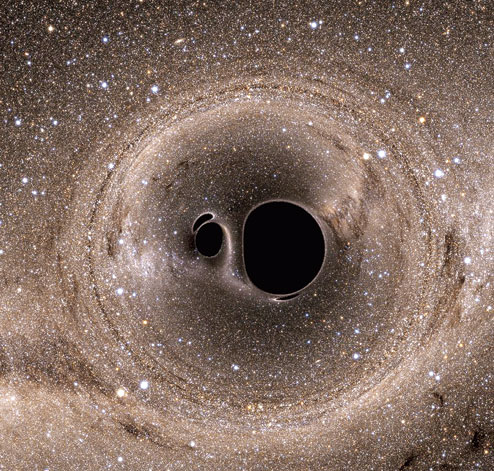

Feb. 12: Detection of gravitational waves, or ripples in the fabric of space-time, has confirmed a prediction made by Albert Einstein 100 years ago and opened a new window to observe hitherto invisible exotic events in the universe.
In synchronised announcements an international consortium of physicists revealed that the waves were produced in the final fraction of the merger of two black holes in a distant part of the universe. A black hole is a remnant of a massive star that has exhausted its fuel and collapsed into an object with such a strong gravitational pull that even light cannot escape it.
Some scientists described the sound - after converting the gravitational wave signal into audio waves - as "a fleeting chirp" that apparently can be reproduced on a piano.
Learn how to do it and more from the following questions and answers:
Why is the announcement so big?
This is the first-ever direct observation of gravitational waves, something Einstein had predicted in 1916 but had never been observed until now. Gravitational waves emerged as a spin-off from the mathematics of Einstein's general theory of relativity.
The other reason why the detection of gravitational waves is such a huge event for astronomers and physicists is that it opens up a new way to observe the universe, to look at exotic objects and events that are invisible to even the best of present-day telescopes.
Wait a minute, what is the general theory of relativity?
It is a complex theory of the universe that Einstein put forward in November 1915.
The theory demands some sophisticated mathematics, but essentially proposes that mass can distort space and time, just like a heavy load pushes down on a spring mattress. Space and time thus behave like a jelly-like substance that can stretch and bend under the influence of mass.
What are gravitational waves?
Gravitational waves may be described as ripples that flow across the fabric of space-time, just as waves flow across the surface of a pond. The difference is that the displacements of space caused by the gravitational waves are so extremely tiny that they need to be measured in dimensions that are smaller than billionths of the size of an atom.
What is the connection between the general theory of relativity and gravitational waves?
The general theory of relativity predicts the existence of gravitational waves. Several other predictions of the theory such as the ability of massive objects to bend light have already been observed. Gravitational waves have been the only prediction of the theory that remained unconfirmed - until now.
What produced the gravitational waves that were detected?
The collision and merger of two black holes. About 1.3 billion years ago, two black holes, one with a mass of about 29 times the mass of the Sun, the other about 36 times the mass of the Sun, collided.
Although the collision took place 1.3 billion years ago, it was so far away that the waves reached us only on September 14, last year.
How were the gravitational waves detected?
Two behemoth instruments - giant arrays of mirrors, lasers and control systems - in the US, one in Hanford, Washington, the other in Livingston, Louisiana, did it. The instruments sensed the gravitational waves as they passed through the Earth on September 14, 2015. The instruments are designed to sense the feeble ripples, or the displacements in space smaller than billionths of the width of an atom.
Was there some sound or something?
No. The instruments detected remarkably small vibrations from the passing gravitational waves. After detecting the gravitational wave signal, the scientists said they converted it into audio waves and were able to listen to the sounds of the two black holes merging.
Writing in The New York Times, Dennis Overbye, a science writer specialising in physics and cosmology, described the audio-wave sound as "a fleeting chirp that fulfilled the last prophecy of Einstein's general theory of relativity".
If replicated by future experiments, that simple chirp, which rose to the note of middle C before abruptly stopping, seems destined to take its place among the great sound bites of science, ranking with Alexander Graham Bell's "Mr. Watson - come here" and Sputnik's first beeps from orbit, Overbye writes.
Here's something for musicians: Rainer Weiss of MIT said you could reproduce the chirp by running your fingernails across the keys of a piano from the low end to middle C.
Who discovered the gravitational waves?
A consortium of over 900 scientists and research scholars worldwide that calls itself the Laser Interferometer Gravitational-Wave Observatory (Ligo) scientific consortium. The Ligo laboratory operates under two institutions, California Institute of Technology (Caltech) and the Massachusetts Institute of Technology. <>The hardware for the detectors has come from the US, the UK and Germany. "The field of gravitational wave astronomy is now a reality," said Gabriela Gonzalez, professor of physics and astronomy at the Louisiana State University in the US.
Physicists are anticipating even more exciting discoveries in the future. "We've been dreaming about this a long time," said Daniel Holz, associate professor of physics at the University of Chicago. "This truly opens a new chapter in physics."
New discoveries involving exotic objects and events could lead to new understanding of the laws that govern the universe.