 |
During the first quarter of the 19th century, the East India Company’s activities in Assam increased and from 1826, after signing the Treaty of Yandaboo, the British began annexing Assam in phases. This brought some officials and soldiers — Christian by faith — to this area. Till then there had been no Christian missionary activity. It was at the request of David Scott, the Commissioner of Assam, that the British Missionary Society (BMS) set up a Mission Centre in 1829 in Guwahati.
A young Scottish gentleman named James Ray was appointed to look after the centre. Ray opened a school at the centre with 12 students. But he could not continue for long due to a number of constraints. In 1836, when the American Baptist Foreign Mission Society (ABFMS) came to Assam, BMS donated its land and property, at the heart of town at Panbazar, facing the Brahmaputra to the newcomer. The centre was now expanded to hold an occasional prayer. But no full-fledged church still. When Miles Bronson visited Guwahati in 1837, he could not meet any member of any church in the town.
In 1839, the Diocese of Calcutta requested Major France Jenkins, the Political Agent to the Governor General in Assam to take “appropriate measures for performance of baptism and marriage by public officers.” On January 26, 1845 the representatives of Christians of Nagaon, Sivasagar and Guwahati assembled at Guwahati. Some were recent converts. Among them was present Nidhi Levi Farwell, the first Assamese to embrace Christianity. In their presence was established the first church in the Mission Complex. Thus the first Baptist Church of the entire Northeast came into existence.
Cyrus Barker, a missionary, was appointed the first pastor of the Church and served for five years. Kandura Rollin Smith, from the Nagaon Baptist Mission orphanage was its second pastor, the third and the fourth being Samuel Loveday and Levi Farwell respectively. The Church started with 30 members but by the end of the first year its membership rose to 70. The next two decades proved very fruitful. Its activities and membership strength grew making the Church the nerve-centre of the Christian society of the town.
From the very beginning, Bible classes were held regularly along with Theology in the Church premises. The first Assamese Bible, which was printed at the Serampore Mission, was used in these classes. The translation was by one Krishna Pal, the first Indian Baptist Christian who had visited Assam in the 1830s.
Kandura Rollin Smith introduced Assamese Christmas carols at this very church. His was an interesting and blessed life. He had grown up at the Nagaon orphanage and embraced Christianity in 1849. Kandura became a disciple of the legendary Miles Bronson. A good singer himself, Kandura also composed a number of prayer songs, which remain popular even today. Kandura not only composed the first Christmas carols in Assamese, he popularised them and collected a lot of Biblical literature as well.
Three beautiful bungalows — the oldest bungalows of Guwahati — were constructed on the church premises by SAD Boggs, who came to Assam on a philanthropic mission. The Church also established a letter press, possibly the first in town, in its compound. Some of the school books and books of prayer songs along with the Gospel were printed at this press.
On June 6, 1897, tragedy struck when the church was razed by an earthquake. A new church was built. It was wooden (Assam-type) with tinned roof. The structure is still in existence inside the Mahendra Mohan Choudhury Hospital complex. But that being a makeshift arrangement, plans were chalked out to construct a new building to suit the needs of the time. Two missionaries — G.R. Campher and A.E. Stephene — took initiative in this regard. The Kamarpatty end of the mission premises where the press was situated, was selected as the new site. The press was dismantled and the machines were sent to Jorhat. Some Chinese carpenters along with a local youth named Anandi were engaged for the construction that was carried out under the personal supervision of Campher in 1914. Next year, Levi Farwell was appointed the new pastor of the church.
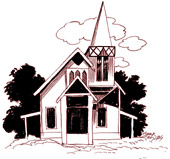
When construction of the new building was completed, it became one of the major attractions for the citizens and visitors to Guwahati. Its cylindrical and cone-shaped top made it the tallest and the most brilliant structure of Guwahati at the time. When its bells tolled, they could be heard for miles around. The music from the church organ filled the air From the decks of the ships passing through the Brahmaputra, flowing nearby, the church looked like a lighthouse set on a full beam of life.
The Guwahati Baptist Church has served as the mother church in the region. The dedicated efforts of its early pastors like Barker and Kandura did not go in vain. Kandura is probably the first Assamese whose biography has been written by an American lady, way back in 1892. The Wonderful Story of Kandura by Sofia Bronson Titerington and published by the American Baptist Publication Society is now at the Library of Congress in Washington.
The Church still stands at the Panbazar-Fancy Bazar junction with its great legacy where the Christians assemble to offer their prayers at the Cavalry Cross — the symbol of redemptive love.
Its well-ventilated high ceilings, criss-crossed by wooden rafters still keep the summer heat at bay and the faithful feel the presence of God in its serenity.
The message of peace and love found its abode as a scarlet fountain in this Guwahati Church when 160 years ago some blessed souls accepted Jesus Christ as their saviour and Lord.
Dipankar Banerjee