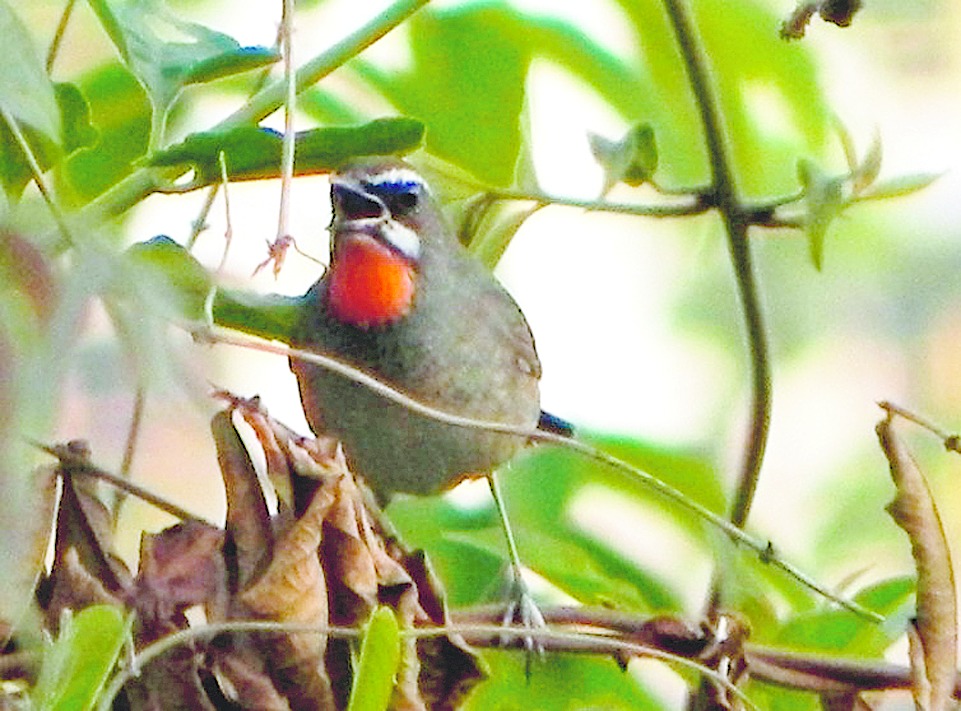

Silchar, Feb. 5: Assam University's Silchar campus has become a favourite destination for both migratory and local birds.
The presence of altogether 73 different species, belonging to 56 genera, 32 families and 13 orders, was recorded during a study on avifaunal diversity on the varsity campus.
The study, published in Journal of Threatened Taxa, an international journal of conservation and taxonomy in January, was conducted by Biswajit Chakdar and Parthankar Choudhury of the department of ecology and environmental science, and Hilloljyoti Singha of the varsity's centre for biodiversity and natural resources conservation. The research was carried out from February to June in 2011.
Altogether 53 species, belonging to 44 genera, 28 families and 12 orders, were encountered on regular basis in the four different habitats on the campus. Of these, six species were exclusively winter visitors, one was a migrant and the remaining 66 were residents, including occasional winter visitors and local and altitudinal migrants.
The red-vented bulbul ( Pycnonotus cafer), spotted dove (Streptopelia chinensis) and the red-whiskered bulbul ( Pycnonotus jocosus) were the most abundant and frequent species found on the campus. In addition to this, the researchers recorded the occasional presence of 20 more species.The researchers selected four different habitats - gorge, eco-forest, degraded area and secondary growth area - on the varsity campus to compare the avifauna. The highest number of species was found in the eco-forest habitat (36 different species) and the lowest in the degraded area (19 species).
Cattle egret, small blue kingfisher, Indian pond-heron, common snipe, white-breasted waterhen and grey-backed shrike were seen in the gorge habitat that is characterised by a narrow deep strip of 1km, flanked by two perpendicular hilly slopes. The golden-fronted leafbird, common hoopoe, fulvous-breasted pied woodpecker, coppersmith barbet, Hodgson's scimitar-babbler, large yellow-naped woodpecker, red-breasted parakeet and common hill-myna, among others, were recorded in eco-forest, a remnant of a hill forest.
Spotted munia and house sparrow were seen in degraded area which had a few trees, while chestnut-headed bee-eater, emerald dove, pied harrier, and spotted owlet were seen in secondary growth area, which did not have any tree, within the campus.
The common hill-myna ( Gracula religiosa), red-breasted parakeet (Psittacula alexandri), rose-ringed parakeet ( Psittacula krameri), blue-throated barbet (Megalaima asiatica), coppersmith barbet ( Megalaima haemacephala) are some of the species that were seen making nests in tree holes.
The study stated that the availability of diversity of birds in different habitat types represented the importance of university as a suitable habitat for birds. "The Assam University, Silchar campus is a remnant of forested area, having a mosaic landscape that provides different habitats for the diverse communities of birds," the study said.
It recorded some migratory species which are rarely found in this region.
"Considering the rich diversity of avian species in heterogeneous habitats on the Assam University campus, the remnant forest area should be kept out of development activities. Our study has revealed that because of heterogeneous habitats within the campus, Assam University, Silchar, holds a high avian diversity," one of the researchers said.