Jaishankar discusses West Asia war, global economy with US Secretary of State Marco Rubio
External Affairs Minister S Jaishankar on Monday spoke to US Secretary of State Marco Rubio focusing on the consequences of the West Asia conflict on the global economy.
The Jaishankar-Rubio phone conversation came hours after US President Donald Trump extended Washington's deadline for Iran to reopen the Strait of Hormuz by five days.
"Our discussions focused on the West Asia conflict and its impact on the international economy. We particularly spoke about energy security concerns. Agreed to remain in touch," the external affairs minister said in a social media post on his conversation with Rubio.
Pakistan PM Sharif holds talks with Iran President Pezeshkian, urges de-escalation in West Asia war
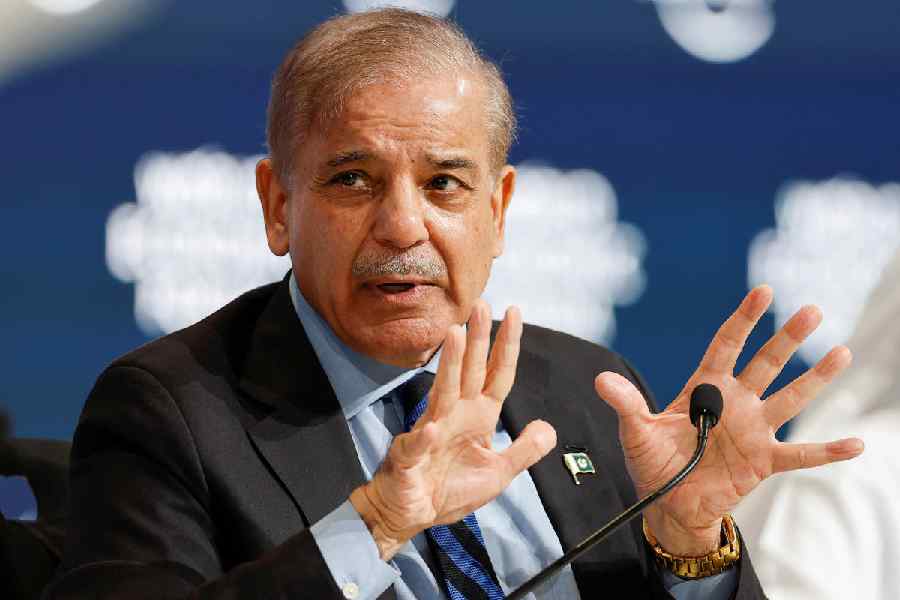
Pakistan Prime Minister Shehbaz Sharif on Monday in a telephonic conversation with Iran President Masoud Pezeshkian stressed the urgent need for collective efforts for de-escalation in West Asia.
The Prime Minister’s Office (PMO) said in a statement that Sharif conveyed his “serious concern” to Pezeshkian over the “dangerous ongoing hostilities in the Gulf region”.
The West Asia crisis began on February 28 when the US and Israel attacked Iran, which sparked a conflict.
“In view of this grave situation, the prime minister underscored the urgent need to work collectively for de-escalation and a return to dialogue and diplomacy amongst all the neighbouring countries to settle their differences,” the statement said.
Sharif stressed upon the “critical importance of unity in the ranks of the ummah, that is required more than ever before”, the statement added.
It further stated that Sharif “assured the Iranian leadership that Pakistan would continue to play a constructive role in facilitating peace in the region”.
“As a neighbouring brotherly country of Iran, the prime minister conveyed Pakistan’s solidarity with the brave Iranian people in the wake of the ongoing hostilities,” the statement said.
Sharif also extended Eid-ul-Fitr and Nowruz greetings to the Iranian president and the people of Iran, the statement added.
Iranian official says US sought talks with parliament speaker, Qalibaf says no negotiations yet
Iran's parliament speaker has denied that there have been any negotiations with the United States.
Mohammad Bagher Qalibaf wrote on X that "No negotiations have been held with the US, and fake news is used to manipulate the financial and oil markets and escape the quagmire in which the US and Israel are trapped."
His post on Monday came after a senior Iranian official told Reuters that the US had requested a meeting with Iran's parliament speaker, Mohammad Baqer Qalibaf, on Saturday, without mentioning any proposed venue.
The official, who asked not to be identified due to the sensitivity of the matter, said the Supreme National Security Council had yet to decide on any proposed talks and Iran had yet to respond.
US President Donald Trump had earlier claimed that Iran was eager to make a deal and that US envoys were talking to a "respected" Iranian leader.
US in talks with Iran’s Parliament Speaker Qalibaf, Israeli official says
The US is holding negotiations with Iran’s Parliament Speaker Mohammad Bagher Qalibaf, an Israeli official said, echoing recent claims by President Donald Trump that talks are underway even as Tehran denies any direct contact.
EasyJet CEO warns of airfare hike, shift in bookings as Iran war hits eastern Mediterranean travel
Discount airline easyJet's CEO said on Monday that ticket prices will rise towards the end of the summer due to the Iran war, adding that the conflict was driving bookings to destinations like Spain and away from Turkey and Cyprus.
The British carrier has hedged the majority of its fuel needs for the coming months but by the end of the summer those hedges start to come off and, depending on the fuel price then, ticket prices could jump.
"The reality is that prices will start feeding through to the consumer towards the back end of the summer," CEO Kenton Jarvis said, as the airline opened a new base at Newcastle Airport in northeast England.
The war, now in its fourth week, has already impacted bookings, Jarvis said, with customers clearly moving away from booking trips to Turkey, Egypt and Cyprus, the island where a British military base was hit by an Iranian-type drone in early March.
"Eastern Mediterranean less popular, west Mediterranean more popular," he said, adding that easyJet had not yet made any capacity changes but could reduce the frequency of flights to destinations served by multiple daily flights.
Jet fuel accounts for about a third of airline costs and Air France-KLM and SAS have already said they will have to hike ticket prices, while Finnair has warned that jet fuel supplies may run out due to the effective closure of the Strait of Hormuz.
EasyJet said in January it had hedged 84% of its fuel needs for the first half of 2026, 62% for the second and 43% for the first half of 2027, at an average cost of $715, $688 and $671 per metric ton, respectively.
For now, Jarvis said he saw no issues with supply and easyJet was dealing with fuel price volatility through "business as usual management through cost."
"The market sees prices coming down. Will it come down to where it was before? ... I don't know," he said, noting that fuel for delivery in six months was still available for under $1,000, despite a spot price around $1,800.
With the situation still "very unpredictable", it was unclear how the conflict would shape longer-term demand, he said, adding that following the outbreak of the Ukraine war there was a six-week drop in booking volumes.
Iran war hits F1 race calendar, Liberty Media shares fall, but analysts see recovery
The Middle East conflict has cut Formula One’s race calendar and battered the share price of its owner Liberty Media, but market analysts believe both will ride out the crisis with long-term prospects intact. Since U.S.-Israeli strikes against Iran began on February 28, the U.S. firm's shares have slid 11.7% - about double the overall global drop - and lost $2.46 billion in market capitalisation while the Bahrain and Saudi Arabia Grands Prix have been cancelled. However, with F1 media revenue seemingly intact, the war hoped to be only short-term, and Middle Eastern nations likely to offer extra incentives to keep races in the region, both the sport and Liberty Media need not panic, analysts said.
"I think it’s a big overreaction ... the stock is discounting a loss of these events seemingly for many years," said Lance Vitanza, a managing director and senior analyst for U.S.-based investment bank and financial services TD Cowen who tracks Liberty. The media, sports and entertainment company, led by new Chairman Robert Bennett, bought F1 in 2016 for $4.4 billion. Liberty's portfolio also includes MotoGP, which rescheduled its Qatar Grand Prix from April to November due to the war.
F1's now reduced, 22-race calendar will mean no revenue hike from last year where income jumped 14% to $3.9 billion, according to Liberty's fourth quarter and year-end 2025 results.
The cancelled Saudi Arabia and Bahrain Grands Prix had been estimated to contribute $118.5 million in race promotion fees and $93.7 million in allocated sponsorships, according to the research and brokerage unit Bernstein.
But despite those losses, the single-seater franchise should still pocket its revenue from media rights.
“The way the contracts work, they (F1) likely won’t receive a (race) promotion fee for these two events. They can mitigate a bit of that because the media rights portion of the race economics is separate, but it’s going to be hard to fully recoup sponsorship as well,” Ian Moore, an equity research analyst from Bernstein, told Reuters.
As long as F1 delivers over 16 races, they will still receive media rights payment given the multi-year agreements in place with broadcasters, he said.
Liberty Media did not respond to a request for comment.
In markets, there is also optimism the conflict, albeit in its fourth week, will be a one-off anomaly for F1 and its owner.
"There is a solid argument that this entire Iran conflict is potentially a clearing event that removes geopolitical volatility from the region on a more permanent basis, meaning you're potentially not going to have disruptions like this recur longer term," said Moore.
And once security is restored, the Middle Eastern countries with an F1 circuit should be looking to rebuild tourism and restore their image with potentially higher promotion fees and other incentives for motor sports events in the region.
TD Cowen's Vitanza said that lower revenues in 2026 than last year could be a springboard for "dramatic growth" in 2027.
"I think years from now, Formula One will almost certainly be unaffected by the fact that maybe a race or two was cancelled this year," added Peter Supino, a managing director and senior analyst of New York-based Wolfe Research.
"Investors in general agree that Formula One is a really good business with a bright future, and that Formula One's cash flows and revenues are going to grow."
Trump says Iran wants to 'make a deal', talks underway; Tehran rejects claim
US President Donald Trump has said Iran wants "to make a deal" and claimed US envoys have been holding talks with a "respected" Iranian leader. The president also said he does not consider Mojtaba Khamenei as Iran's supreme leader.
Earlier, Iran's foreign ministry rejected Trump’s claim of talks between Washington and Tehran. However, an Axios reporter said Iran’s foreign ministry acknowledged “initiatives” to reduce tensions. He added that Turkey, Egypt and Pakistan had met White House envoy Steve Witkoff and, separately, Iranian Foreign Minister Abbas Araghchi, according to Reuters.
Iran’s foreign ministry, led by Araghchi, has previously called Trump’s remarks an effort to lower energy prices and buy time for military plans.
Citing an unnamed source, Iran’s Fars News Agency said Trump had retreated after hearing that Iran would respond by attacking power plants in the region.
Trump told reporters Monday that his Middle East special envoy Witkoff and his son-in-law Jared Kushner conducted talks Sunday into the evening. He said talks would continue today.
Israel must extend its border to Litani: Minister hints at seizing Lebanese territory
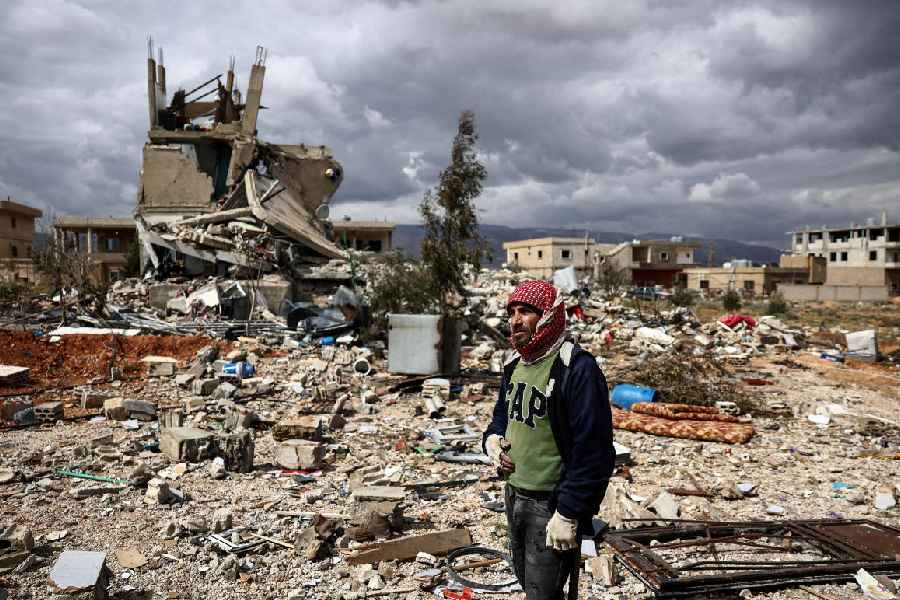
Israel should extend its border with Lebanon up to the Litani River deep inside the country's south, Israel's finance minister said on Monday as Israeli troops bombed bridges and destroyed homes in the area in an escalating military assault.
The comments by Finance Minister Bezalel Smotrich were the most explicit yet by a senior Israeli official on seizing Lebanese territory in a fight Israel says targets Iran-backed Hezbollah militants.
Lebanon was pulled into the regional war on March 2 when Hezbollah fired missiles into Israel. Since then, Israel has ordered all residents to leave the area south of the Litani River as it pummels the area with air strikes, viewing it as a Hezbollah stronghold.
Lebanese authorities say the Israeli air and ground assault has killed more than 1,000 people, and more than a million have been driven from their homes with Israel having ordered residents to flee swathes of the country.
Smotrich told an Israeli radio program that the military campaign in Lebanon "needs to end with a different reality entirely, both with the Hezbollah decision but also with the change of Israel's borders."
"I say here definitively...in every room and in every discussion, too: the new Israeli border must be the Litani," Smotrich said.
Smotrich, leader of a small far-right party in Prime Minister Benjamin Netanyahu's cabinet, often makes comments that go beyond official Israeli policy.
Netanyahu's office did not immediately respond to a request for comment on the remarks. Defence Minister Israel Katz hinted earlier this month at plans to capture land, saying Lebanon could face "loss of territory" if it did not disarm Hezbollah.
Smotrich's remarks were deeply resonant in Lebanon, which is trying to emerge from a decades-old cycle of invasions and occupations by its neighbour. Israeli forces have launched repeated assaults on Lebanon since 1978 and occupied the south from 1982-2000.
A Lebanese official told Reuters that Beirut was still counting on foreign powers to put enough pressure on Israel to put an end to the war, through an offer from President Joseph Aoun to hold direct talks.
Smotrich also called for Israel to annex territory it now controls in the Gaza Strip, up to an armistice line with Hamas. A ceasefire signed in October left Israel in control of 53% of Gaza, where it has ordered residents out and bulldozed buildings.
The Israeli military says its troops in Lebanon are carrying out ground maneuvers and targeted raids on Hezbollah militants and weapons stores, aimed at protecting residents in northern Israel from Hezbollah fire.
The Lebanese government has outlawed Hezbollah military activity and said it wants to engage in direct talks with Israel.
Over the weekend, Israel struck a main bridge linking south Lebanon with the rest of the country after ordering its military to destroy all crossings over the Litani River and to step up the demolition of homes near the southern border.
International law generally prohibits militaries from attacking civilian infrastructure, and the United Nations human rights chief has criticised Israel's actions in Lebanon, particularly its use of widespread evacuation orders.
Israeli strikes hit two more crossings on the Litani River on Monday -- a road running near a main bridge hit on Sunday and another small bridge on another section of the river.
Hanna Amil, the mayor of Christian border town Rmeish whose residents have refused to leave their homes, told Reuters that it was getting increasingly difficult to move around.
"Once or twice a week, a convoy from the Lebanese army accompanies us as we try to get basic goods from nearby areas," he said.
"Already, we have no state electricity, no water and we have diesel shortages. If all the routes to the north get cut off, who knows what the future could hold for us," Amil said.
German chancellor 'grateful' to Trump for postponing strikes on Iran's power plants
German Chancellor Friedrich Merz said that he had spoken to U.S. President Donald Trump on Sunday and expressed his concerns about threatened attacks on Iran's power plants.
"I am grateful that he said today that he is postponing them for another five days and is now also opening the possibility for immediate and direct contact with the Iranian leadership," said Merz at a press conference in Berlin on Monday.
Iran's Tasnim, citing official, says Hormuz won't return to pre-war conditions
Iran's Tasnim news agency, citing an Iranian official, said that the strait of Hormuz will not return to pre-war conditions and energy markets will remain unsettled, adding that no negotiations with the US are under way.
Tasnim said US President Donald Trump backed down from attacking critical Iranian infrastructure amid financial market pressure, warning Tehran would continue to defend itself until it achieves deterrence.
Israeli military says it is conducting strikes in Tehran
The Israeli military said on Monday it is conducting strikes in Tehran, after US President Donald Trump said the United States and Iran had held talks and that he would postpone any strikes on power plants and energy infrastructure.
Iran state media, embassy claim trump ‘backed down’, deny any US talks
Iran's Fars news agency, citing a source, said there are no direct or indirect communications with the United States, despite US President Donald Trump's recent statement about "productive" talks with Tehran.
Fars also said Trump backed down on targeting Iranian power plants after Iran warned it would target power plants across West Asia in response.
Earlier, Iranian state television on Monday offered Tehran's first reaction to US President Donald Trump's decision to extend a deadline for reopening the Strait of Hormuz by five days.
Reacting to the news, Iranian state television said in a graphic on screen: "US president backs down following Iran's firm warning."
The Iranian embassy in Kabul, Afghanistan, reacted to Trump’s message delaying strikes on Iranian nuclear plants. The embassy said that Trump refrained from attacking after “Iran’s stern warning”, reports Al Jazeera.
First Israeli civilian killed in Lebanon border war was hit by Israeli fire
Israel said on Monday its own forces had misfired artillery that killed an Israeli farmer near the Lebanese frontier, the first Israeli civilian killed in a border conflict being waged in parallel with the war in Iran.
Ofer Moskovitz, 60, an avocado farmer in the town of Misgav Am, had spoken with Reuters just last week and said he was worried about the fighting at the border.
In a statement, Major General Rafi Milo, who heads the military's northern command, said: "Moskovitz was killed by our own forces’ fire during an operation whose entire purpose was to protect them."
The military had initially blamed cross-border fire from Lebanon when it first reported the incident on Sunday.
Israel has launched a major ground assault and air campaign into Lebanon to root out Hezbollah, a powerful Iran-backed militia, which fired into Israel in support of Tehran two days after the start of the Israeli-U.S. air attacks on Iran.
Lebanese authorities say more than a thousand people have been killed and more than a million driven from their homes in Lebanon. The death of Moskovitz was the first reported in Israel. The military says two Israeli soldiers have been killed in combat.
"Every five minutes you can hear the bombs," Moskovitz told Reuters last week.
The military's statement said troops had opened fire to support soldiers operating in southern Lebanon, but "severe issues and operational errors" had taken place.
"The artillery fire was carried out at an incorrect angle and did not follow required protocols," it said. "As a result, five artillery shells were fired at the Misgav Am ridge instead of toward the enemy target."
Briton held in Iran urges UK PM Starmer to publicly reject spying accusation
A British man detained in Tehran urged Prime Minister Keir Starmer on Monday to "step out of the shadows" and publicly deny the spying charges against him and his wife, who fear for their lives more than three weeks into the U.S.-Israeli war on Iran.
Craig Foreman and his wife Lindsay were sentenced to 10 years in prison in February after Iran accused them of spying for Britain and Israel. The couple have repeatedly denied the charges.
In a voice message recorded from Evin prison in Tehran and shared with Reuters, Craig Foreman said he and his wife were living in a "war zone" and accused the British government of failing to defend their innocence.
He said the couple felt "let down, alone and completely frustrated by the lack of public defence by the people in charge of the government".
"You know we are innocent," he said. "Go public with the information you have, to clearly step up, step out of the shadows and help us. Our lives are constantly at risk."
Tehran has been hit repeatedly by U.S. and Israeli airstrikes. A blast near the jail blew out window panels and sent prisoners diving under beds for cover.
Craig Foreman said the couple had received "zero information" from the British government about what to do if conditions deteriorated further.
Britain's foreign ministry reiterated in a statement that the sentences were "totally unjustifiable" and said the welfare of British nationals detained in Iran was a priority.
"We will continue to pursue this case relentlessly with the Iranian regime until we see Craig and Lindsay safely returned to the UK and reunited with their family," a spokesperson said.
Israel military says friendly fire killed civilian near Lebanon border
An Israeli civilian killed on Sunday on the Lebanese border dies as a result of friendly fire and not from a rocket attack from Hezbollah, the Israeli military said on Monday.
Initial findings indicate that the man, Ofer Moskowitz, was killed by artillery fire that was carried out to assist forces operating in southern Lebanon, the military said.
UK sees no evidence of Iran targeting Britain, says Starmer
British Prime Minister Keir Starmer said on Monday there had been no assessment that mainland Britain was being targeted by Iran.
"We carry out assessments all the time in order to keep us safe, and there's no assessment that we're being targeted in that way," Starmer told reporters.
He was asked if Britain could be targeted by Iran after reports at the weekend that Iran had fired two ballistic missiles at the U.S.-U.K. military base Diego Garcia in theIndian Ocean.
Starmer also said that any attempt to reopen the Strait of Hormuz needed careful consideration and a viable plan, and that his number one priority was to protect British interests and de-escalate.
Kremlin says strikes near Bushehr nuclear plant in Iran are dangerous
U.S.-Israeli strikes near the Bushehr nuclear power plant in Iran are extremely dangerous and Russia has shared its concerns with the United States, Kremlin spokesman Dmitry Peskov said on Monday.
Such strikes could have irreparable consequences, Peskov said.
Iran says coastal attack will lead to full Gulf closure and mine-laying
An attack on Iran's southern coast and islands will lead to Gulf routes being cut with the laying of sea mines, the country's Defence Council said on Monday according to state media.
The U.S. is considering plans to occupy or blockade Iran's Kharg Island, the country's main oil export hub, to pressure Tehran to reopen the Strait of Hormuz to all shipping, according to Axios.
"Any attempt to attack Iran's coasts or islands will cause all access routes in the Gulf (...) to be mined with various types of sea mines, including floating mines that can be released from the coast," the statement read.
"In this case, the entire Gulf will practically be in a situation similar to the Strait of Hormuz for a long time (...) One should not forget the failure of more than 100 minesweepers in the 1980s in removing a few sea mines."
The Defence Council recalled that non-belligerent states can only pass through the Strait of Hormuz by coordinating passage with Iran.
China warns of 'vicious cycle' if war escalates in Middle East
China on Monday urged all parties involved in the Middle East conflict affecting the Strait of Hormuz to end military operations to prevent a "vicious cycle" and return to negotiations.
"Should hostilities continue to escalate and the situation deteriorate further, the entire region will be plunged into chaos," the Chinese foreign ministry spokesperson Lin Jian said when responding to a question about U.S. President Donald Trump pressuring Iran to reopen the key shipping waterway.
"The use of force will only lead to a vicious cycle," he said adding that the war should not have begun in the first place.
Israel's El Al Airlines says reviewing operations after government limits traffic
El Al Israel Airlines said on Monday it was reviewing its continued operations after the Transportation Ministry ordered a reduction of traffic at Ben Gurion Airport near Tel Aviv.
Israel's flag carrier, which has been operating repatriation flights since the outbreak of the U.S.-Israeli led air war with Iran on February 28, called on authorities to open Ramon Airport near the Red Sea city of Eilat as an alternative to Ben Gurion.