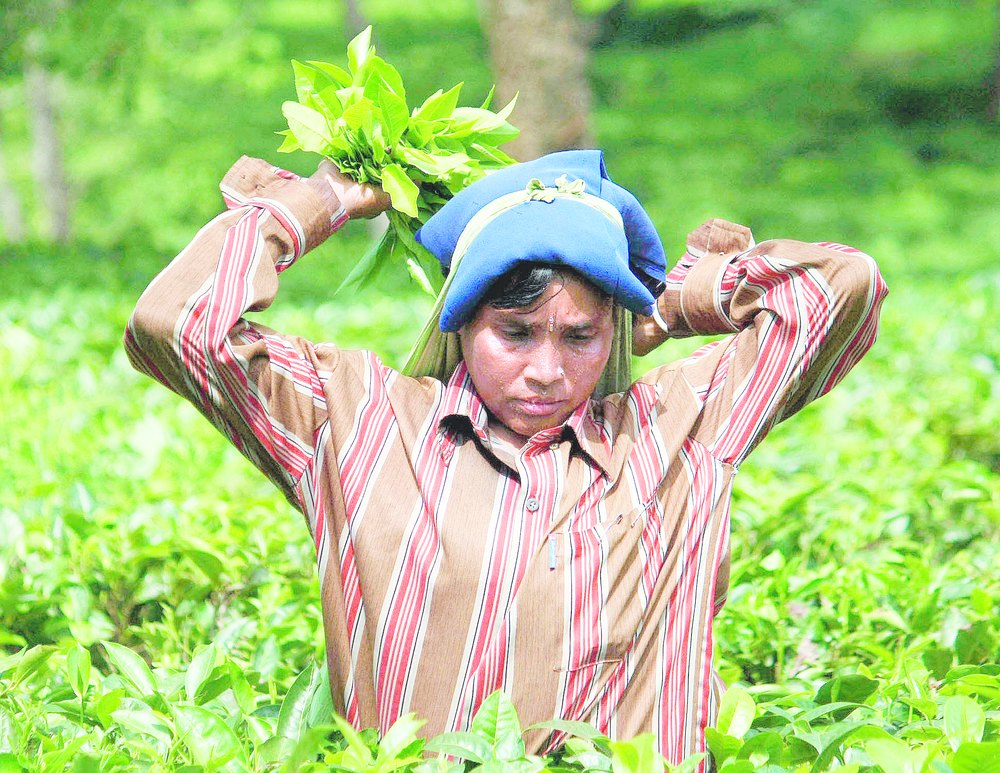

A woman plucks leaves at a tea garden in Assam.
File picture
Jorhat, Feb. 23: Experts voiced concern on the survival of the tea industry, and its opportunities and challenges at a session held on the margins of the Assam International Trade and Industrial Fair in here today.
The industry’s ability to sustain itself, with corporate houses like Tata Tea and Hindustan Unilever selling off and divesting their stakes in the plantations, was discussed at length.
Tea Research Association vice-chairman and planter P.K. Bezboruah, said the farmers would soon be left holding a declining industry.
He wondered if it would not be more profitable to simply take to marketing tea from Calcutta or elsewhere, as the two fast-moving consumer goods (FMCGs) industries were doing, after giving up growing tea.
“Hindustan Unilever has sold all its gardens in Upper Assam and Tata Tea is on the path of divestment, having divested into a new company Amalgamated Plantations Private Ltd, holding only a limited stake in north India and selling all its shares to workers in south India. Both are no longer bothered about growing tea but only in the marketing part,” Bezboruah said.
On the uncertainty of the tea market, Bezboruah said, “The auction, though transparent, is extremely unfair to producers and in 2014 when there was a 20-30 per cent loss in production because of weather vagaries, many companies held back hoping that prices would rise but instead of rising, it collapsed. And now when there is no tea being produced, the market has risen. There is no economics in this kind of variability.”
Suggesting that one of the ways in which planters could stabilise prices and have some insurance was marketing tea through futures and options, in which tea would be traded not as a commodity but as a tea price index. Futures imply trading on the price of a commodity or services at a particular time in the future.
For example, if tea is trading at Rs 80 per kg at present, in futures one buys if you think that it is going to go up and you sell if you think the price is going to go down.
In this kind of trading the buyer and seller are those who predict whether the price goes up or down, and there is no commodity, as in the share market. Bezboruah said this was not a new concept and had been given the nod by the Multiple Commodities Exchange (MCX) which deals in futures and options trading and also the BSE.
However, the United Planters’ Association of Southern India (UPASI) had not gone ahead because of the variability of tea from one season to another.
As the tea produced in June is totally different from that produced in September, prices could not be predicted accurately.
Bezboruah said one of the ways in which this problem could be circumvented was to take the auction index for that season — the average price of tea sold in the auction — and then fix the price.
Bezboruah said an individual could take up the project or maybe a company from the US could do this.
Assam Tea Planters Association chairman Raj Barooah said one way to sustain tea was to transform it from bulk commodity to a speciality product in the market. China is doing good business in European and US markets whereas India’s share is negligible.
Tea planter and former NETA chairman Manoj Jalan and the director of the Tea Research Association, N. Muraleedharan, spoke of the challenges faced by the industry, stressing on climate change, vagaries of weather and shortage of labourers.