 |
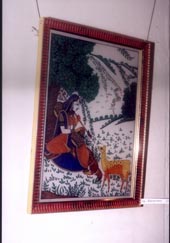
| A Rajasthani miniature by Sudepa Gupta. A Telegraph Picture |
Nov. 8: She has always been innovative. Now she is on a mission to popularise Assamese traditional art forms. And that, too, on plastic.
Meet painter Sudepa Gupta, aka Diya.
In her forthcoming solo exhibition, which will be her fourth, Gupta will bring the famous Assamese manuscript paintings on the innovative medium of plastic for the first time. Some of the other traditional art forms with which Sudepa experimented on plastic are famous Madhubani paintings, Rajasthani miniatures and Odissi tribal art.
As many as 40 works by Sudepa will be put on display at the art gallery of Srimanta Sankaradeva Kalakshetra, where minister of cultural affairs Gautam Bora will inaugurate the four-day exhibition at 4.30 pm on Friday.
Originally from Calcutta, Sudepa came to the city as her husband, Samrat Gupta, an official of the Indian Oil Corporation is posted here. She said she wanted to pay a “colourful” tribute to the rich cultural and artistic heritage of the state by depicting Assamese manuscript paintings, an art form developed during the rule of the Ahom dynasty, on sheets of plastic film.
Asked what quality in plastic attracted her to choose the unusual medium for her work, Sudepa said: “I always wanted to introduce innovative elements in my artworks. Though I work with traditional artforms, I never wanted to simply copy them. Plastic as a medium is not only easily available, but its tendency to hold and reflect colours is excellent.”
She uses translucent plastic films and permanent colour pens made in Germany for her work. A unique feature of her paintings is the way they are framed. The translucent plastic sheets mix the colour of the paintings with that of the wall on which they are hung to produce an exquisite hue.
A self-made artist, Sudepa has won several awards in different art competitions during her school and college days.
After her marriage, Sudepa has travelled to different parts of the country with her husband, who has a transferable job. Her first solo exhibition at Barauni in May 2003 was widely appreciated by both critics and connoisseurs. The famous Chitrakoot Art Gallery in Calcutta hosted her second exhibition — on women and nature — in December 2003. Following the success of her previous two exhibitions, she again received rave reviews for her third solo at the Academy of Fine Arts, Calcutta, in December 2005.
“Each of my exhibitions had a different theme and different media of paintings, but two things in common. One is the presence of traditional arts of not only India but also other countries like Egypt, Japan and China and the other is that they all reflected my optimistic character through the bright colours.”
“The traditional arts of India are generally done on handmade paper or on cloth. I have tried to present the same art forms on a new and innovative medium — plastic films. I believe that this it is the first time that the richness of Indian art is depicted on plastic sheets,” she added.
About the hue and cry against the use of plastic, she said: “My paintings are not something to be thrown away easily. Rather, they are meant to be preserved. So, how will they cause harm to the environment?”