
Pynursla, Nov. 20: Bolivia's ambassador to India Jorge Cardenas today inaugurated a garden aimed at preserving medicinal plants and named after former President A.P.J. Abdul Kalam in Meghalaya's remote Siatbakon village along the Indo-Bangladesh border.
The Dr A.P.J. Abdul Kalam Memorial Herbal Garden is located in the Wah Suri Khongdong-Wah Dieng Rod area on the way to Mawlynnong, the cleanest village in Asia, in East Khasi Hills district.
Cardenas, who is on a visit to Meghalaya since Wednesday, travelled to the village, about 55km from Shillong, today and spent the entire day there till dusk.
Before unveiling the memorial stone dedicated to Kalam, who passed away in Shillong on July 27 this year, in the herbal garden and planting a few medicinal saplings, the Bolivian ambassador also visited Mawlynnong in the morning.
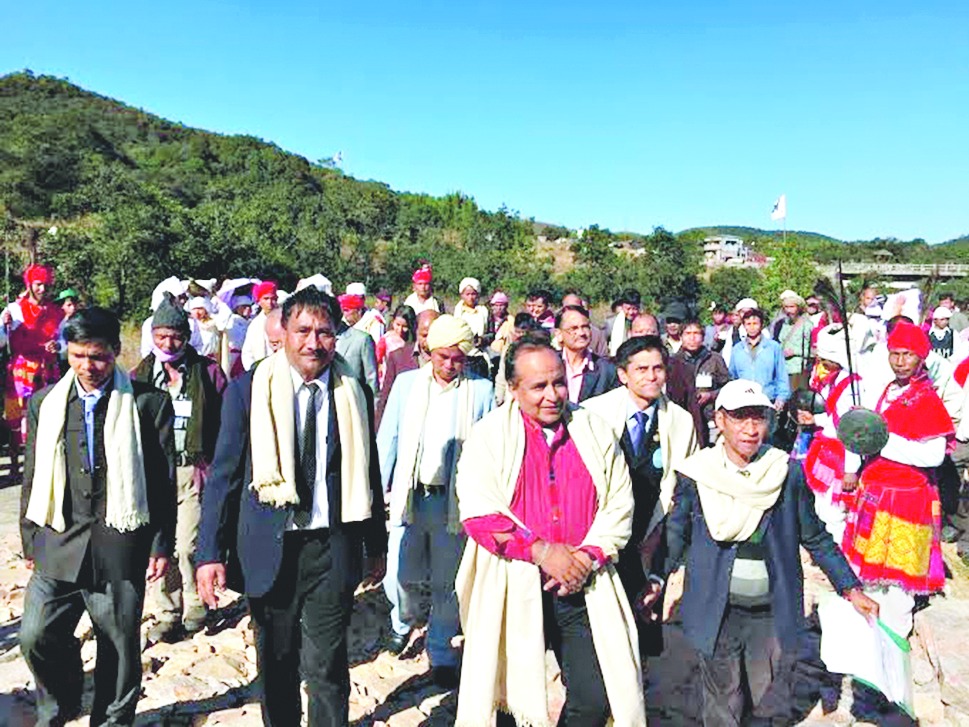
Traditional chiefs, including the Syiem (king) of Hima Khyrim, Balajied Sing Syiem, the convener of the conglomerate of the traditional chiefs of Meghalaya, Laborious Manik S. Syiem, elders and members of the clan Sawkur Khun Trai and villagers attended the programme. The land for the garden has been gifted by the clan.
However, no minister or senior officials of the Meghalaya government accompanied the Bolivian ambassador.
Traditional dances and songs performed at the event mesmerised the ambassador who at times stood up from his seat and danced to the beat of traditional musical instruments, including drums and flutes.
The troupes presented the ambassador gifts, including a ryndia tlem (traditional Khasi shawl) and a tangmuri (traditional wind pipe).
"I feel at home here. This place has many similarities with Bolivia, not only in terms of rich culture, nature and medicinal plants but the existence of indigenous tribal people as well. Bolivia has 60 per cent indigenous tribal population and our president Juan Evo Morales Ayma is our country's first president from the indigenous population," Cardenas told the gathering.
Expressing concern over the degradation of environment, he stressed on the need to preserve forests and refrain from destroying natural beauty.
Talking about the importance of herbal medicines and its usefulness in healthcare, Cardenas lauded the villagers for setting up the garden in the name of Kalam and hoped that it would provide a learning experience for people from all walks of life and promote research.
Ike Sinha, the national director of Unite4:good in India, remembered Kalam as people's and children's President, a renowned scientist with a vision and a person who loved nature and valued the preservation of environment, including medicinal herbs. He urged the state and the Centre to extend extensive support to further develop the garden.
The convener read out a declaration related to the garden. He said the garden measured 5,22,720 square feet and was owned by the clan Sawkur Khun Trai.
The garden will be looked after by the clan while the Meghalaya state medicinal plant board will extend technical support, including planting more species of medicinal herbs, and provide funds for improving the garden.
The chairman of Sawkur Khun Trai, Elkana Khongmawloh, said they had dedicated the garden to Kalam as the former President was concerned about the welfare of tribes, minority communities and the environment.
Speaking to reporters, Cardenas spoke of bringing herbal plants from Bolivia and "linking" the indigenous people of Meghalaya with the indigenous tribes of his country. "We have to link more than the species and we have to link the culture and the people," he said.
He said the tourist spots in Meghalaya, including Mawlynnong, were "very beautiful" and looked like the Andes range and Amazon in Bolivia. He said the most important thing was to respect nature and mother earth.