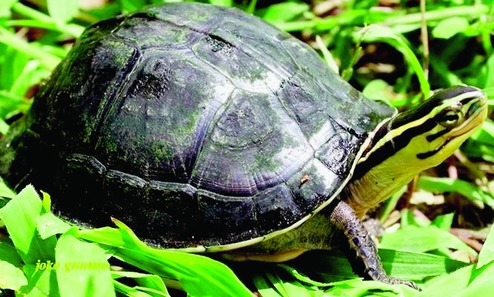

Guwahati, Aug. 5: A study on the sighting of a turtle species, Cuora ambofinensfis, for the first time in Barak Valley proves that the area is still rich in turtle and tortoise species.
The sighting was reported in the current issue of the Journal of Threatened Taxa, by scientists Kulendra Chandra Das of Mizoram University and Abhik Gupta of Assam University. The study was conducted from February 2002 to June 2007.
Cuora ambofinensfis, which known by different names such as Malayan box turtle, Southeast Asian box turtle and Ambofina box turtle, is widely found in a variety of habitats in the floodplains of the Brahmaputra.
In Barak Valley, the live specimens were recorded near Jirighat in Cachar district and the carapaces (a scientific term for protective shell) of the species were also recorded at Baliapunjee, a village adjoining the Longai river and Longai reserve forest in Karimganj district.
The species is semi-aquatic, inhabiting rivers, lakes, marshes, mangrove swamps and rice fields in and around lowland forests. These turtles bask on banks or on logs and breed during early monsoon. They lay one to six eggs which hatch 45-90 days later.
The authors say no intensive survey of semi-aquatic turtle fauna of Barak Valley has been conducted, apart from a couple of publications documenting onsite records of soft-shell turtles and tortoise species. The study was conducted with the objective of reporting the distributional status of Cuora ambofinensfis in the valley.
"The present records are from an area between these localities and fill the gap in the distribution of this species in the Northeast and Bangladesh. It is highly likely that this species is rarely seen in Barak Valley. However, the carapace records should be treated as possible sites where these turtles may be found and not as perfect site records. The villagers in this region hang turtle and tortoise carapace in their cowsheds and homes as they ascribe some magic and religious properties to them," the report says.
The study says the Barak Valley has an affluent pool of turtle and tortoise species. Both aquatic as well as forest-dwelling species are well represented but semi-aquatic species are least represented in this region and are encountered in a diversity of fragmented habitats. The study points out the urgent need for ex situ conservation of this species because of severe threats like fragmentation of habitats, shifting cultivation, illegal hunting or trade.
Therefore, it says, rare species like Cuora amboinensis, should be listed in Schedule I of the Indian Wildlife (Protection) Act, 1972. So far, this species is included under Appendix II of the Convention on International Trade in Endangered Species of Wild Fauna and Flora since 2000 (CITES 2017). This argument is justified by the inclusion of this species by the International Union for Conservation of Nature in the threatened "vulnerable" category.
The authors say the addition of this species in Schedule I of the wildlife act would aid in its conservation.