
Let's leave politics, godmen and JNU aside for now and look at the state of education in this country.
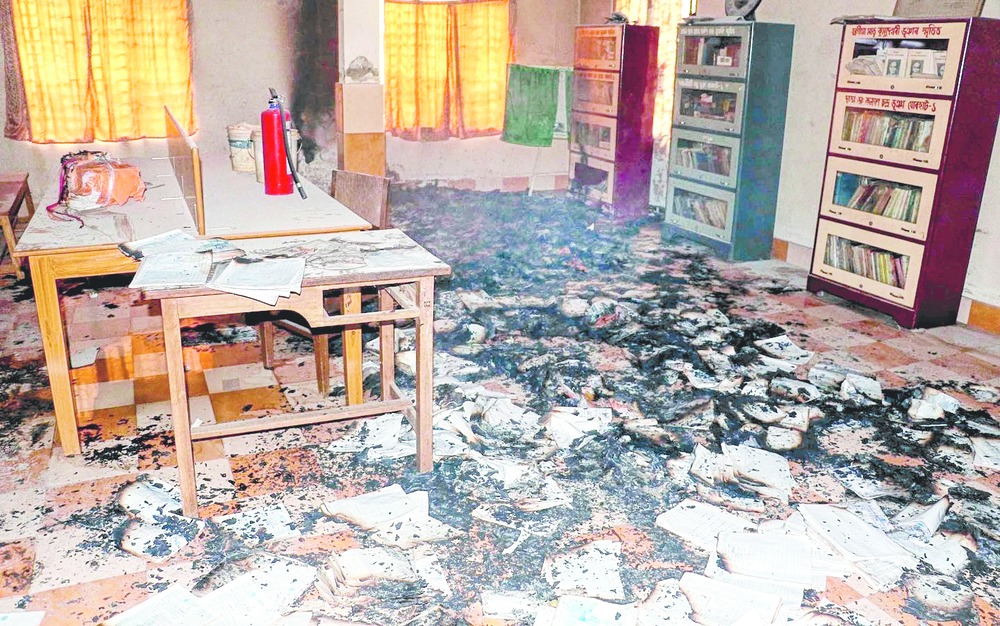
On March 3 , about 600 answer scripts of the Class X board examinations of Assam conducted by the Secondary Education Board of Assam (Seba) went up in flames and with them the hopes and dreams of hundreds of students. This happened at Sankardev Seminary High School in Jorhat. Naturally the incident evoked statewide protests as uncertainty looms large over the fate of those students whose answer scripts were charred. The Assam government has ordered a CID probe into the matter but this is not likely to assuage the feelings of those who had struggled hard and burnt the midnight oil with the hope of securing brilliant marks and carving out an academic future for themselves.
This incident is indicative of a system that continues to fail its citizens; in this case, hundreds of youth whose future now hang in the balance. That the charred answer scripts are of important subjects like mathematics, English, Assamese MIL, elective papers of Sanskrit, additional maths, geography and computer science points to the fact that someone, somewhere who knew exactly where the system is most vulnerable and decided to hack it. This is an age when adolescent crimes are spiralling. In the Nirbhaya rape case it is the adolescent who was the most cruel and vicious. Similarly, there are deviant adolescents whose idea of education is to have a good time, bunk school and when the time of reckoning comes they find themselves caught out. They are not ready to write the examinations because they have not studied. Examinations extract a cost on students. They have to be disciplined and regular in school attendance. They cannot be distracted by other activities because in our education system unless your score very high marks, getting a seat in a premier college or university is out of question.
Stress
In this day and age it is not just the students who are stressed out about performing well but their parents who push them to attain marks that often are well beyond their ken, who agonise the most. The number of student suicides should tell us just how cruel the education system is and how narrow its vision. If you are not good at mathematics and the sciences you are not considered good enough for life. The arts and humanities are always considered second best.
One can only conjecture that the bonfire of examination scripts was lit up by some desperate soul who knew he/she had no stake in the entire rigmarole of an examination system that tests the ability to cram information and vomit it out. Comprehension of concepts has never been the objective of education in India. Those who have gone through a BEd course would have also read Harvard scholar Howard Gardner's thesis on multiple intelligences. Gardner identified seven distinct intelligences. This theory is a result of recent cognitive research and "documents the extent to which students possess different kinds of minds and therefore learn, remember, perform, and understand in different ways". According to Gardner's theory, "we are all able to know the world through language, logical-mathematical analysis, spatial representation, musical thinking, the use of the body to solve problems or to make things, an understanding of other individuals, and an understanding of ourselves. Where individuals differ is in the strength of these intelligences or the profile of intelligences -and in the ways in which such intelligences are invoked and combined to carry out different tasks, solve diverse problems, and progress in various domains".
Differences
Gardner says that these differences "challenge an educational system that assumes that everyone can learn the same materials in the same way and that a uniform, universal measure suffices to test student learning. Indeed, as is the current trend our educational system is heavily biased toward linguistic modes of instruction and assessment and, to a somewhat lesser degree, toward logical-quantitative modes as well". Gardner argues that a contrasting set of assumptions is more likely to be educationally effective. Students learn in ways that are identifiably distinctive. The broad spectrum of students -and perhaps the society as a whole would be better served if disciplines could be presented in a numbers of ways and learning could be assessed through a variety of means.
Our education system in India does not lend itself to Gardner's idea of education because of the size of the classroom which inhibits creative thinking and expects conformity. The ideal class of 25-30 students is not possible in a country with a huge student population. Besides, the curriculum is so sacrosanct that teachers are not actually "teaching". They are "completing the syllabi". The former has become the most important part of the education system. Naturally, children find the classroom boring and unimaginative and the teachers ill at ease, trying to straddle between completing the syllabus, correcting scripts and "teaching", which actually means conveying a few facts that are already in the text. Most teachers are so bored with the daily grind of teaching that their body language conveys what they feel. The problem with teaching is that not everyone has the passion for it. Just as politics is the last resort of scoundrels; teaching is the last resort of the unemployable. I am not generalising here. Just try and sit through a class and see for yourself the complete lack of inspiration and imagination in the way a lesson is taught. Why blame the children then if they don't have the appetite to attend to their lessons? How many of us can remember a teachereachers who has/have made an impact on our lives? Sometimes it's hard to recall.
Laboured toil
Teaching has become a chore and students the victim of an unimaginative education system that fails to identify their inherent strengths as outlined by Gardner. I know of many parents who are troubled by the fact that their little six-year-olds who have just joined Class I are virtually told to shut up when they speak animatedly with their companions. They are called trouble makers in class and yet parents are sworn to silence because if they say anything they would be told to take the child out of the premier institution where getting admission is in itself a tall order. Coming back to the charred answer scripts, Seba has fixed March 29 and 31 for re-examination. It clarified on Wednesday that if a student, whose HSLC exam answer script was damaged in a fire earlier this month, did not appear for re-examination, he/she would be awarded the highest score achieved in any of the remaining subjects.
Any which way you look at it, this is a system failure. Why couldn't the answer scripts have been kept in a strongroom that is fire-proof and well guarded? Is that asking for too much when the future of hundreds of students is at stake? Assam chief minister Tarun Gogoi has simply said, "Sorry." But is that enough? Will the CID be able to find the culprit and subject the person to rigorous punishment so that a similar incident is not repeated? Is there a strong civil society voice that can follow this matter to its logical conclusion?
(The writer can be contacted at patricia.mukhim@gmail.com)