If the budget was designed to avoid theatrics, the markets supplied the drama anyway. India’s benchmark equity indices tumbled sharply on Sunday after the Budget proposed a steep increase on some stock market transactions, triggering a broad sell-off and dragging markets to multi-month lows.
But despite the bloodbath on Dalal Street, industry leaders and analysts were quick to decouple the market reaction from the broader aim of the government, which they called growth-oriented, balanced and reform-focused. Sanjay Mehta, deputy director general of the IMC Chamber of Commerce, said the Budget was “very positive and forward-looking”.
Still, if anyone was expecting dramatic announcements, though, they came away disappointed. Last year’s income tax cuts, making income up to Rs 12 lakh effectively tax free, have already stretched the government’s finances, leaving it little room for giveaways.
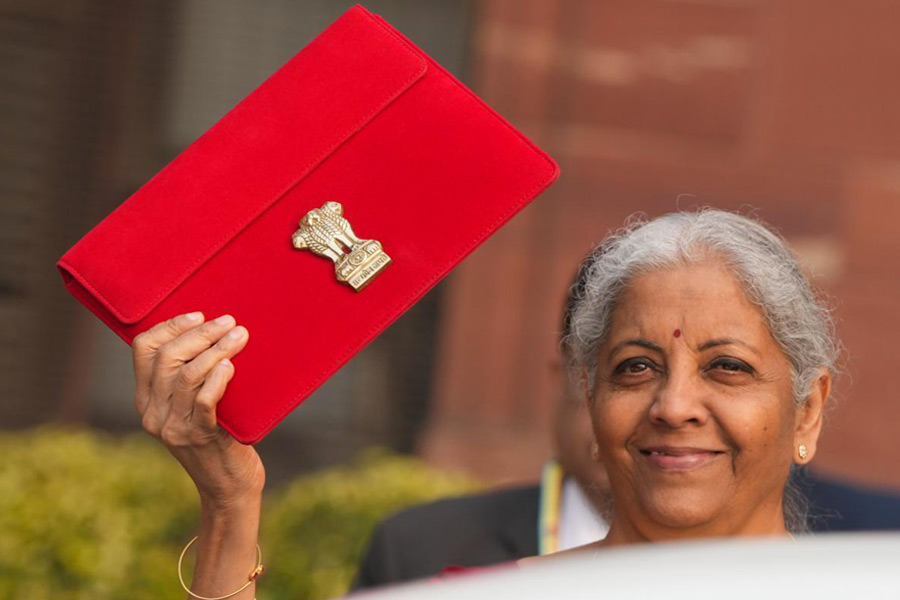
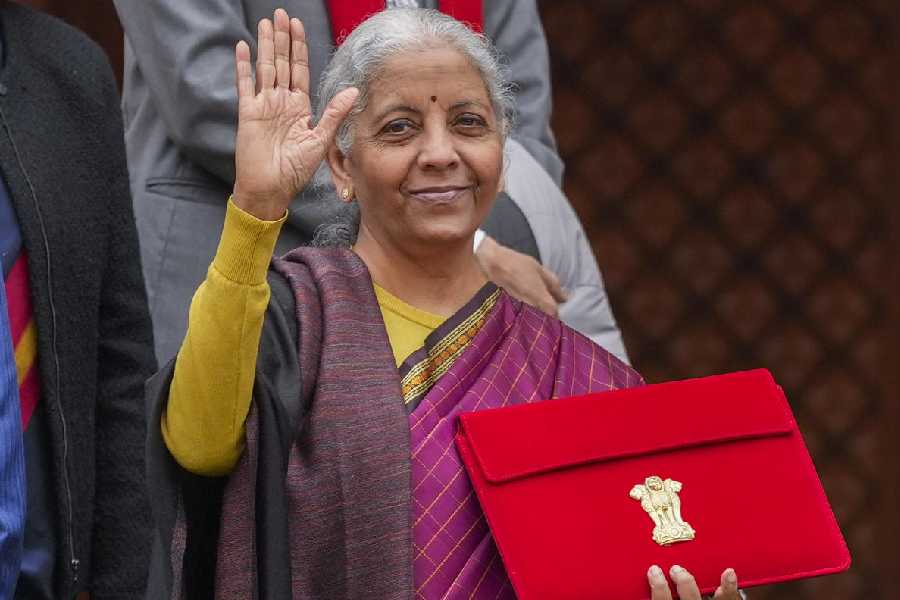
Finance Minister Nirmala Sitharaman delivered a long-game budget that focused on longterm growth, betting that factories, technology, and public investment can keep the economy humming in the face of a volatile world outlook.
“Today, we face an external environment in which trade and multilateralism are imperilled and access to resources and supply chains are disrupted. New technologies are transforming production systems while sharply increasing demands on water, energy and critical minerals,” Sitharaman told parliament. “We face heightened uncertainty and disruption,” she added.
Even so, the government expects India’s economy to grow between 6.8 per cent and 7.2 per cent, despite facing 50 per cent tariffs in the US, its largest export market. That’s a bit slower than the current 7.4 per cent projected for this year, but still faster than other major economies.
At the heart of the budget is manufacturing which makes up less than 20 per cent of the economy. The government’s goal is to increase it to 25 per cent to help absorb the millions of young people entering the workforce every year.
Seven sectors are getting special attention: pharmaceuticals, semiconductors, rare-earth magnets, chemicals, capital goods, textiles, and sports equipment. Sitharaman announced new industrial parks, “manufacturing corridors,” plans to revamp 200 old industrial clusters, big incentives for electronics, chips and clean tech, mega textile parks, and a fresh push for handlooms and khadi.
India’s free trade deals, such as the one signed with the EU last week, open doors to new markets but only if Indian factories can produce at the right price, quality and amount. Sitharaman also emphasised the need for manufacturing self-reliance so India doesn’t need to import as much.
MSMEs, seen as the backbone of exports, will get support to scale, modernise, and compete globally. Anish Shah of Mahindra & Mahindra noted, “The long-term positives are around ease of doing business… These are things that will make it easier for us to create a better manufacturing setup in India, to lower the cost of manufacturing.”
The budget, though, found no favour with Bengal Chief Minister Mamata Banerjee. She dismissed it as a “Humpty Dumpty budget” that dressed up routine announcements as big reforms. And in Kerala both the state’s ruling CPM and the opposition Congress are incensed that it has been completely ignored in the Budget. Even the new high-speed rail projects will be far from Kerala.
Meanwhile, with investment by private companies weakening, the government is picking up the slack. Public investment has been raised by nine per cent to a record Rs 12.2 lakh crore. Spending on infrastructure has now grown more than six times over the past decade.
The money will go mainly into railways and transport, infrastructure like roads, ports and airportsmanufacturing and factories, support for small businesses and healthcare and medical research. The government will invest Rs 100 billion over five years in cutting-edge medical and biopharmaceutical research
Meanwhile, in a push to strengthen India’s traditional medicine ecosystem, the government plans to set up three new All India Institutes of Ayurveda to boost education, research and clinical services. But while the government didn’t specify where the institutes would be located, Kerala wasn’t mentioned despite its strong ayurvedic tradition.
Big spending allocations are expected to “ripple through” the economy, boosting demand for steel, cement, electronics and logistics, while creating jobs, Sitharaman told reporters at a post-budget press conference.
The budget highlights technology, AI, and high-tech skills. Training centres are being set up for STEM, youth keen to upskill, aiming to make India a hub for electronics design, semiconductors, quantum tech, and AI.
In a key move, the government proposed a longterm tax holiday until 2047 for foreign companies that provide cloud services globally using data centre infrastructure in India. The aim is to make India a hub for digital cloud infrastructure and cloud services.
The budget also cut the upfront tax deducted by banks when families send money abroad for education or medical treatment, known as the Tax Collected at Source or TCS to 5 per cent from two per cent. That tax can later be claimed back or adjusted in tax returns. The government announcement reduces the immediate cost of foreign study for Indian families.
The budget highlights technology, AI, and high-tech skills. Training centres are being set up for STEM, youth keen to upskill, aiming to make India a hub for electronics design, semiconductors, quantum tech, and AI.
Sitharaman emphasised: “New technologies are transforming production systems while sharply increasing demands on water, energy and critical minerals.” Startups got a boost too. Apoorva Ranjan Sharma of Venture Catalysts called the creation of a ₹100 billion Fund of Funds and the proposed Deep Tech fund “a monumental step towards strengthening India’s startup ecosystem.”
The government is also providing some relief on healthcare access. There is a plan for Day Care Cancer Centres in all district hospitals over three years as well as exempting 36 cancer drugs from customs duty.
Public debt is expected to decline gradually, while the fiscal deficit is pegged at 4.3 per cent next year, a shade lower than this year.
None of this soothed the stock market, which remained fixated on the sharp increase in the securities transaction tax, making trading costlier and prompting a rush to sell. The Sensex went into a free fall, plunging more than 2,370 points to slip below the milestone 80,000-point mark, while the Nifty dropped nearly 750 points to hit a four-month low.
Government officials defended the move, saying the higher tax was designed to curb frothy speculation in futures and options and protect ordinary investors. The objective, they said, was long-term market stability.
The budget delivered another surprise, limiting tax-free gains on Sovereign Gold Buyers to investors who bought them originally from the Reserve Bank of India. This goes against earlier expectations that anyone holding them to maturity, even secondary market buyers, would escape capital gains tax. Now, only original buyers who hold the bonds to maturity will get the tax-free.profit.