 |
During the 1820s, British contact with Assam and the Northeast Frontier increased because of two historically significant events. Consequent to the Treaty of Yandaboo in 1826, British hegemony was extended to Assam. Almost around the same time, it was established that tea could be cultivated in Assam. These two events resulted in the influx of British officers, soldiers and planters into the region. Along with the British came Christianity — the cross followed the sword.
Gradually, the need for a church was strongly felt by the Christians who came to Assam for administrative and economic reasons.
Some of them were stationed here for two decades. In 1839, Maj. Francis Jenkins, agent to the governor general in the Northeast Frontier provinces, received a notice from the diocese of Calcutta “to take appropriate measure for performance of baptism and marriage by public officers.”
This accelerated the process of establishment of a church at Guwahati. Rev. A. Garstin, the chaplain of Sylhet, visited Guwahati twice between 1841 and 1843 to ensure proper planning of the church.
He was the first Anglican clergyman to visit the valley. In 1844, Rev. R.J. Bland was appointed the first chaplain of Assam and he reached Guwahati from Calcutta after an arduous journey by country boat lasting six months.
For the construction of the building for the church at Guwahati, a committee was formed with Lt Col James Mathie, Maj. Francis Jenkins, Maj. F. Foquet, Capt. E. T. Dalton, Capt. E.A. Rowlatt, Lt Angew and Lt H.S. Biver as members. This committee mobilised resources and ultimately the foundation stone of the Christ Church at Guwahati was laid in May 9, 1844.
Rev. Bland had the honour of conducting the inaugural service at the newly-constructed church on October 26, 1845. On August 23, 1850, Daniel Wilson, the bishop of Calcutta, consecrated the church. A burial ground for the Christians, also provided in the land adjacent to it, was also consecrated the same evening.
The church originally “was an imposing building with a large square tower and a porch.” But the original building was completely ruined in successive earthquakes.
The church had to be thoroughly renovated right from its foundation after the severe earthquakes of 1854. This renovated structure was also destroyed completely on June 12, 1897, when another earthquake rocked Assam. The imposing building was razed to the ground and the chaplain, Rev. G.M. Davies, had to take shelter in the boat of the chief commissioner, anchored in the nearby Katcharyghat.
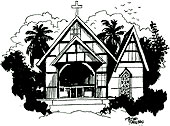
On public donation, the church was rebuilt in 1903. However, it was now a smaller Assam-type structure — all ornamental motifs and stained glass panels that adorned the original building were now avoided in order to withstand earthquakes in future.
The Christ Church, Guwahati, located opposite to Cotton College at the centre of the city, is the “reasonably well-maintained” construction of 1903, which was given a facelift in 1978.
Till 1915, the church was under the diocese of Calcutta. But to serve the Christian community in Assam and the newly-formed tea gardens, the diocese of Assam was formed in 1915 and Rev. H.P. Walsh was appointed the first bishop of Assam with headquarters at Shillong. In order to conduct special services at Christ Church, both the bishop and his wife used to travel from Shillong to Guwahati on their bicycles which intrigued the local populace no end. This was even reported in an Assamese newspaper.
It is interesting to note that Sudmerson, principal of Cotton College, conducted some church services in 1904 when an organ was also purchased for the Church.
World War II saw the church rendering yeoman’s service to the Allied Forces’ cause.
Christian soldiers regularly came there to offer prayers and many funeral services were also conducted. Temporary structures were constructed for the men of the armed forces on the adjacent grounds. Often special holy communion services were also conducted to boost the morale of the soldiers.
The church was surrounded by vast open spaces and beautiful gardens.
In 1955, most of the land held by it was transferred to the government of Assam, on which the Nehru Park stands today. Christ Church is not merely a well-known landmark of Guwahati, it is also a silent spectator to the progress of the city over 155 years.
It is also the epicentre from which the history of the churches in the Northeast effectively begins.
In 1994, the church celebrated its sesquicentennial year with the theme “Give thanks to the Lord, proclaim His greatness” to mark the occasion. A community and healthcare centre has been constructed in the church annexe, which has been named after Walsh, the first bishop of Assam. The work that started 160 years ago continues without end.