 |
| Salil V. Bhatt Pictures by Biju Boro |
Music is in his heart. And what is a better place to stir euphony in his soul than the banks of the Brahmaputra?
“I was mesmerised by the Brahmaputra. It is so intimidating, yet at the same time it has a strange power that is overwhelming,” Salil V. Bhatt said. Bhatt, an exponent of the mohan veena, is in the city to perform in the Virasaat series organised by the Northeast chapter of the Spic Macay.
On his first visit to Assam, Salil was in rapture. “The state is so rich in music. People here are almost born with music in their hearts in tune with the soul-stirring picturesque landscape here.”
Salil will be performing with tabla player Udai Mazumdar at the Indian Institute of Technology, Guwahati, SOS Village, Army Public School and Sibsagar College. The highlight will, however, be his performance at the inaugural function of the golden jubilee celebrations of the Assam Engineering College. “We travelled by the Rajdhani Express to Assam and en route we turned our compartment into a place for riyaz. The journey was a musical odyssey,” he said.
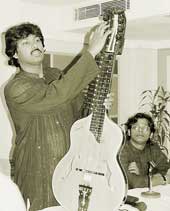
Also known as the “King of Raga”, Bhatt represents the 10th generation of the famous Bhatt lineage, where music has been flowing for more than 500 years. Salil is the son of the legendary slide player and India’s Grammy Award winner Padmashree Pandit Vishwa Mohan Bhatt. His five-year-old son Satwik also plays the mohan veena. Salil displays the mohan veena, which was conceptualised by his guru and father Pandit Bhatt. The instrument has been hailed as a revolutionary discovery in the Indian classical music scenario.
“The body resembles a Hawaiian guitar and the whole is made of one piece of wood. The side and the back portion is made of oakwood, the front of pine and the felt board is of rosewood,” he said, adding that the speciality of this instrument is that it can be played in the vocal style or gayaki. It has a singing effect because of the continuity of sound.
For him, vocal is the supreme form. “Every instrumentalist tries to come closer to the vocal form. We can play up to 30 notes but we have surpassed the basic principles of the stringed instrument.”
Salil has been mastering the mohan veena for more than 16 years. With a masters degree in music and an A-grade of the All India Radio, Salil has performed throughout the country as well as abroad and is a regular performer for the AIR and the national television network, along with other prime television channels. His music albums Revival Of Gavti, In Harmony, Swar Shikhar were instant hits.
Salil’s style incorporates the authentic and systematic exposition of classical Indian ragas and the embellishments of the world music as well.
The major awards he has been honoured with are Mahakaal Sangeet Ratna, Abhinav Kala Samman, International Young Achiever’s Award and Raag Bhavishya.
He said, “I have heard a lot about the music of Assam. And a lot of credit goes to Bhupen Hazarika, who has done a commendable job as the chairman of the Sangeet Natak Akademi.”
He also lauds the efforts of Spic Macay in the promotion of Indian classical music. “In fact, classes on Indian classical music and dance should be made a mandatory part of the curriculum of the schools and colleges,” he said.
“We want everyone to feel the glory of Indian classical music. The new music videos and the remixes are popular but it can’t be made the staple of the musical preferences of the young people. The youngsters will have to learn how to sift and choose good music.”
He agrees that the Northeast is well known for the wrong reasons — killings and militancy — but thinks it is a passing phase. “Even my home state Rajasthan has been witnessing killings across the border and Punjab has too. But violence will die soon.”