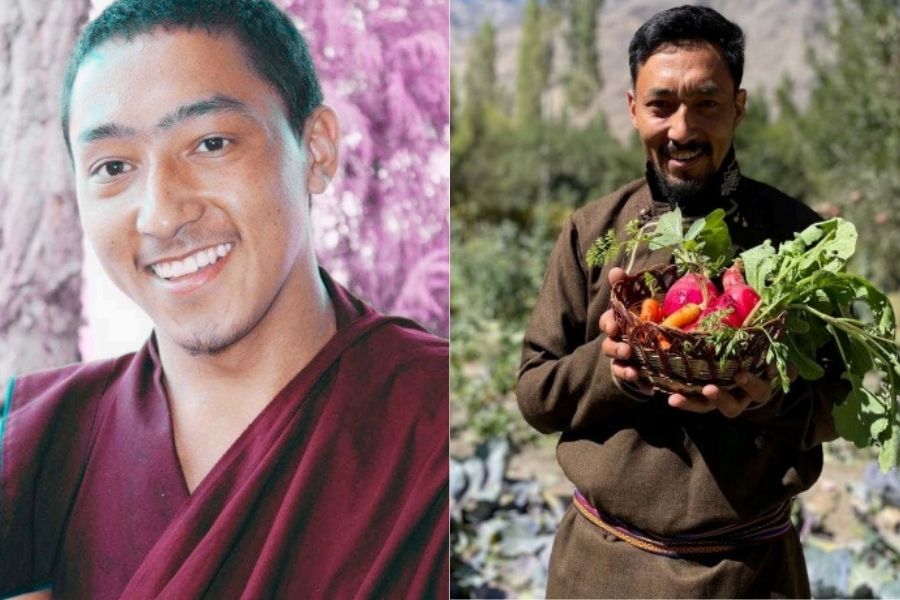
Jigmet Mingur entered monastic life at nine, an age at which most of his friends were discovering the world around them and exploring new hobbies.
Now 30, Mingur is a man on a mission, promoting Ladakhi cuisine on a global scale.
Born in Khemi village in Ladakh’s Nubra Valley, Mingur had few career choices as a child. “In our family, everyone either worked with the army or became a monk. Ladakh was very remote in the late ’80s. So I chose the monk’s life,” he said.
Mingur’s early years were spent at Hemis Monastery in Leh, before he was sent to Nepal for deeper philosophical studies.
“I think it was around 2000 or 2001 when we moved to Nepal. I spent almost 14 or 15 years there. Those years were shaped by silence, repetition and discipline. Life was very structured. Study, work and meditation were part of everyday life,” he recalled.
Where food became care
Life inside a monastery, Mingur explained, is deeply practical. “We had to do everything ourselves, from plumbing and electrical work to sweeping and cooking. I spent a lot of time working with the cooks in the monastery kitchen. That’s where my connection with food really started,” he explained.
The idea of food as service became sharper during the 2015 Nepal earthquake. He said, “People from nearby villages came to the monastery for shelter. We were cooking and serving them food. I was enjoying that moment, serving people food and shelter. Food felt meaningful. It felt like care.”
From calm to chaos
With family responsibilities calling him home, Mingur formally renounced monastic life with the blessings of his teachers. “I knew I had something with food,” he said. His next move was unexpected. “I moved to Goa directly,” he laughed. “From calm to chaos.”
With no formal training or contacts, he started at the bottom. “I didn’t know anyone in Goa. I met one Nepali guy and he helped me get a dishwasher job,” he said.
Over the next few years, including a long stint at Prana Cafe, he learnt techniques, ingredients and flavour structures. “That’s where I really understood ingredients and how flavours work in a professional kitchen.”
Returning to Ladakh
In 2021, Mingur returned to Ladakh with clarity about what he wanted to do. “I wanted to understand Ladakhi food properly,” he said. Initially, he experimented with Ladakhi fusion cuisine while working at a hotel in Nubra Valley. “I was doing experimental Ladakhi food with different ingredients. But somewhere I felt I should stick to the traditional way.”
That decision led him back to food shaped by climate and scarcity. “Most ingredients are not available in markets. In families, people forage their own ingredients. Everything has to be dehydrated so that we can use it in winter and keep it for a long time.”
Foraging, seasons and flavour
Wild chives known as skotse, wild gravy seeds called kosnjot, capers, winter peas, barley and buckwheat form the backbone of his cooking. “Skotse is very interesting. You get both onion and garlic flavour in one ingredient. We use winter peas a lot in soups and thukpas. I’m bringing that pea to Kolkata as one of my main ingredients,” he said.
Modern food habits worry him. “Nowadays people just go to the market or supermarket,” he said. “We are almost losing the culture of foraging and dehydrating.” His work, he believes, is about preservation as much as cooking.
A table in the mountains
Today, Mingur runs intimate dining experiences at Stone Hedge in Nubra Valley and Tsam Khang in Leh. Tsam Khang is an outdoor kitchen set among trees, running water and mountain views. “It’s a very open space. I grow my own vegetables there.” Guests come only to eat. “People don’t stay,” he said. “They just come for the meal. It’s a very quiet table in the mountains.”
Cocktails as a tasting medium
In Kolkata, the menu will also feature Ladakh-inspired cocktails developed in collaboration with the Glenburn team. “I want people to taste Ladakhi wild ingredients not only through food, but also through drinks,” Mingur said. Drawing from experiments he began in Goa, he plans to infuse white spirits such as vodka and gin with wild gravy seeds, seabuckthorn, wild chives and even yak cheese. “It sounds unusual, but the flavours are very clean and interesting.”
Coming to Kolkata
Mingur now brings his story and food to Kolkata with Gormei at The Glenburn Penthouse on January 31 and February 1. He will present a seven-course Ladakhi winter menu inspired by the region’s terrain, seasonal produce and traditional techniques, paired with Ladakh-inspired cocktails and personal storytelling. “This is my first visit to Kolkata. I’m excited not only to feed people, but also to try street food and authentic Bengali food,” he said.