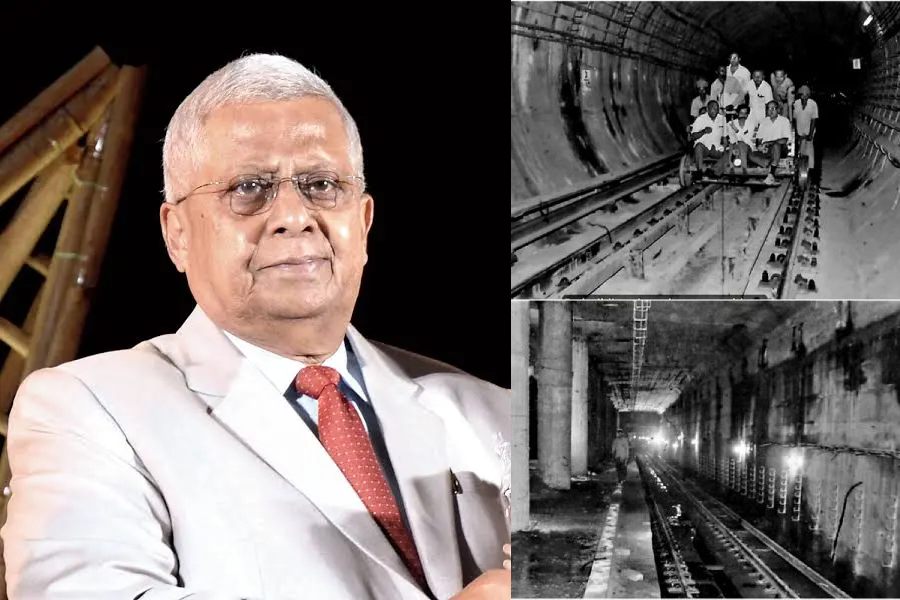
South Kolkata was starved of drinking water for three consecutive days after Kolkata Metro construction work damaged a 30-inch water main in 1983 — this was among the many challenges chief engineer Tathagata Roy and his team faced while gifting the city South Asia’s first rapid transport system.
Roy, now 81, did not sleep for a minute during those three days.
“None of us went to sleep until the water supply resumed. We worked, CMDA people worked, corporation people worked, and together, we got the job done,” Roy told My Kolkata during a chat at his Lansdowne residence.
“Fortunately, it was winter, so people did not suffer to that extent,” he said, visibly proud of his contribution in building Kolkata Metro, then Calcutta Metro, and proving naysayers wrong.
The journey wasn’t easy. It took nearly four decades for the Kolkata Metro to come into existence.
“It was conceptualised in 1949, sanctioned in 1971, but did not see the light of the day until 1984,” recalled Roy.
The first metro service, he added, ran on October 24 between Esplanade and Bhowanipore (now Netaji Bhavan).
But there were many stumbling blocks the construction team had to face prior to the rollout.
“The biggest technical challenge was the soil of Kolkata. The soil here is mostly alluvial silt and clay, with occasional old silted up river courses of fine sand. Such soil is susceptible to cave-ins,” said Roy.
To make up for the unstable soil, the engineers used the cut and cover method of construction after studying metro networks in countries with similar soil composition, Roy, who later went on to serve as the Tripura Governor, said.
Used heavily in the Blue Line, and some parts of the Green Line, the cut and cover method allows tracks laid 17 to 18 metres under the ground.
“Kolkata metro is not as decorated as the Moscow Metro or the London Metro. We just wanted the stations to be environmentally acceptable and workable,” added Roy.
But as the team of engineers inched towards creating history, many doubted its potential.
“There were many skeptics. It was mostly about Indians trying to build a metro network,” said Roy.
Years before the cornerstone was laid, the Centre pushed for foreign parties to take over the job, Roy recalled. But Indian engineers eventually won the trust of the government.
“The project report of the metro was accepted by the planning commission, but the Ministry of Railways did not accept it then. The nodal ministry in this case was the Ministry of Railways,” said Roy. “This riddled the process with hurdles.”
Abnormalities in the network crept in, but they never affected the overall operations. For instance, Park Street platforms are on the opposite side as compared to all other underground stations.
“That was done as an experiment by one of the general managers. We were initially following the Soviet model, which has an island platform with the two tracks on the two sides, but he wanted two platforms at Park Street, which did not work out,” said Roy.
As per latest data with the Kolkata Metro, at least seven to eight lakh commuters use the metro network daily on the Blue line (Dakshineswar to Kavi Nazrul) and Green line (Howrah Maidan to Sector V) combined.
Today the metro system has expanded, so have the platform designs, rail gauges, and technological advances, yet stations like Central remind the daily commuter of how it all started. And Roy, now leading a retired life, stands witness to the efforts that created what today stands as the lifeline of Kolkata commuters.