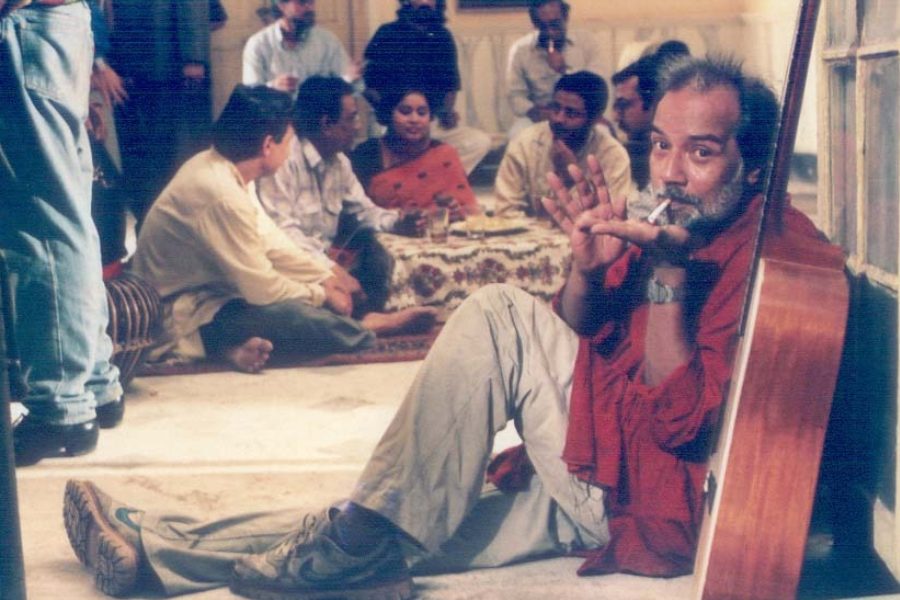
Even in 2026, every college canteen’s gaaner lorai (musical battle) in Bengal is likely to feature at least one song that is composed by Mohiner Ghoraguli’s Gautam Chattopadhyay decades ago.
Songs like Hay Bhalobashi or Prithibita Naki Chhoto Hotey Hotey – the second one now famous across India thanks to the Bollywood adaptation – continue to shape Bengal’s soundscape, resonating with every generation and proving impossible for young listeners to ignore.
Three decades after his passing, Gautam Chattopadhyay continues to shape Bengal’s musical imagination. The band’s music is often called ‘Baul Jazz’ by its admirers.
His son, musician Gourab ‘Gaboo’ Chatterjee who plays with a number of outfits including the Bangla rock band Lakkhichara, told The Telegraph Online that on every June 1, he remembers his father through his songs and unwavering ideals, which remain a guiding light and feel especially relevant in the current times.
Gaboo’s personal favourite among his father’s compositions is Ei Muhurte, a powerful song that explores themes of political unrest, displacement and the search for refuge.
“His songs are getting more relevant to us every single day. My father never flinched from voicing the socio-political realities around him, and Ei Muhurte matches perfectly, almost like a verdict,” he said.
On the birth anniversary of the artist affectionately remembered as Moni Da, here’s a look at five iconic songs that showcase the depth, experimentation and enduring appeal of his music.
Bhalobashi (Hay Bhalobashi)
From the iconic 1977 album Shongbigno Pakhikul O’ Kolkata Bishoyok, the song wouldn't have been possible without Gautam Chattopadhyay. It is dedicated to the working classes, especially the farmers of Bengal, while simultaneously addressing the looming alienation that marked the socio-political struggles of the era.
The song is not a typical romantic ballad but an introspective reflection on the despairing human condition, co-existing with the simple joys of life while acknowledging everyday struggles, conveyed through its lyrics and observations.
Beethoven and Dylan lilt along in the lyrics of the song that remains timeless like the masters.
Kolkata, Kolkata
Another masterpiece from Shongbigno Pakhikul O’ Kolkata Bishoyok, Kolkata, Kolkata is a bittersweet tribute to the city that evolved before Chattopadhyay’s eyes. Through the song, the composer searches for his long-lost childhood in the fractured soul of a turbulent Calcutta, capturing both nostalgia and disillusionment with the city he called home.
The song opens with nostalgic imagery, drawing on bits and fragments of the composer’s childhood — a misty Calcutta morning where one played amid krishnachura and kathchampa trees.
However, the euphoria is shattered by the bleak urban reality.
Telephone
Sung and composed by Chattopadhayay, Telephone (from the album Maya) is a lyrical piece released in the late 1990s. From the collections of Mohiner Ghoraguli Sompadito, the track is structured as a poignant, emotional monologue of a lover caught in a state of endless waiting.
The track relies on a gentle acoustic rhythm and an incredibly soulful flute section that exudes the pent-up melancholy of the lyrics.
The song is based on the raag Bhairavi.
Prithibita Naki Chhoto Hotey Hotey
Prithibita Naki Chhoto Hotey Hotey is the most popular anthem associated with Mohiner Ghoraguli, although it was not performed by the band.
Released in 1995 in the album Aabar Bochor Kuri Pore that Chattopadhyay put together with young musicians, the song was performed and given shape to by the rock band Krosswindz which then had Neil Mukherjee, a guitarist-composer who is a nephew of Chattopadhyay and who is best known across India as the nylon-string virtuoso on the Bollywood song Senorita.

The song is a commentary on and critique of globalisation and the human isolation it has precipitated.
It addresses the profound paradox of the internet age, where one may get connected with the world in seconds but somehow is utterly alone stuck in their room.
Aamar Priya Cafe
From the album Jhora Somoyer Gaan (1996/1998), Aamar Priya Cafe is a romantic song steeped in longing, as the narrator sips coffee and reminisces. The raw, lo-fi acoustic track is known for its conversational, bedroom-recording feel and enduring sentimental value.
The song was later used in the 1999 film Kichhu Sanglap Kichhu Pralap. Directed by Ashoke Vishwanathan, the film stars N. Viswanathan, Sanjiban Guha and Nandini Ghoshal.