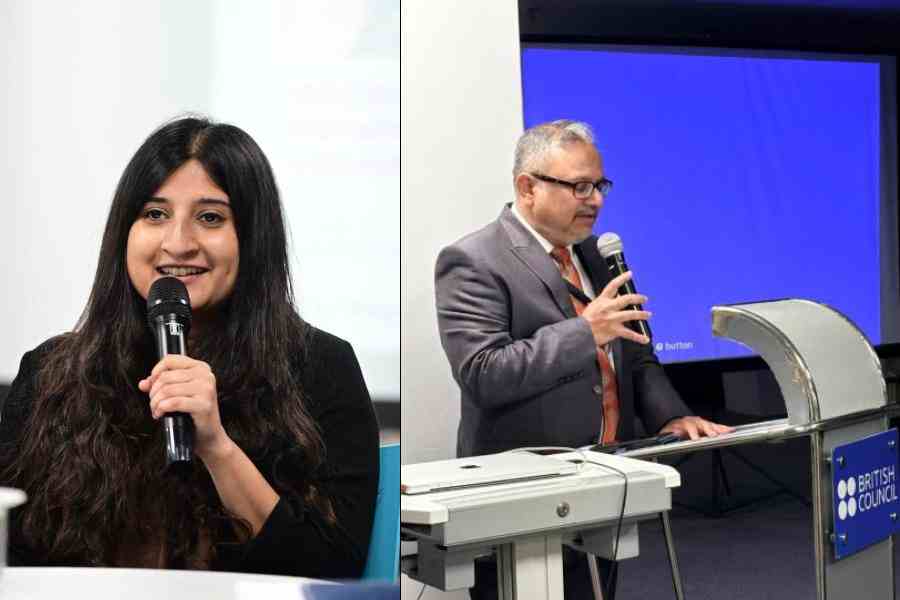
Recently, the British Council, in partnership with the Indo-British Scholars’ Association, hosted a conversation with environmental and wildlife filmmaker Ashwika Kapur at the British Council Calcutta library. Held in June, the month that marks World Environment Day, the session celebrated environmental responsibility and eco-consciousness. It also paid tribute to legendary wildlife broadcaster, natural historian and writer Sir David Attenborough, who recently turned 100, and with whom Ashwika has collaborated on acclaimed wildlife documentaries such as Attenborough and the Giant Elephant and Attenborough’s Life in Colour.
During the conversation, Ashwika offered a fascinating glimpse into the world of wildlife filmmaking, sharing stories from her travels behind the camera and her experiences documenting some of the planet’s most captivating landscapes. The Green Oscar-winning filmmaker also reflected on Sir David Attenborough’s enduring influence in shaping global perspectives on the natural world, while revealing little-known stories from her collaborations with the celebrated broadcaster. t2 caught up with Ashwika for an exclusive chat on her environmental calling, filmmaking travels and the role of the youth in shaping an environmentally responsible future.
What drew you to wildlife as a subject to focus on?
I’ve always had an instinctive connection with animals, and a love of stories has run alongside it. When it was time to pick a career, I simply fused the two and decided to become a wildlife filmmaker. There was no wildlife film industry in India to apprentice into, no obvious door to knock on, so the path had to be built rather than found. The Green Oscar early on was a thrilling vote of confidence, but the real apprenticeship was everything after it: years in the field that led to directing for the BBC Natural History Unit, National Geographic, Netflix, Discovery, Disney, and alongside those, the smaller, fiercely personal ones closer to home, like Catapults to Cameras in the forests of Bengal.
As a young representative of the filmmaking landscape, how do you think visual storytelling can address environmental awareness?
Visuals do something far more powerful. They appeal to emotion, not through words but through the universal language of pictures. When powerful visuals and powerful storytelling go hand in hand, there is nothing more potent. I am not in the business of merely documenting wildlife; I am in the business of telling stories about it. The films I love have a protagonist, a stake, a heart. That is what makes people care, and once someone cares, the awareness follows on its own.
Do you think love and respect for nature can go hand in hand with the digital life, with so many prioritising screens over scenery?
I don’t cast it as a battle, mostly because the screen is exactly where I do my work. Like it or not, the device in your pocket is one of the most powerful conservation tools ever invented. The whole question is where you point it. I don’t think nature and digital life are enemies. My only worry is when the screen becomes the entire window, the sole way we ever meet the wild. Let the screen be the spark, not the substitute. Watch the film, then go and experience the real thing, even if the real thing is just a bulbul on your balcony.
In your travels as a filmmaker, has a particular site been stuck in your memory even after leaving?
So many places leave a thumbprint on you, but the one I keep returning to is the Sundarbans. It is home in a way nowhere else is, and also the most maddening place I have ever tried to film: impenetrable on foot, battered by deadly storms, ruled by tigers that aren’t just notorious for their temperament but frustratingly elusive! But the challenges fade the moment you remember what it means to us all. Millions of people depend on it, the largest mangrove delta on earth, a natural shield against the worst cyclones, and yet one of the places climate change is hitting hardest.
Lastly, what message would you give to the youth with regard to environmental responsibility?
Two things. The first is that environmental responsibility is not a job for scientists and wildlife filmmakers to go off and handle on everyone else’s behalf. That is the great misconception. You do not have to make this your career to make it your business. A teacher shapes how an entire generation sees the natural world. A lawyer can defend a forest. And a businessman, frankly, holds more power to help or harm the planet than most of us ever will. So my message is not “become an environmentalist instead.” It is to keep the planet front and centre in whatever you choose to be. Conservation is not a profession. It is a lens you carry into your profession.
The second is that, like charity, conservation begins at home. You don’t have to fly off to the Arctic to make a difference. It is not always about saving iconic creatures in faraway places; it is about looking after your own patch, because if all of us did just that, it would add up to the bigger picture. Start small, start where you stand: the choices you make, the habits you keep, the bit of green you fight for in your own part of the world. None of it feels like much on its own. But every bit adds up to the whole.